Today, the 9th September, marks the fall of former Prime Minister KP Oli Sharma’s government in Nepal following massive uprising by the Gen-Z in the country in September 2025. Large-scale anti-corruption protests and demonstrations intensified after the government imposed a nationwide ban on several major social media platforms, including YouTube, Instagram, TikTok, X, Facebook, and WhatsApp. The protests reportedly resulted in the deaths of at least 76 people, including 63 protesters, 10 escaped prisoners, and three police personnel[1] and the fall of the government led by KP Oli. An interim government headed by Interim Prime Minister Sushila Karki was subsequently constituted.[2] Following elections, a new government led by Prime Minister Balendra Shah came to power in March 2026.[3]
The political transition has raised renewed expectations that Nepal’s long-delayed transitional justice process will finally move forward. The process is intended to address the grave human rights violations committed during the 1996-2006 armed conflict, which resulted in the deaths of more than 17,000 people and the disappearance of approximately 3,288 persons. Thousands of others were subjected to torture, sexual violence, forced displacement, and other serious human rights violations.[4]
Prime Minister Balendra Shah’s government should seize this opportunity to ensure that Nepal’s transitional justice process is credible, independent, victim-centred, and consistent with international human rights standards. It should provide effective remedies and reparations to victims and survivors, establish the truth concerning conflict-related violations, and ensure accountability for those responsible for serious human rights abuses.
However, the Gen-Z revolution is increasingly following the footsteps of the Maoist revolution in the country on the issue of justice and accountability.
I. Balendra Shah’s failure to deal with the UN on transitional justice
Prime Minister Balendra Shah’s handling of the proposed visit of the United Nations Special Rapporteur on the promotion of truth, justice, reparation and guarantees of non-recurrence has raised serious questions about the Government of Nepal’s commitment to addressing the longstanding demands of thousands of victims and survivors of the country’s 1996-2006 armed conflict.
Bernard Duhaime, the UN Special Rapporteur, is still awaiting a formal response from the Government of Nepal regarding his proposed visit from 17 to 27 November 2026. The government had earlier stated that it would welcome his visit after September 2026. In August 2025, Nepal had agreed to the Special Rapporteur’s visit following years of reluctance by previous governments.
The visit was initially scheduled for 10-20 March 2026 but was subsequently postponed because it coincided with Nepal’s general elections. The government and the Special Rapporteur then agreed on new dates, from 9 to 19 June 2026.[5] However, the June visit was also cancelled after the Shah government removed the office-bearers of Nepal’s two transitional justice commissions – the Truth and Reconciliation Commission (TRC) and the Commission of Investigation on Enforced Disappeared Persons (CIEDP) in early May 2026.[6]
The government informed Special Rapporteur Duhaime that his June visit could not proceed because the two commissions were without the office-bearers. In a letter dated 18 May 2026, the government stated that it would welcome the Special Rapporteur’s visit after September 2026. Duhaime subsequently proposed 17-27 November 2026 as new dates. However, the Government of Nepal has not provided a formal response to his proposal.[7]
This situation raises a fundamental question: if the absence of commissioners was the reason for postponing the Special Rapporteur’s June visit, why has the government not expedited the appointment of the office-bearers of the two transitional justice commissions till date?
The continued delay risks further undermining confidence in Nepal’s transitional justice process and prolonging the uncertainty faced by thousands of victims and survivors of conflict-related human rights violations. The Government of Nepal should therefore ensure that the transitional justice institutions are promptly reconstituted and that the Special Rapporteur’s proposed visit is facilitated without further delay.
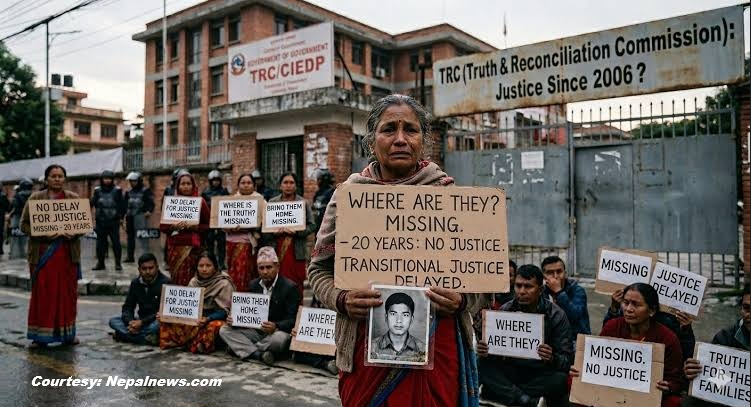
II. Victims Have Already Waited for 20 Years
As stated above, Nepal’s 1996-2006 armed conflict between the Government and the Communist Party of Nepal (Maoists) resulted in the deaths of more than 17,000 people and the disappearance of approximately 3,288 persons. Thousands of others were subjected to torture, sexual violence, displacement and other serious human rights violations.[8]
The Truth and Reconciliation Commission and the Commission of Investigation on Enforced Disappeared Persons were established in 2015 to address serious human rights violations committed during the conflict.[9] However, despite the TRC receiving more than 78,875 complaints[10] and the CIEDP receiving more than 3,200 complaints concerning enforced disappearances, both the Commissions made limited progress.[11] Political interference, legal challenges, limited institutional capacity and concerns regarding the independence of commissioners have repeatedly impeded Nepal’s transitional justice process. Although Nepal amended its transitional justice legislation in 2024 and appointed new commissioners in May 2025, victims’ groups continued to raise concerns about the transparency and credibility of the selection process.[12]
After Prime Minister Balendra Shah’s government came to power in March 2026, it removed the office-bearers of both commissions in May, stating that it intended to replace politically influenced appointments with credible and independent members. However, the appointment of new office-bearers has been delayed till date, leaving both commissions without permanent leadership and further disrupting an already protracted transitional justice process.[13]
Nearly two decades have passed since the signing of the Comprehensive Peace Agreement, and more than a decade has elapsed since Nepal established its transitional justice mechanisms. Yet, there has been little tangible progress in delivering justice to victims and survivors of the conflict. Successive governments have failed to bring the process to completion amid political interests, concerns over transparency and repeated institutional delays. Victims and survivors, who have already waited for nearly two decades for truth, justice, reparations and guarantees of non-recurrence, should not be subjected to yet another cycle of delays and unfulfilled commitments. For many victims and their families, every additional delay represents not merely an administrative setback but a further prolongation of their suffering and denial of justice.
The proposed visit of the UN Special Rapporteur on the promotion of truth, justice, reparation and guarantees of non-recurrence therefore presents an important opportunity. The visit would enable the Special Rapporteur to meet victims and survivors, hear their concerns directly, assess the functioning and independence of Nepal’s transitional justice mechanisms, examine the obstacles that have impeded progress, and make recommendations to the Government of Nepal to ensure that the transitional justice process is credible, victim-centred, transparent and consistent with international human rights standards.
III. Nepal Should Not Be Afraid of Scrutiny
A democratic country should remain open to independent and impartial human rights scrutiny. Cooperation with UN human rights mechanisms is an important demonstration of a State’s commitment to transparency, accountability and the protection of human rights.
The UN Special Rapporteur is not visiting Nepal simply to criticise the government. His mandate is to assess the situation, engage with the government and a broad range of stakeholders, including victims and survivors, civil society organisations and other relevant actors, and make recommendations concerning truth, justice, reparations and guarantees of non-recurrence.
The purpose of the proposed visit is to assess the measures taken by the Nepalese authorities to address serious human rights violations committed during the 1996–2006 armed conflict, particularly with regard to truth, justice, reparations, memorialisation and guarantees of non-recurrence. The visit would provide the Special Rapporteur with an opportunity to develop a comprehensive understanding of the progress achieved, good practices, gaps and shortcomings in the initiatives undertaken since the conflict, and to make recommendations for strengthening Nepal’s transitional justice process.
The Special Rapporteur is expected to present a public report on the country visit to the UN Human Rights Council in September 2027.[14] Such independent scrutiny should be viewed as an opportunity to strengthen Nepal’s transitional justice process rather than as a threat to the government.
Nepal’s position is particularly significant given its candidature for a third term on the UN Human Rights Council, with elections scheduled for October 2026. A country seeking another term on the Council should demonstrate its commitment to international human rights standards by remaining open to independent scrutiny and cooperating fully with UN human rights mandate-holders, rather than leaving a UN Special Rapporteur awaiting a formal response.[15]
If Nepal wishes to continue playing a constructive role in the international human rights system, it should demonstrate that its commitment to human rights extends beyond its international engagements and includes a willingness to facilitate independent scrutiny of the human rights situation within the country.
IV. Appointments Should Not Become an Excuse
There is no doubt that Nepal needs competent, independent and credible members of the TRC and CIEDP. Victims, survivors and human rights organisations have repeatedly called for a transparent, credible and victim-centred appointment process.
However, the appointment process should not become a reason for further delaying the visit of a UN human rights expert. The two issues should be addressed simultaneously rather than sequentially.
Prime Minister Balendra Shah came to power promising a different kind of government-one based on accountability, transparency and respect for human rights. The government’s handling of the proposed visit of the UN Special Rapporteur therefore provides an important test of whether these commitments will be reflected in practice.
The Government of Nepal should immediately respond formally, before the elections to the UN Human Rights Council, to Duhaime’s proposal for a visit from 17 to 27 November 2026 and provide a clear timetable for facilitating the visit. At the same time, it should expedite the appointment of new members of the TRC and CIEDP through a transparent, credible and victim-centred process in which victims and survivors have a meaningful opportunity to participate. Nepal’s conflict victims and survivors have already waited for almost two decades for truth, justice and reparations. The proposed visit of the UN Special Rapporteur should not become another instance of prolonged postponement and unfulfilled commitments. Nepal now has an opportunity to demonstrate that its commitment to human rights includes not only international declarations but also accountability and meaningful action at home.
[1]. Nepal police arrest more than 400 over September protests, The Straight Times, 10 November 2025, https://www.straitstimes.com/asia/south-asia/nepal-police-arrest-more-than-400-over-september-protests
[2] . Nepal gets first female PM after deadly unrest, BBC, 12 September 2025, https://www.bbc.com/news/articles/c179qne0zw0o
[3]. Rapper-politician Balendra Shah unseats Nepal’s ex-PM as he heads for victory, BBC, 8 March 2026, https://www.bbc.com/news/articles/c93w6y0lnd9o
[4]. Breaking Barriers to Justice, Human Rights Watch, 5 March 2025, https://www.hrw.org/report/2024/03/05/breaking-barriers-justice/nepals-long-struggle-accountability-truth-and
[5]. Nepal stalls UN rapporteur visit amid delays in transitional justice appointments, The Katmandu Post, 22 August 2026, https://kathmandupost.com/national/2026/08/22/nepal-stalls-un-rapporteur-visit-amid-delays-in-transitional-justice-appointments
[6]. Nepal stalls UN rapporteur visit amid delays in transitional justice appointments, The Katmandu Post, 22 August 2026, https://kathmandupost.com/national/2026/08/22/nepal-stalls-un-rapporteur-visit-amid-delays-in-transitional-justice-appointments
[7]. Nepal stalls UN rapporteur visit amid delays in transitional justice appointments, The Katmandu Post, 22 August 2026, https://kathmandupost.com/national/2026/08/22/nepal-stalls-un-rapporteur-visit-amid-delays-in-transitional-justice-appointments
[8]. Breaking Barriers to Justice, Human Rights Watch, 5 March 2025, https://www.hrw.org/report/2024/03/05/breaking-barriers-justice/nepals-long-struggle-accountability-truth-and
[9]. Breaking Barriers to Justice, Human Rights Watch, 5 March 2025, https://www.hrw.org/report/2024/03/05/breaking-barriers-justice/nepals-long-struggle-accountability-truth-and
[10]. Transitional justice complaints soar but victims skeptical, The Kathmandu Post, 29 August 2025, https://kathmandupost.com/national/2025/08/29/transitional-justice-complaints-soar-but-victims-sceptical
[11]. Delayed Justice Undermines The Republic, The Rising Nepal, 29 May 2026, https://risingnepaldaily.com/news/81059
[12]. Breaking Barriers to Justice, Human Rights Watch, 5 March 2025, https://www.hrw.org/report/2024/03/05/breaking-barriers-justice/nepals-long-struggle-accountability-truth-and
[13]. Conflict victims need justice, not another test of their patience. The Kathmandu Post, 6 August 2026, https://kathmandupost.com/editorial/2026/08/06/conflict-victims-need-justice-not-another-test-of-their-patience
[14]. Call for inputs – Country visit to Nepal, 30 April 2026, https://www.ohchr.org/en/calls-for-input/2026/call-inputs-country-visit-nepal
[15]. Nepal stalls UN rapporteur visit amid delays in transitional justice appointments, The Katmandu Post, 22 August 2026, https://kathmandupost.com/national/2026/08/22/nepal-stalls-un-rapporteur-visit-amid-delays-in-transitional-justice-appointments