Bangladesh ratified the International Covenant on Civil and Political Rights (ICCPR) on 6th September 2000. In the last fourteen and half years, Bangladesh has not even submitted its Initial Report to the United Nations Human Rights Committee. In this submission to the United Nations Human Rights Committee, which is holding its 113th Session from 16 […]
Info by Country
UN Security Council urged to intervene on Maldives following sentencing of former President Nasheed under terrorism charges
NEW DELHI: The Asian Centre for Human Rights (ACHR) today called upon members of the United Nations Security Council to hold an emergency session on the situation in the Maldives following sentencing of former President Mohammed Nasheed to 13 years imprisonment under trumped up terrorism charges and urged the members of the UN Security Council to […]
Bangladesh: About 90 killed in violence, BNP reminded of its obligation under the Rome Statute
NEW DELHI: Asian Centre for Human Rights in its report, “Bangladesh: Polarisation, Political Violence & an Undeclared Civil War”, released today stated that about 90 people have been killed and more than a thousand were injured in the ongoing violent anti-government protests by the Bangladesh Nationalist Party (BNP) led 20-party alliance demanding resignation of Prime Minister Sheikh Hasina’s […]
Vetting in Nepal: Challenges and Issues
Over the last few years, there have been several high profile cases where the United Nations (UN) Department of Peacekeeping Operations (DPKO) has ordered the return of Nepali peacekeepers after it became known that there was prima facie evidence of their involvement in serious human rights violations in Nepal. Two of the most emblematic cases […]
Bangladesh: Sending death squads to keep the UN’s peace
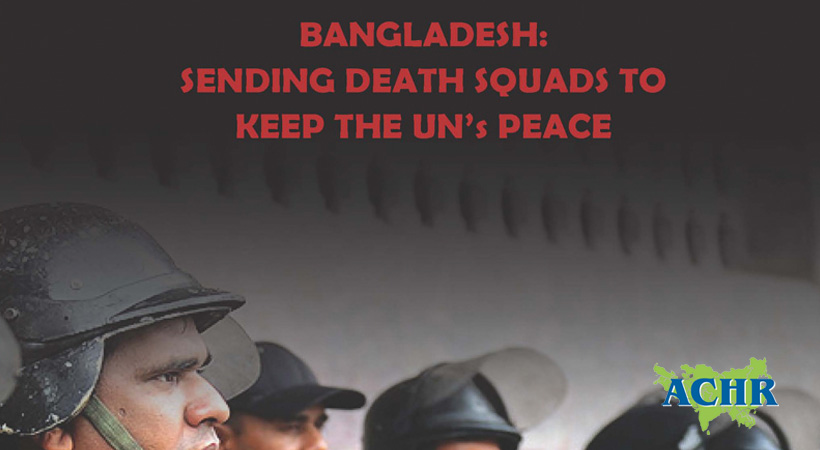
Despite a return to democracy in December 1990, the Bangladesh Army remains “the power behind the throne” in Dhaka. Its control over the security forces is absolute. A large number of senior positions in the Bangladesh Navy and Bangladesh Air Force are served by Army officers as per Section 2A of the Army Act of […]
Bangladesh: Sending death squads to keep the UN’s peace
Despite a return to democracy in December 1990, the Bangladesh Army remains “the power behind the throne” in Dhaka. Its control over the security forces is absolute. A large number of senior positions in the Bangladesh Navy and Bangladesh Air Force are served by Army officers as per Section 2A of the Army Act of […]
Nigeria: Navigating Secrecy in the Vetting and Selection of Peacekeepers
Since 1960, Nigeria has been one of the United Nations’ (UN) largest troop contributing countries. Throughout these years, Nigerian forces have been regularly accused of corruption and human rights abuses. For example in 2005, 11 Nigerian policemen serving on a UN peacekeeping mission in the Democratic Republic of Congo (DRC) were withdrawn over sexual harassment […]
Nepal: Time to Prosecute the Perpetrators
As Nepal successfully concluded the second Constituent Assembly elections on 19th November 2013, the Supreme Court in a historic judgement on 2 January 2014 held that general amnesty provided in the ‘Commission of Inquiry on Disappeared Persons, Truth and Reconciliation Ordinance’ of March 2013 is unconstitutional. The Court further held that the merger of two […]
India’s Role For Promotion of Human Rights in Third Countries Through Universal Periodic Review
Under the Universal Periodic Review (UPR) mechanism, the United Nations Human Rights Council (HRC) scrutinises human rights records of all the member States of the United Nations. The UPR was created as a mechanism of the HRC ostensibly to address selectivity and politicization under then UN Commission on Human Rights. Since its first session in […]
Nepal’s Constituent Assembly Elections: A Lesson For The Convicted Politicians?
As Nepal prepares to hold the Constituent Assembly (CA) elections on 19th November 2013, there already seems to be one positive lesson: those “convicted of a criminal offence involving moral turpitude” have been barred from contesting the elections. Law has finally caught up though accountability for the violations committed during the conflict remains elusive. The […]