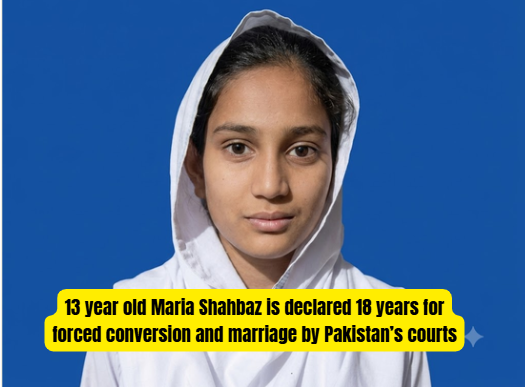
On 9 July 2026, the European Parliament adopted a resolution calling on Pakistan to establish a national mechanism to receive and investigate complaints from families of girls from religious minority communities who have been abducted or forcibly converted to Islam. The resolution highlighted the case of a 13-year-old Christian girl Maria Shahbaz and urged the Pakistani authorities to ensure that she has access to legal representation, regular contact with her family and psychological support. It also condemned the abduction, forced conversion and forced marriage of underage girls from religious minority communities, describing Maria Shahbaz’s case as emblematic of the broader human rights violations faced by religious minorities in Pakistan.[1]
Earlier on 22 April 2026, a group of six UN human rights experts expressed serious concern about the continued and widespread patterns of abduction and forced religious conversion through marriage affecting women and girls belonging to minority communities in Pakistan.[2] These practices disproportionately target underage girls from Hindu, Christian, Sikh and other minority communities in Pakistan and expose them to violence, coercion and lifelong discrimination while denying them access to justice and effective legal protection.
I. The case of Maria Shahbaz
In July 2025, 13-year-old Maria Shahbaz, a Christian girl from Lahore, was abducted by a 30-year-old Muslim man near her home. She was subsequently forced to convert to Islam and marry her captor. The Police were accused of delaying the filing of the family’s First Information Report (FIR) and influencing the judge to dismiss their abduction complaint.[3]
This is despite the fact that a police investigation confirmed that the marriage certificate produced by the abductor was fabricated and not registered with any union council. The girl’s father presented the National Database and Registration Authority (NADRA) issued B-Form and school records to the court as evidence of her age.[4] The family submitted documentary evidence, including official birth records, demonstrating Maria’s age to be 13 years and that the marriage certificate and related documents had been falsified. They further argued that statements attributed to Maria before judicial authorities were made while she remained under the control and influence of her alleged abductor and therefore could not be regarded as freely given.[5]
However, on 31 July 2025, the Model Town court of Judicial Magistrate Hassan Sarfaraz Cheema awarded custody of Maria Shahbaz to her captor after accepting falsified documents that claimed she was 18 years old.[6] In March 2026, Pakistan’s Federal Constitutional Court upheld the validity of her conversion and marriage and ordered that she remain with the man she had allegedly been forced to marry. The Court concluded that she had voluntarily converted to Islam and entered into the marriage.[7]
The judgment generated widespread concern as it will embolden the perpetrators in the absence of judicial protection.
II. Thousands of girls like Maria Shahbaz: A systemic pattern of forced conversion and child marriage
Maria Shahbaz’s case is not an isolated incident. It reflects a long-standing and well-documented pattern of abduction, forced religious conversion and forced marriage affecting girls from Pakistan’s religious minority communities.
According to Pakistan’s National Commission for Human Rights (NCHR), “Young women and girls belonging to minority communities are disproportionately subjected to violence and harmful practices, such as child marriage and forced abductions.”[8]
The United States Commission on International Religious Freedom noted that a 2014 report of local Pakistani NGOs stated as many as 1000 women and girls are forcibly converted to Islam in Pakistan every year.[9]
On 22 April 2026, six UN human rights experts flagged systemic forced conversions in Pakistan. According to the experts, in 2025, about 75 percent of the women and girls affected by forced conversion through marriage were Hindu and 25 percent Christian. Almost 80 percent of incidents occurred in Sindh province. Adolescent girls between 14 and 18 are particularly targeted and some girls are even younger. Women and girls facing poverty and experiencing marginalisation face heightened risks, often being exposed to physical and sexual abuse and exploitation, social stigma and severe trauma. They noted that these women and girls endure a continuous sense of terror, face coercion and are deprived of their freedom of religion or belief and autonomy under patriarchal and political pressures. The scale and persistence of these grave human rights violations point to systemic discrimination against non-Muslim women and girls who are forced to convert to Islam in order to marry Muslim men.[10]
According to UN human rights experts, weaknesses in Pakistan’s criminal justice system have further contributed to impunity. In several cases, courts have accepted disputed documentary evidence relating to a victim’s age, consent to marriage and religious conversion without adequate scrutiny, despite allegations that such documents were obtained through fraud or coercion. The experts have also reported that victims are often compelled to sign statements declaring that they are adults and that they voluntarily converted to Islam and married their alleged abductors. These statements are subsequently relied upon by police and courts as evidence that no criminal offence has occurred.[11]
These practices have created an environment of impunity, undermining public confidence in the justice system and leaving minority girls vulnerable to continued lifelong violations.
III. Legal and institutional challenges
Pakistan has taken certain legislative steps to address child marriage, including the adoption of laws in some provinces establishing 18 years as the minimum legal age of marriage and proposals for a national framework aimed at ending child marriage. Pakistan is a State Party to the Convention on the Rights of the Child (CRC), the Convention on the Elimination of All Forms of Discrimination against Women (CEDAW) and the International Covenant on Civil and Political Rights (ICCPR). These treaties require States to protect children from all forms of violence, exploitation, abduction and harmful practices, ensure free and full consent to marriage, safeguard freedom of religion or belief, guarantee equality before the law and provide effective remedies to victims of human rights violations.
It is clear that implementation of the laws prohibiting child marriages remains deplorable. On 22 April 2026, six UN human rights experts noted that the Government of Pakistan has not taken sufficient measures to address the root causes of forced conversion through marriage such as gender inequality based on patriarchal norms, poverty, social exclusion, discrimination against religious minorities, religious intolerance and rampant impunity. The experts urged Pakistan to intensify efforts to eradicate forced conversions, to raise the minimum age for marriage to 18 in all provinces and territories, to criminalise forced religious conversion as a distinct offence and to enforce applicable laws pertaining to human trafficking and sexual violence.[12]
IV. UNHRC ought to follow the EU Parliament
Even today as the United States Commission on International Religious Freedom noted, “abduction, forced conversion to Islam, rape, and forced marriage remain an imminent threat for religious minority women and children, particularly those from the Christian, Hindu, and Sikh faiths in Pakistan”.
The United Nations Human Rights Council which is slated to hold its 63rd session from 7 September to 9 October 2026 ought to consider for the adoption of a resolution on abduction, forced conversion and child marriage in Pakistan in view of the EU Parliament’s resolution and opinions of the United Nations special rapporteurs.
[1]. European Parliament resolution of 9 July 2026 on the abduction, forced conversion and child marriage of Maria Shahbaz and the protection of girls in Pakistan (2026/2801(RSP)), https://www.europarl.europa.eu/doceo/document/TA-10-2026-0269_EN.html
[2]. UN experts concerned by forced conversion through marriage in Pakistan, 22 April 2026, https://www.ohchr.org/en/press-releases/2026/04/un-experts-concerned-forced-conversion-through-marriage-pakistan
[3]. See https://www.uscirf.gov/religious-prisoners-conscience/forb-victims-database/maria-shahbaz
[4]. A girl’s age, Dawn, 11 May 2026, https://www.dawn.com/news/1999329
[5]. See United States Commission on International Religious Freedom (USCIRF), Maria Shahbaz, Freedom of Religion or Belief Victims Database (2025); “A girl’s age,” Dawn, 11 May 2026; and Shahbaz Masih v. Additional Sessions Judge, Lahore, Federal Constitutional Court of Pakistan, F.C.P.L.A. No. 536 of 2025.
[6]. See https://www.uscirf.gov/religious-prisoners-conscience/forb-victims-database/maria-shahbaz
[7]. FCC decision on Maria Shahbaz case condemned strongly, Voicepk.net, 27 March 2026, https://voicepk.net/2026/03/fcc-decision-on-maria-shahbaz-case-condemned-strongly/
[8]. Upholding Inclusivity: MINORITY RIGHTS INITIATIVES 2022-2023, National Commission for Human Rights, Pakistan, 2022-2023, https://nchr.gov.pk/wp-content/uploads/2023/09/Upholding-Inclusivity-Minority-Rights-Initiatives-2022-2023.pdf
[9]. United States Commission on International Religious Freedom, https://www.uscirf.gov/sites/default/files/RFQ22006%20-%20Pakistan%20Forced%20Conversion.pdf
[10]. UN experts concerned by forced conversion through marriage in Pakistan, 22 April 2026, https://www.ohchr.org/en/press-releases/2026/04/un-experts-concerned-forced-conversion-through-marriage-pakistan
[11]. Pakistan: UN experts urge action on coerced religious conversions, forced and child marriage, 16 January 2023, https://www.ohchr.org/en/press-releases/2023/01/pakistan-un-experts-urge-action-coerced-religious-conversions-forced-and
[12]. UN experts concerned by forced conversion through marriage in Pakistan, 22 April 2026, https://www.ohchr.org/en/press-releases/2026/04/un-experts-concerned-forced-conversion-through-marriage-pakistan