Dear Hon’ble Home Minister of Bangladesh,
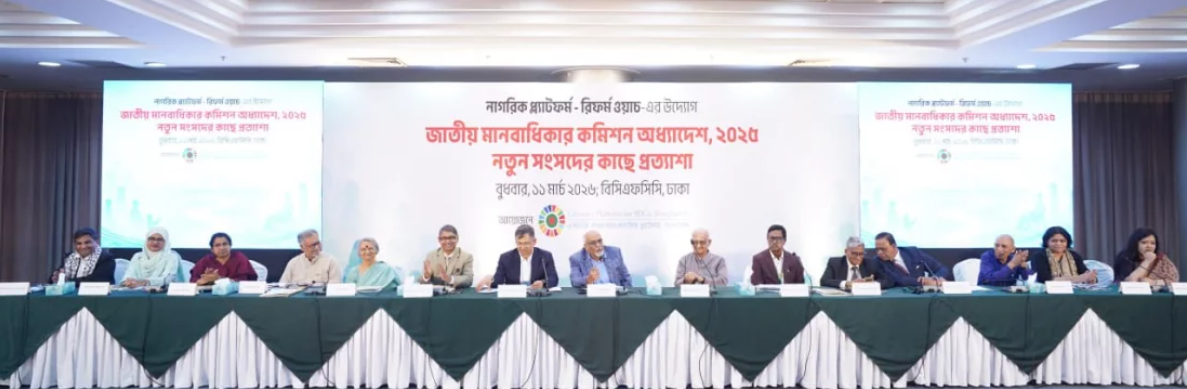
The Asian Centre for Human Rights (ACHR), a NGO having Special Consultative Status with the UN Economic and Social Council, is writing to express our dismay with your statement on 11 March 2026 at a seminar on “National Human Rights Commission Ordinance, 2025 and Expectations from the New Parliament” that it is not possible to ensure 100% respect for human rights in the Chittagong Hill Tracts (CHT) given ‘the threat to territorial integrity and sovereignty of Bangladesh’ and that the Bangladesh Army must be kept out of the jurisdiction of the NHRC.
Through this common letter, we urge Your Honour, H.E. UN High Commissioner for Human Rights, His / Her Excellencies of the diplomatic community in Dhaka, Chairperson of the Global Alliance of National Human Rights Institutions (GANHRI), Director of the Asia Pacific Forum of the NHRIs, representatives of the UN and other multilateral agencies in Bangladesh and Chairperson of the NHRC of Bangladesh to ensure that the Bangladesh Army is not exempted when National Human Rights Commission Ordinance, 2025 is turned into a law by the new parliament; democracy denied to the indigenous peoples of the CHT by not holding elections to the three Hill District Councils of the region from 1989 and to the CHT Regional Council from 1998 is corrected; and the Government of Bangladesh and international community ensures that no political organisation that maintains an armed group is allowed to run legally constituted CHT Regional Council for the sake of human rights and the rule of law.
In a nutshell, Asian Centre for Human Rights calls for inclusion of the Bangladesh Army within the jurisdiction of the NHRC of Bangladesh on two grounds, which are based on facts and law and can stand judicial scrutiny, as given below:
Firstly, there is no threat to territorial integrity and sovereignty of Bangladesh because problems of insurgency in the CHT had ended after the signing of the Chittagong Hill Tracts Accord on 2 December 1997 by the Government of Bangladesh and the PCJSS.[1] The prevailing law and order problems have been created (i) by the Bangladesh Army with the patronage of successive governments of Bangladesh by denying democracy in the CHT through not holding of elections to the Hill District Councils from 1989 and the CHT Regional Council from 1998 and instead ruling the indigenous peoples of the CHT through a local war lord, Mr Jyotirindra Bodhirpriyo Larma alias Santu Larma, President of the PCJSS by retaining him as the Chairman of the CHT Regional Council without elections for the last 28 years despite being the leader of an armed group, armed with AK-47, machine guns and rocket launchers; (ii) as per records from 1998, India taking far more consequential administrative and legal actions against such criminal activities by the PCJSS on Indian soil while Bangladesh allowed the PCJSS to keep its armed group and run the CHT Regional Council; (iii) no political organisation of indigenous peoples of the CHT ever demanding separation from Bangladesh; and finally, (iv) the CHT being used by the Bangladesh Army to control democratic politics of Bangladesh without security sector reforms.
Secondly, Bangladesh has ratified the International Covenant on Civil and Political Rights (ICCPR) on 6 September 2000 and therefore, it cannot exempt the Bangladesh Army from the jurisdiction of the NHRC as the situation in the CHT is not of “public emergency which threatens the life of the nation and the existence of which is officially proclaimed” and certain rights under any circumstances cannot be derogated from as per Article 4 of the ICCPR.[2] The exclusion of the Bangladesh Army from the jurisdiction of the NHRC shall be in violations of the Principle 2 of the Paris Principles on the National Human Rights Institutions relating to the mandate.[3]
The detailed explanations to support the above two contentions are given below:
1. Statement on keeping Bangladesh Army out of the ambit of the NHRC
At the national seminar on “National Human Rights Commission Ordinance, 2025 and Expectations from the New Parliament” organised by Citizen’s Platform for SDGs, Bangladesh on 11 March 2026, You Honour had stated the following:
“হিল ট্রাক্টস এর বিষয়টা আলাদা আপনারা চিন্তা করে দেখেন। এখানে যদি আমরা ১০০% হিউমেন রাইটস ভাইওলেশনের বিষয়টা নজরে আনি, তাহলে আমাদের ডিফেন্স ফোর্সের জন্য অনেককিছু আমরা প্রয়োগ করতে দিতে পারবো না। অতচ দেখা যাবে ওখানে এমন কিছু বিষয় হচ্ছে, রাষ্ট্রীয় অখণ্ডতা আর স্বাধীনতাকে নিশ্চিত রাখতে, অনেক সময় ডিফেন্স ফোর্সের অনেক বিষয়ে তাদের হস্তক্ষেক করতে হবে যেটা আবার হিউমেন রাইটস কমিশনে ১০০% নিয়ে আসি সেটা আরও বড় থ্রেট হয়ে যাবে।
The issue of the Hill Tracts is distinct; you should consider that. If we bring the matter of 100% human rights violations into focus here, we won’t be able to allow many things to be implemented by our defence forces. Yet, it will be seen that certain things are happening there [where] to ensure national integrity and sovereignty in which the defence forces must intervene in many matters. If we bring those instances fully under the Human Rights Commission, it will become an even greater threat.” [4]
2. No threat to territorial integrity or sovereignty of Bangladesh in the CHT – it is a case of denial of democracy and a law and order problem created by the Bangladesh Army with the patronage of Dhaka
There is no threat to territorial integrity and sovereignty of Bangladesh from the Chittagong Hill Tracts. About 180 million people of Bangladesh feeling threatened about territorial integrity and sovereignty from less than 1.5 million indigenous peoples is not a cruel joke but an excuse to continue violation of human rights through mechanisms and situations created by the Bangladesh Army to not implement the CHT Accord of 1997.
2.1. Successive Bangladesh Government kept local war lord, Santu Larma, President of the PCJSS in power of the CHT Regional Council for the last 28 years without elections despite having an active armed group, armed to the teeth
The PCJSS signed the CHT Accord on 2 December 1997 and Mr Jyotirinda Bodhipriyo Larma alias Santu Larma has been kept in power of the CHT Regional Council since 1998 without elections. The last and only elections to the Hill District Councils of Khagrachari, Rangamati and Bandarban was organised by the last military ruler of Bangladesh, then President H M Ershad in June 1989.[5] Thereafter, elections were not organised in the Hill District Councils from 1989 and the CHT Regional Council after its creation in May 1998.[6]
More concerning is the fact that the PCJSS has been allowed to keep an armed group that operates in Bangladesh, India and Myanmar,[7] despite enjoying the powers of the CHT Regional Council and holding the status of the State Minister of Bangladesh as per Section 11 of the CHT Regional Council Act relating to Facilities of chairman and Members.[8] Even late Khaleda Zia, Sheikh Hasina or Tariq Zia as Prime Ministers of Bangladesh were not allowed to have such private army for their political parties.
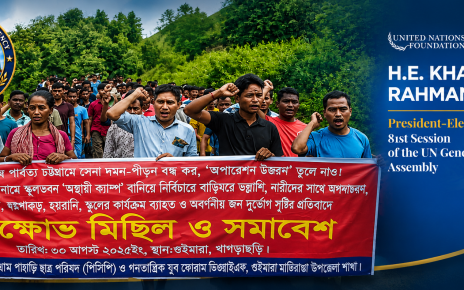
Hundreds of indigenous peoples have been killed by the armed cadres of the PCJSS while enjoying the powers of the legally constituted CHT Regional Council. According to partial data compiled by the Institute for Conflict Management, “627 people were killed in the Chittagong Hill Tracts (CHT) in such fratricidal clashes since the signing of the CHT Peace Accord in 1997 (data till August 28, 2022). These include 321 members of UPDF-Prasit Khisa, 204 members of PCJSS-Santu Larma, 86 members of the PCJSS-M. N. Larma, 10 members of UPDF-D, and six members of PCJSS-Reformation”.[9]
In our considered view, these killing of 627 persons till 28 August 2022 are just tip of the iceberg as they are based on cases reported in the media. Most cases of murder by the PCJSS or others were not reported in Bangladeshi press. Over a thousand indigenous peoples might have been murdered in the CHT, mainly by the PCJSS armed cadres.
For the sake of brevity, a few instances of murders/killings by the PCJSS armed cadres using sophisticated fire-arms since August 2022 are highlighted below to substantiate the contentions:
– On 7 March 2026, Apon Tripura (28), also known as Sangram, a member of the United People’s Democratic Front (UPDF), was shot dead in an armed attack reportedly carried out by armed terrorists of the PCJSS (Santu) group in Borkona under the Latiban area of Panchari Upazila in Khagrachari district.[10]
– On 6 June 2025, an unidentified member of the UPDF was reportedly shot dead by armed cadres of the PCJSS in Shubharanjan Karbaripara under Bangaltali union of Baghaichhari upazila in Rangamati district. Four other persons, including a five-year-old child named Pragya Chakma and a UPDF member identified as Morto Chakma were also injured.[11]
– On 19 March 2025, Antin Tripura Subi (35), an activist of the UPDF and a resident of Mayakumar Para, was allegedly shot dead by armed cadres of the PCJSS in Taindong Headman Para under Matiranga upazila of Khagrachhari district. His sister, Tarapti Tripura, was also reportedly injured in the attack.[12]
– On 16 March 2025, Nirmal Khasa alias Tareng of Toijengma village in Naniarchar Upazila and an activist of the UPDF was shot dead by armed cadres of the PCJSS in Khamarpara of Rangamati Sadar upazila, in Rangamati district. He was killed on the spot.[13]
– On 30 October 2024, three members of the UPDF – Sijon Chakma, Shahon Tripura and Join Chakma were shot dead by unidentified assailants at Santi Ranjan Para under Panchari upazila of Khagrachhari district. The attackers, believed to be armed cadres of the PCJSS, reportedly opened fire on the trio, killing them on the spot.[14]
– On 8 June 2024, Barun Bikash Chakma (55), a supporter of the UPDF, was shot dead by armed cadres of the PCJSS at his residence in Dudokchara Seemanapara under Logang Union of Panchari upazila in Khagrachhari district.[15]
– On 18 May 2024, Tinak Chakma (50) and Dhanyamoti Chakma (40), both members of the UPDF, were shot dead by armed cadres of the PCJSS in Monpoti area under Langadu union of Langadu upazila in Rangamati district. Both were killed on the spot.[16]
– On 11 December 2023, four persons identified as Bipul Chakma, Central Organising Secretary of the Democratic Youth Forum; Sunil Tripura, Central Vice-President of Pahari Chatra Parishad; Liton Chakma, leader of the Democratic Youth Forum; and Ruhin Bikas Tripura, a UPDF member were shot dead by unidentified assailants, allegedly belonging to the PCJSS, in Panchari upazila of Khagrachhari district.[17]
– On 15 May 2023, Rupantor Chakma (47), a member of the UPDF from Dighinala upazila in Khagrachhari, was shot dead by armed cadres of the PCJSS in Manikchhari area under Rangamati Sadar upazila in Rangamati district. He was killed on the spot while on his way to Chakrachhora from Naraichhari for organisational work.[18]
These are not ordinary political killings one usually witnesses in Bangladesh. These killings in the CHT take place by using AK-47 rifles, machine guns and in some instances by using PRG / rocket launchers. Often, the Bangladesh Army personnel remain present alongside the PCJSS armed cadres. Only on 23 February 2026, the Bangladesh Army called the PCJSS led by Santu Larma as a terrorist group[19] after killing of one its cadre.[20] However, on 2 March 2026, the Minister for CHT Affairs Mr Dipen Dewan went to call on warlord Mr Santu Larma i.e. a Cabinet Minister calling on Minister of State.[21] This shows the patronage of Dhaka to an armed organisation enjoying the State power with the sole aim to not implement the CHT Accord.
Because the law and problems in the CHT have been manufactured and managed by the Bangladesh Army, the contention that the situation in the CHT pose any threat to “territorial integrity and sovereignty” of Bangladesh holds no water.
2.2. India has taken more actions on illegal activities by the PCJSS and other groups of the CHT on Indian soil while Bangladesh kept arming the local warlord of the CHT
Since 1997, the records including judicial pronouncements show that the Government of India has taken far more administrative and legal actions against the PCJSS and other groups from the CHT for their illegal activities on Indian soil while the Government of Bangladesh kept the PCJSS headed by Santu Larma in power of the CHT Regional Council.
Some of the emblematic cases of actions taken by India especially against procurement of illegal arms are given below:
– On 9 March 2009, Indian security forces seized 31 AK-47 rifles, one LMG and one Browning automatic rifle and ammunitions from the cadres of the PCJSS. India’s anti-terror agency, National Investigation Agency (NIA) investigated the seizure, filed a chargesheet before the courts in Mizoram and on acquittal of a conspirator, the NIA filed an appeal for the constitutional court, Gauhati High Court. The Guwahati High Court delivered its judgment on 05.09.2024 among others describing the PCJSS as a terrorist organisation.[22]
– On 28 August 2014, Indian Police seized “five M-16 rifles, 5100 round of live cartridges of M-16 and AKs, 10 cell phones and Indian rupees 60,000” and arrested five Chakmas including Jius Chakma, 28, and Sumitro Chakma, 48, both residents of Rangamati, Bangladesh. Jius identified himself as an active member of the PCJSS.[23]
– On 12 February 2025, Indian Police arrested Roni Chakma (45), Anirban Chakma (34) and Ribeng (24), members of the PCJSS and seized “two AK-47 assault rifles, five US-made M4 carbines, 20 Magazines, 504 rounds of 7.62mm and 4,675 rounds of 5.56mm ammunition, in addition to Rs 49,550 in cash, ID Cards, SIM cards, ATM cards and five mobile phones”.[24] The Indian Police registered a criminal case and prosecution under (Sessions Registration/7/2025 is continuing before the District and Sessions Court, Lunglei, Mizoram.
-On 4 June 2025, Indian Police arrested 13 cadres of the PCJSS who had crossed over to Tripura State of India to receive medical treatment at Tripura Medical College following armed clashes in the CHT.[25]
It is clear that India, a country governed by the rule of law, has taken more concrete administrative and legal actions against the groups like the PCJSS.
Despite such well reported actions, the Bangladesh government and the Bangladesh Army permitted criminal activities of the local warlord Santu Larma enjoying the position of the Chairman of the legally constituted CHT Regional Council for the last 28 years without elections as on date!
2.3. Separatism by indigenous peoples of the CHT is a figment of imagination
The indigenous peoples of the CHT never raised the demand for separation from Bangladesh. Mr M N Larma, founder of the PCJSS, as a Member of Parliament wanted to be recognised based on his ethnic identity, not as the mainstream Bengali. The PCJSS’s original five-point demands were about provincial autonomy and they settled their demands through the CHT Accord of 1997.
The United Peoples Democratic Front (UPDF), another regional political party of indigenous peoples of the CHT, states that, “The aim and objective of the Party is to establish a genuine democratic society free from oppression and exploitation through the attainment of full autonomy, the just right of the people of the Chittagong Hill Tracts, by peaceful and democratic means”.[26]
The United People’s Democratic Front (UPDF) submitted its 66-page peace proposal to the government of Bangladesh through a facilitator in June 2022. The government of Bangladesh even refused to acknowledge the peace process,[27] therefore, making it clear it is happy with the current policy of ruling the CHT by keeping the PCJSS, armed to the teeth, in power without elections as long as it can.
Therefore, the question of separatism or threat to territorial integrity or sovereignty of Bangladesh from indigenous peoples of the CHT does not arise. It is a government of Bangladesh manufactured and managed problem.
2.4. Militarisation in the CHT is a threat to democratic Bangladesh
The government of Bangladesh cannot carry out much needed security sector reforms if it accepts the false narrative of the CHT posing a threat to territorial integrity and sovereignty of Bangladesh. It ultimately threatens democracy in Bangladesh. Democratic political parties of Bangladesh need to dispassionately examine the CHT and security sector reforms in Bangladesh.
As on date, the 24th Infantry Division of the Bangladesh Army based in Chittagong has been given the absolute authority on the CHT. The Bangladesh Army therefore kept warlord Mr Santu Larma in power without elections for the last 28 years since 1998 and further, the Ministry of the CHT Affairs after taking consent from the Bangladesh Army kept on appointing the Chairman and members of Khagrachari, Rangamati and Bandarban Hill District Councils.
It is pertinent to bear in mind that the Government of Bangladesh will not be able to carryout meaningful security sector reforms so long the Bangladesh Army is able to bluff with its narrative on the threat to territorial integrity and sovereignty from the CHT.
Democratisation in the CHT is indispensable for meaningful security sector reforms in Bangladesh.
3. Exemption to the Bangladesh Army is illegal under the ICCPR and violations of the Paris Principles on the NHRIs
It is stated that the proposed exemption to the Bangladesh Army from the jurisdiction of the NHRC of Bangladesh violates the ICCPR and the Paris Principles on the NHRIs.
3.1 Violations of the ICCPR
Since Bangladesh has ratified the International Covenant on Civil and Political Rights (ICCPR), if it seeks to suspend certain rights by keeping the Bangladesh Army out of the jurisdiction of the NHRC, as a ratifying party to the ICCPR, Bangladesh has to declare “public emergency which threatens the life of the nation and the existence of which is officially proclaimed” as per as per Article 4 of the ICCPR. Furthermore, derogation must be “consistent with the other obligations under international law and do not involve discrimination solely on the ground of race, colour, sex, language, religion or social origin” and “no derogation from articles 6 (right to life), Article 7 (prohibition of torture), Article 8 (paragraphs I and 2 relating to slavery and servitude), Article 11 (imprisonment for non-fulfilment of contractual obligation), Article 15 (double jeopardy), Article 16 (equality before law) and Article 18 (freedom of thought, conscience and religion)” may be made.[28]
The government of Bangladesh is fully aware and the evidence given herein establish beyond any reasonable doubt that the case in the CHT is not a case of ‘public emergency’ but the Government of Bangladesh manufacturing public emergency by illegally allowing a local warlord to rule the indigenous peoples without elections and with the arms and funds of the Government of Bangladesh routed through the CHT Regional Council. This is a case of denial of democracy and the rule of law.
3.2 Violations of the Paris Principles on the National Human Rights Institutions
The exclusion of the Bangladesh Army because of its deployment in the Chittagong Hill Tracts region will be in violations of the Paris Principles on the National Human Rights Institutions.
Principle 2 of the Paris Principles state that “A national institution shall be given as broad a mandate as possible, which shall be clearly set forth in a constitutional or legislative text, specifying its composition and its sphere of competence”.[29]
This clearly spells out the need to include the military within the jurisdiction of a National Human Rights Institution. The Asia Pacific Forum of the NHRIs in October 2018 had stated that “A court or tribunal with expertise in the application of international humanitarian law may be preferred to an NHRI in relation to human rights violations allegedly committed by military or security forces during armed conflict. However, the NHRI should not be excluded from attending, monitoring and reporting on, or seeking to intervene in such proceedings. There should be no limitation of the NHRI’s jurisdiction with regard to human rights violations allegedly committed by military or security forces when not engaged in conflict.”[30]
Therefore, if Bangladesh keeps the military out of the purview of the NHRC, it shall not comply with the Paris Principles on the NHRIs and it may never be accorded the “A” Status.
4. Conclusion and recommendations
The information submitted herein above establish beyond any reasonable doubt that insurgency in the CHT had ended with signing of the CHT Accord in 1997. The current law and order problems are manufactured and managed by the Bangladesh Army.
In order to establish the rule of law and democracy in Bangladesh including the CHT, we urge to take the following measures:
– Bring the Bangladesh Army within the ambit of the proposed National Human Rights Commission Act including for deployment in the Chittagong Hill Tracts;
– Bar any political party which maintains illegal armed groups such as the PCJSS from enjoying the powers of the legally constituted government bodies such as the CHT Regional Council or the Hill District Council and take necessary measures as per the law of the land;
– Hold elections to the Hill District Councils of Khagrachari, Bandarban and Ranagmati, and the CHT Regional Council after removing existing selected chairmen and members to ensure free and fair elections;
– Engage in dialogue with the regional political parties and civil society organisations for peace in the CHT;
– Implement the CHT Accord in letter and spirit, bearing in mind that keeping the PCJSS in power of the CHT Regional Council is not one of the conditions of the CHT Accord; and
– Undertake security sector reforms to make the Bangladesh Army accountable to the political leadership including on the Chittagong Hill Tracts.
[1]. The CHT Accord can be accessed at UN Peacemaker at https://peacemaker.un.org/sites/default/files/document/files/2024/05/bd971202chittagong20hill20tracts20peace20accord.pdf
[2]. The International Covenant on Civil and Political Rights can be accessed at https://www.ohchr.org/en/instruments-mechanisms/instruments/international-covenant-civil-and-political-rights
[3]. The Paris Principles on the NHRIs can be accessed at https://www.ohchr.org/en/instruments-mechanisms/instruments/principles-relating-status-national-institutions-paris
[4]. The statement of Home Minister Salahuddin Ahmed can be accessed at https://www.youtube.com/watch?v=cMMqZr1zWKo
[5]. Bangladesh Tries to Dampen Ethnic Insurgency With Ballots, The New York Times, 26 Jun 1989, https://www.nytimes.com/1989/06/26/world/bangladesh-tries-to-dampen-ethnic-insurgency-with-ballots.html
[6]. CHT Regional, District Councils, No election in two decades, The Daily Star, 20 July 2018, https://www.thedailystar.net/frontpage/no-election-two-decades-1608802
[7]. Bangladesh rebels training in Mizoram, claims former armed group, The Hindu, 25 January 2024, https://www.thehindu.com/news/national/other-states/bangladesh-rebels-training-in-mizoram-claims-former-armed-group/article67775986.ece
[8]. The CHT Regional Council Act is available at https://faolex.fao.org/docs/pdf/bgd165438.pdf
[9]. Bangladesh: CHT And Violent Factionalism – Analysis, Eurasia Review, 31 August 2022, https://www.eurasiareview.com/31082022-bangladesh-cht-and-violent-factionalism-analysis/
[10].UPDF Member Apon Tripura Shot Dead by PCJSS (Santu) Terrorists in Panchari, 7 March 2026, CHT News, https://chtnews.com/english/2026/03/07/updf-member-apon-tripura-shot-dead-by-pcjss-santu-terrorists-in-panchari/
[11].JSS, UPDF exchange fire in Baghaichhari, Prothomalo, 6 June 2025, https://en.prothomalo.com/bangladesh/crime-and-law/izbzueoic9
[12].UPDF member shot dead in Khagrachhari’sMatiranga, Banglanews24, 19 March 2025, https://banglanews24.com/english/national/news/bd/169981.details
[13].UPDF activist shot dead in Rangamati, The Daily Star, 16 March 2025, https://www.thedailystar.net/news/bangladesh/news/updf-activist-shot-dead-rangamati-3849561
[14]. 3 UPDF members shot dead in Khagrachhari, Prothomalo, 30 October 2024, https://en.prothomalo.com/bangladesh/local-news/o1ac98080r
[15].UPDF supporter killed in khagrachari’s Panchari, The Report, 9 June 2024, https://thereport.live/bangladesh/updf-supporter-killed-in-khagracharis-panchari/30386
[16]. 2 UPDF members shot dead in Rangamati, Jagonews24, 18 May 2024, https://www.jagonews24.com/en/national/news/74565
[17].Case filed over killing of 4 UPDF leaders in Khagrachhari, Bangladesh Sangbad Sangstha, 13 December 2023, https://www.bssnews.net/news/163074
[18].UPDF member shot dead in Rangamati, The Daily Star, 15 May 2023, https://www.thedailystar.net/news/bangladesh/crime-justice/news/updf-member-shot-dead-rangamati-3320151
[19]. The statement of Bangladesh Army can be accessed it its Facebook account at https://www.facebook.com/permalink.php?story_fbid=pfbid028EE7P2dhMSjp965Aa5xU93j6NP8Gv9sTG7ruSLGssA3aLZeAP7N2pCwCH1jVLWhQl&id=61573393628354
[20]. Army operation in Bandarban: Arms seized, JSS member held,
24 February 2026, https://www.jagonews24.com/en/national/news/90279
[21]. সন্তু লারমার সঙ্গে মন্ত্রীর সাক্ষাৎ, পাহাড়ের রাজনীতিতে ইতিবাচক বার্তা, Jugantor, 3 March 2026, https://www.jugantor.com/country-news/1072980
[22]. The judgment of the Gauhati High Court in the National Investigation Agency Vs. Rohmingliana @ Hmingte @Hminga dated 05.09.2024 can be accessed at https://www.casemine.com/judgement/in/66de966f8497f8199b7c1bfc
[23]. Two Bangladeshi Chakmas among five arrested with huge arms in India, BDNEWS24.Com, 28 August 2014, https://bdnews24.com/bangladesh/two-bangladeshi-chakmas-among-five-arrested-with-huge-arms-in-india
[24]. Mizoram arms haul: 3 held with AK-47s, M4 carbines, The Times of India, 12 February 2025, https://timesofindia.indiatimes.com/city/guwahati/mizoram-arms-haul-3-held-with-ak-47s-m4-carbines/articleshowprint/118188444.cms?val=3728
[25].13 Suspected PCJSS Members Detained Near Agartala, Handed Over to MTF, NEIndia, 4 June 2025, https://neindia.com/13-suspected-pcjss-members-detained-near-agartala-handed-over-to-mtf/
[26]. The Constitution of the UPDF can be accessed at https://updfcht.com/?page_id=630
[27]. Bangladesh rebel group’s offer of peace talks with gov’t welcomed, Aljazeera, https://www.aljazeera.com/news/2022/6/14/bangladesh-rebel-groups-offer-of-peace-talks-with-govt-welcomed
[28]. The International Covenant on Civil and Political Rights can be accessed at https://www.ohchr.org/en/instruments-mechanisms/instruments/international-covenant-civil-and-political-rights
[29]. The Paris Principles on the NHRIs can be accessed at https://www.ohchr.org/en/instruments-mechanisms/instruments/principles-relating-status-national-institutions-paris
[30]. A Manual on National Human Rights Institutions, APF, October 2018, https://ganhri.org/wp-content/uploads/2020/07/Manual_on_NHRIs_Oct_2018.pdf