What is new?
On 10 September 2026, the Government of Bangladesh formed three Committees on the Chittagong Hill Tracts (CHT) affairs i.e. National Committee[1], Executive Committee[2] and Advisory Committee[3] to formulate the National Strategy on the Chittagong Hill Tracts within the next 90 days. The CHT is the homeland of majority indigenous peoples of Bangladesh.
The process has raised particular concern regarding the role assigned to the Directorate General of Forces Intelligence (DGFI), Bangladesh’s military intelligence agency. The Director General of the DGFI has been appointed as the Secretary of the National Committee and the Chief Convenor of the Executive Committee. The key task of the Executive Committee is to “review of the existing laws, the provisions of the CHT Accord or the constitutional provisions relating to the CHT or their amendments, reforms or new legislation”.
Equally ironical is the mandate of the Advisory Committee, which includes indigenous peoples in the form of Chairmen of the Hill District Councils, the CHT Regional Council and the CHT Development Board, to make recommendations concerning “the development of the Hill Tracts, ensuring security, combating terrorism, and maintaining communal harmony.” The insurgent Parbatya Chattagram Jana Sanghati Samiti (PCJSS), which has been running the CHT Regional Council without elections from its establishment in 2000 and maintains an armed group, has been given the charge of making recommendations on ensuring security and combating terrorism and maintaining communal harmony!
What is the apparent objective of the National Strategy on the CHT?
The proposed National Strategy on the CHT raises concerns that the principle of equality could be interpreted in a manner that undermines the existing safeguards and preferential measures for the indigenous peoples of the CHT, by giving so-called equal rights to majority Muslim settlers implanted in the CHT between 1979 and 1983 to reduce indigenous peoples into a minority on their own lands.[4] There are apprehensions that the Government of Bangladesh will end the existing reservation of positions for indigenous/tribal peoples in the chairmanship and membership of the three Hill District Councils[5] and CHT Regional Council[6] as well as preferential access to public employment by these councils. There are also concerns that the existing legal distinction between tribals and non-tribals, including distinctions based on permanent residency and ownership of land, could be weakened or removed.[7]
These existing preferential measures are grounded, inter alia, in Article 29(2) of the Constitution of Bangladesh[8] which empowers the State to “make special provision in favour of any backward section of citizens for the purpose of securing their adequate representation in the service of the Republic”.
What could be the key components of the National Strategy on the CHT?
Five areas of particular concern emerge regarding the possible direction of the National Strategy:
(i) Redrawing the political map of the CHT in ways that could facilitate further implantation / settlement of Muslim settlers and potentially Rohingya refugees in the region;
(ii) Weakening the legal foundations of traditional governance, including the framework established under the CHT Regulation, 1900;
(iii) Undermining the CHT Accord, while concerns remain regarding the use of the CHT Regional Council in the context of continuing divisions and fratricidal violence among indigenous peoples;
(iv) Opening the CHT to expanded tourism and strategic interventions without respect for the right to free, prior and informed consent as well the rights of indigenous peoples to their lands and resources; and
(v) Securitisation of the CHT, rather than strengthening civilian administration, democratic institutions and accountable governance.
What could be the consequences?
If implemented without adequate safeguards, these measures could result in significant demographic and political changes in the CHT within a relatively short period.
A further transformation of the CHT into a Muslim-majority region could have profound consequences for the indigenous peoples, including the erosion of their political representation, traditional institutions, land rights and cultural identity. Such developments could contribute to what has been described as the ethnocide of indigenous peoples.
The implications would extend beyond Bangladesh’s internal affairs and could have wider consequences for regional peace and security. In particular, demographic and security developments in the CHT could impact indigenous Rakhine – Rohingya conflict in Arakan Province of Myanmar, including creating circumstances where Rohingya armed groups were to resort to insurgency in pursuit of repatriation.[9] This will equally impact regional peace and security in the North East India too.
What could be done?
The international community should urge with the Government of Bangladesh to ensure that any National Strategy on the CHT is consistent with Bangladesh’s constitutional framework, the 1997 CHT Accord, applicable domestic law and relevant international human rights standards.
In particular, the Government of Bangladesh should be urged to:
- prevent further large-scale settlement of non-tribal Muslim populations in the CHT;
- refrain from redrawing the political map of the CHT in a manner that could create additional Hill District Councils primarily for the Muslim settlers;
- prohibit the settlement of Rohingya refugees in the CHT;
- maintain and strengthen preferential representation of indigenous/tribal peoples in the chairmanship and membership of the Hill District Councils and CHT Regional Council, as well as in public employment;
- strengthen and preserve the legal protections under the CHT Regulation, 1900;
- implement the CHT Accord, including the withdrawal of the Bangladesh Army and the disarmament of the PCJSS armed cadres;
- remove the PCJSS from the CHT Regional Council and take necessary legal measures against the PCJSS for maintaining an armed group while enjoying the statutory powers of the CHT Regional Council;
- ensure the right to free, prior and informed consent of the indigenous peoples concerning any project including tourism projects;
- strengthen civilian administration and democratic governance in the CHT; and
- facilitate the holding of elections to the Hill District Councils and the CHT Regional Council, thereby enabling the CHT to be administered through accountable civilian institutions.
A National Strategy on the CHT should ideally be developed through an inclusive, transparent and participatory process, with the meaningful participation of the indigenous peoples of the region and with due regard to their collective rights, land rights, traditional institutions, political representation and cultural identity. The Bangladesh Nationalist Party (BNP) government has decided to do away with such an approach.
I. The three Committees and their mandates
The National Committee on the CHT Affairs is chaired by the Prime Minister but the Member Secretary is Director General of the DGFI. The members of the National Committee include Finance Minister, Home Minister, Foreign Affairs Minister, Land Minister, Law and Justice Affairs Minister, CHT Affairs Minister, Advisor of Finance, Minister of State on Foreign Affairs (I), Minister of State on CHT Affairs, Defence Advisor, Cabinet Secretary, Principal Secretary to the Prime Minister, three Members of Parliament from the CHT region, Principal Staff Officer of Bangladesh Army, Director General of National Intelligence Agency and Director General of the DGFI.[10]
The main functions of the National Committee are to (a) determine priorities regarding various important issues concerning the Chittagong Hill Tracts and oversee the implementation of the decisions taken; (b) determine the activities and jurisdiction of the security forces, law-and-order forces, and organizations concerning various matters related to the Chittagong Hill Tracts; and (c) finalize and adopt measures for the formulation and implementation of national policies concerning the Chittagong Hill Tracts.[11]
The Government of Bangladesh also formed the Executive Committee on the CHT Affairs. The Chairman is the Secretary, Ministry of Home Affairs while Director General of the DGFI is the Principal Coordinator and Director, Social Stability Intelligence Bureau (SSIB) serves as the Member-Secretary. Other members of the Executive Committee are Secretary, Ministry of Land; Secretary, Ministry of Law, Justice and Parliamentary Affairs; Secretary, Ministry of Chittagong Hill Tracts Affairs; Inspector General of Police, Bangladesh Police; Director General, National Security Intelligence (NSI); Director General, Border Guard Bangladesh (BGB); Director General, Bangladesh Ansar and Village Defence Party (VDP); General Officer Commanding (GOC), 24th Infantry Division (in charge of CHT); Divisional Commissioner, Chittagong; Additional Inspector General of Police, Special Branch of Police (SB); Director General, Operations and Planning Directorate, Armed Forces Division and Director (Border and Chittagong Hill Tracts), National Security Intelligence (NSI).[12]
To formulate the National Strategy on the CHT, the Executive Committee has been given the functions to (a) determine the specific tasks to be undertaken by the concerned ministries/divisions and various organisations under them; (b) formulate a national strategy for the development of the Chittagong Hill Tracts, including the suppression of terrorism and separatism, ensuring border security, promoting communal harmony, and improving the livelihoods of all communities residing in the Chittagong Hill Tracts; (c) review the existing laws, provisions of the CHT Accord and constitutional provisions relating to ensuring sustainable security in the Chittagong Hill Tracts; recommend necessary amendments and reforms; and recommend the enactment of new laws and regulations; and (d) within the next three months (90 days), prepare a draft National Strategy on the Chittagong Hill Tracts and submit it to the National Committee on the Chittagong Hill Tracts.[13]
The Government of Bangladesh also formed an “Advisory Committee on CHT Affairs” under the Chairmanship of the Chairman, Chittagong Hill Tracts Accord Implementation and Monitoring Committee. The members are Chairman, Chittagong Hill Tracts Land Dispute Settlement Commission; Chairman, Task Force Committee on Rehabilitation and Resettlement of Tribal Refugees Repatriated to Bangladesh from India and Internally Displaced Persons; Secretary, Ministry of Chittagong Hill Tracts Affairs; Chairman, Chittagong Hill Tracts Development Board; Representative of the Chairman, Chittagong Hill Tracts Regional Council; Ms. Mamaching, Chairman, Bandarban Hill District Council; Mr. Dipan Talukdar, Chairman, Rangamati Hill District Council; and Mr. Rasa Thoyai Marma, Chairman, Khagrachari Hill District Council.[14] The Advisory Committee has a few indigenous representatives appointed by the Government such as the Chairmen of the District Councils, Regional Council, CHT Development Board without mandatory elections.
The only function of the Advisory Committee is “to submit recommendations to the Executive Committee on Chittagong Hill Tracts-related matters within the next two months (60 days) for the development of the Hill Tracts, ensuring security, combating terrorism, and maintaining communal harmony.”[15]
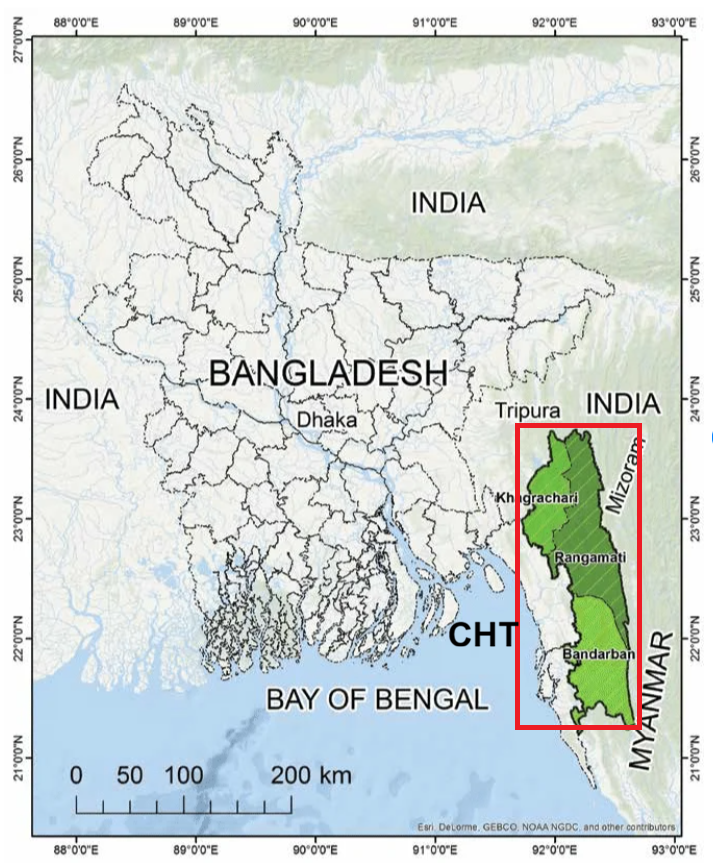
II. DGFI in charge to design ethnocide of indigenous peoples
A cursory scrutiny of the composition of the three Committees shows that the most significant feature is the formal positioning of the Directorate General of Forces Intelligence (DGFI) within these new institutional structures. The Director General of the DGFI is the Member-Secretary of the National Committee and the Chief Convenor of the Executive Committee. This is not merely an administrative arrangement. It places the country’s principal military intelligence agency at the centre for formulation of the National Strategy on the CHT within the next 90 days.
The mandate of the Advisory Committee reinforces this conclusion. Although the Advisory Committee includes indigenous peoples such as Chairmen of the District Councils, the CHT Regional Council appointed by the Government without elections and the Chairman of the CHT Development Board- its mandate is narrowly defined. It can recommend only on “the development of the Hill Tracts, ensuring security, combating terrorism, and maintaining communal harmony.” Crucially, the Advisory Committee has no mandate to review the existing laws, the provisions of the CHT Accord or the constitutional provisions relating to the CHT, or their amendments, reforms or new legislation.
Therefore the DGFI alone will decide the future of the indigenous peoples of the CHT.
III. The objective: Ethnocide in the name of equality
The broader policy direction appears to be aimed at establishing what the Government may describe as “equal rights”, but which in practice could dismantle the special constitutional, statutory and customary protections available to the indigenous peoples of the CHT. The preference given to indigenous peoples under Article 29(2) of the Constitution of Bangladesh[16] which empowers the State for “making special provision in favour of any backward section of citizens for the purpose of securing their adequate representation in the service of the Republic” is at risks of being violated.
The main objectives appear to be:
- End reservation of indigenous peoples in the positions of Chairmanship and membership of the Hill District Councils and the CHT Regional Council and ensure the so-called equality of the majority Muslim settlers in these positions;
- End reservation of indigenous peoples in public employment by the Hill District Councils and the CHT Regional Council in the name of so-called equality of the majority Muslim settlers;
- End the legal distinction between permanent residents (indigenous peoples) and non-permanent residents (Muslim settlers), which is fundamental to the protection of indigenous peoples’ rights in the CHT;
- End the special status of the Chittagong Hill Tracts by repealing the CHT 1900 Regulation; and
- Nullify the Chittagong Hill Tracts Accord of 1997.
If implemented, this would fundamentally alter the political balance in the CHT by effectively decimating the indigenous peoples.
IV. Expected Programme of Actions for ethnocide of the indigenous peoples in the CHT
The key five expected priorities of actions to be adopted for carrying out apparent ethnocide of indigenous peoples i.e. (i) redrawing the political map of the CHT to allow implantation of more Muslim settlers and Rohingya refugees; (ii) dismantling the legal foundation of the traditional governance provided under the CHT Regulation, 1900; (iii) nullifying the CHT Accord while using the CHT Regional Council in the meantime for fratricidal killings among indigenous peoples; (iv) opening the CHT for tourism and strategic interventions; and (v) securitisation of the CHT, are elaborated below.
1. Redrawing the political map of the CHT to allow implantation of more Muslims settlers and Rohingya refugees
Presently, there are three districts in the Chittagong Hill Tracts i.e. Bandarban, Khagrachari and Rangamati and the region is governed by three Hill District Councils and the CHT Regional Council.
The Hill District Councils give preference to indigenous and tribal peoples to the positions of chairmen and members. The Bandarban Hill District Council consists of a Chairman, reserved for tribals, 19 members from tribals, 11 members from non-tribals and three women members out of which two are tribals and one is non-tribal[17] while the Khagrachari District Council consists of Chairman, reserved for tribals, 21 members from tribals, nine members from non-tribals and three women members out of which two are tribals and one is non-tribal.[18] The Rangamati District Council consists of a Chairman which is once again reserved for tribals, 20 members from tribals, 10 members from non-tribals and three women members out of which two are tribals and one is non-tribal.[19]
Furthermore, under common Article 32 of the Hill District Council laws, the Councils may appoint employees to the posts of the third and fourth grades but “in making such appointments, preference shall be given to the indigenous inhabitants of the concerned district.”
These preferences for the indigenous tribal peoples for the chairmanship, membership and employment of the Hill District Councils are consistent with Article 29(2) of the Constitution of Bangladesh[20] which especially empowers the State for “making special provision in favour of any backward section of citizens for the purpose of securing their adequate representation in the service of the Republic”.
The Muslim settlers, however, have been demanding “equality” and an end to these constitutionally guaranteed special measures for indigenous peoples. The current Government of Bangladesh is expected to ensure the so-called equality through the division of the three existing CHT districts i.e. Bandarban, Khagrachari and Rangamati districts into at least six districts as per the following configuration:
- In Bandarban district, Naikhyangchari, Alikadam and Lama upazilas/sub-districts would reportedly be combined to create a new district dominated by the Muslim settlers.
- In Rangamati district, Kaptai, Rajasthali and Juraichari upazilas/sub-districts would reportedly be combined to establish another new district for the Muslim settlers.
- In Khagrachari district, Matiranga, Ramgarh, Manikchari and Lakshmichari upazilas/sub-districts would reportedly be brought together to create yet another new district for the Muslim settlers.
The objective appears to go beyond ordinary administrative reorganisation of the districts. Redrawing district boundaries would require creation of more district councils and enactment of new laws and amendments of the existing Hill District Council laws. These measures would fundamentally alter political representation, electoral arithmetic, administrative control and the composition of the Hill District Councils.
New districts would require new Councils and amendments to the existing legislation giving the powers to the Muslim settlers. These amendments could then be used to alter provisions governing reservation for chairmanship and membership of the District Council as well as for public employment.
The proposed division of the CHT could therefore become the legal mechanism for dismantling the existing indigenous-majority institutional structure. Indigenous peoples fear that the division of the CHT would facilitate further settlement of Muslim populations, potentially including Rohingya refugees, thereby accelerating demographic transformation of the region.
2. Dismantling the legal foundation of the traditional governance provided under the CHT Regulation, 1900
The Government is also likely to target the CHT Regulation, 1900[21] which recognises three traditional tribal chiefs of the region i.e. Chakma, Mong and Bohmang chiefs. Over the years, the CHT Regulation has become the foundational basis for traditional governance by indigenous peoples.
Its repeal would represent a major assault on the legal framework governing the distinctive administrative and customary institutions of the indigenous peoples of the CHT.
If the Regulation is retained but its interpretation is fundamentally altered, the consequences could be equally serious. The traditional indigenous Chiefs could potentially be compelled to appoint non-indigenous Muslim settlers within traditional governance institutions such as the Headman and Karbari system.
The strategic objective of the Government of Bangladesh appears to be clear: either abolish the traditional legal framework or neutralise it from within. This will allow settlement of more Muslims without prior permission and purchase of indigenous peoples/ tribals’ lands without any restriction or permission as currently required under the CHT 1900 Regulation.
3. Nullifying the CHT Accord while using the CHT Regional Council in the meantime for fratricidal killings
The 1997 CHT Accord[22] signed between the Government of Bangladesh and the insurgent Parbatya Chattagram Jana Sanghati Samiti (PCJSS) ended the 25 year old insurgency in the region. The ruling Bangladesh Nationalist Party (BNP) has always opposed the Accord and in its 2026 election manifesto, it promised a review of the CHT Accord.[23]
The CHT Regional Council Act,[24] the key outcome of the CHT Accord, is therefore likely to become the main target under the guise of ensuring socalled equality. As per Section 5 of the CHT Regional Council Act, the Council consists of Chairman, reserved for the tribals and 12 tribal members; six non-tribal members, and three women members with two from the tribals and one from non-tribals. Section 29 of the CHT Regional Council Act further provides that “in appointment employees of the Council, the members of the tribal community of the hill districts shall be given preference“.
However, in April 2010, the CHT Regional Council was declared unconstitutional by the High Court of Bangladesh on the ground that the State’s unitary character, which is the basic feature of the constitution, has been hampered due to formation of the Regional Council.[25] An appeal has been filed against the judgment and the CHT Regional Council has been functioning based on a stay granted by the Supreme Court. For the last 15 years, the appeal has not been decided by the Supreme Court.[26]
The Government could potentially seek to exploit the pending litigation concerning the constitutionality of the Regional Council. The DGFI will most likely retain the Regional Council to continue to use the PCJSS armed cadres[27] as the State militia to counter possible rise of other tribal armed groups and also continue the fratricidal killings. If the PCJSS leaders lose interest in fratricidal killings[28], the government of Bangladesh can easily declare the CHT Regional Council unconstitutional anytime by the handpicked judges of the Supreme Court of Bangladesh.
4. Open the CHT for tourism and strategic interventions
On 21 February 2026, immediately after becoming State Minister for Chittagong Hill Tracts Affairs, Mir Mohammad Helal Uddin expressed his firm commitment to develop the Chittagong Hill Tracts (CHT) into a world-class ecotourism destination.[29] A massive expansion of tourism-focused development is also likely.
The stated justification for tourism is development, connectivity and economic integration. The strategic consequences, however, appear to be considerably broader. Opening the CHT through roads, tourism corridors, commercial projects and associated infrastructure would:
- increase migration and settlement of the majority Muslims;
- weaken geographically concentrated indigenous control;
- facilitate military and security access;
- commercialise indigenous lands and resources; and
- reduce the strategic space available for any future armed indigenous resistance.
Tourism would function as an instrument of demographic and strategic integration.
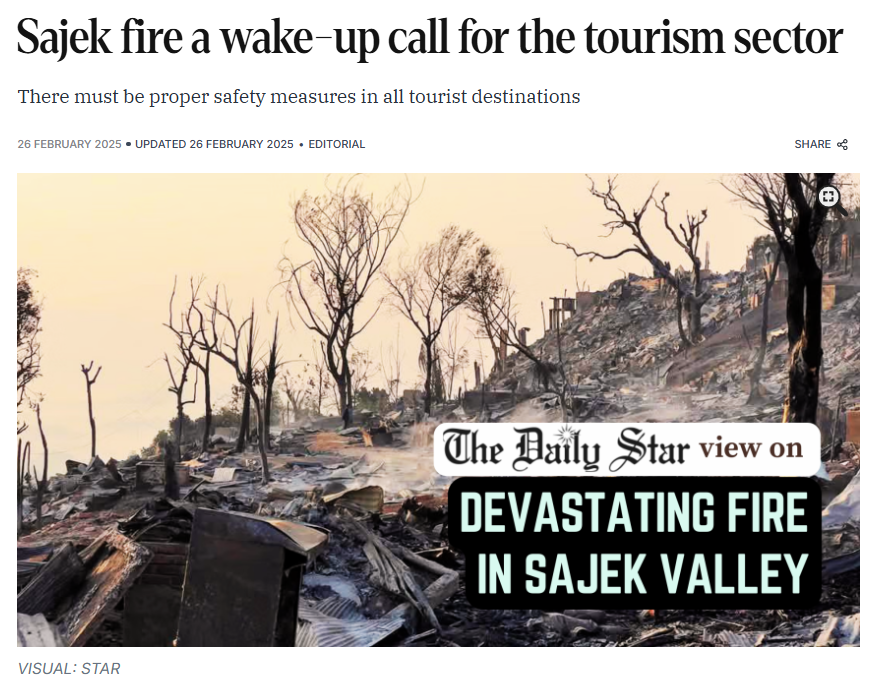
Bangladesh Army runs most of the tourist spots in the CHT by forcibly occupying the lands of indigenous peoples. For example, on 24 September 2025, nine UN Special Rapporteurs in a communication (Ref.: AL BGD 4/2025) to the Government of Bangladesh stated that on 12 September 2020, a joint venture was announced between the 24th Division and 69th Brigade of the Bangladesh Army, the Army Welfare Trust, and Sikder Group conglomerate company R&R Holdings Limited- for the construction of a large-scale tourism complex in Chimbuk, Bandarban district. The proposed project covers an estimated 800–1,000 acres of land and reportedly includes a hotel, an amusement park, an artificial lake, residential quarters for army personnel, as well as extensive infrastructure such as roads, drainage and sewage systems, energy facilities, and cable cars connecting twelve hills. Despite widespread objections and protests from the local Mro Indigenous People and Indigenous student organizations, construction activities began in September 2020 and have continued without interruption. Reports indicate that the project already occupies approximately 500 acres of land. It is expected to directly displace at least 150 Mro families, with additional 250 families affected across a broader area of around 1,000 acres (405 hectares). Altogether, approximately 10,000 Indigenous persons face the risk of eviction. The Special Rapporteurs urged the Government of Bangladesh to provide information on the measures taken to ensure that businesses, in particular commercial rubber businesses, tourism businesses such as Sikder Group conglomerate company R&R Holdings Limited, respect human rights in accordance with the UN Guiding Principles on Business and Human Rights and how the above-mentioned companies have meaningfully engaged with potentially affected stakeholders in accordance with Free Prior and Informed Consent requirements.[30] The Government of Bangladesh is not known to have submitted any reply.
Considering the Bangladesh Army’s influence over the security architecture in the CHT and formal role assigned for developing National Strategy on the CHT, tourism projects would be used for strengthening the security establishment’s control over the region.
5. Securitisation of the CHT
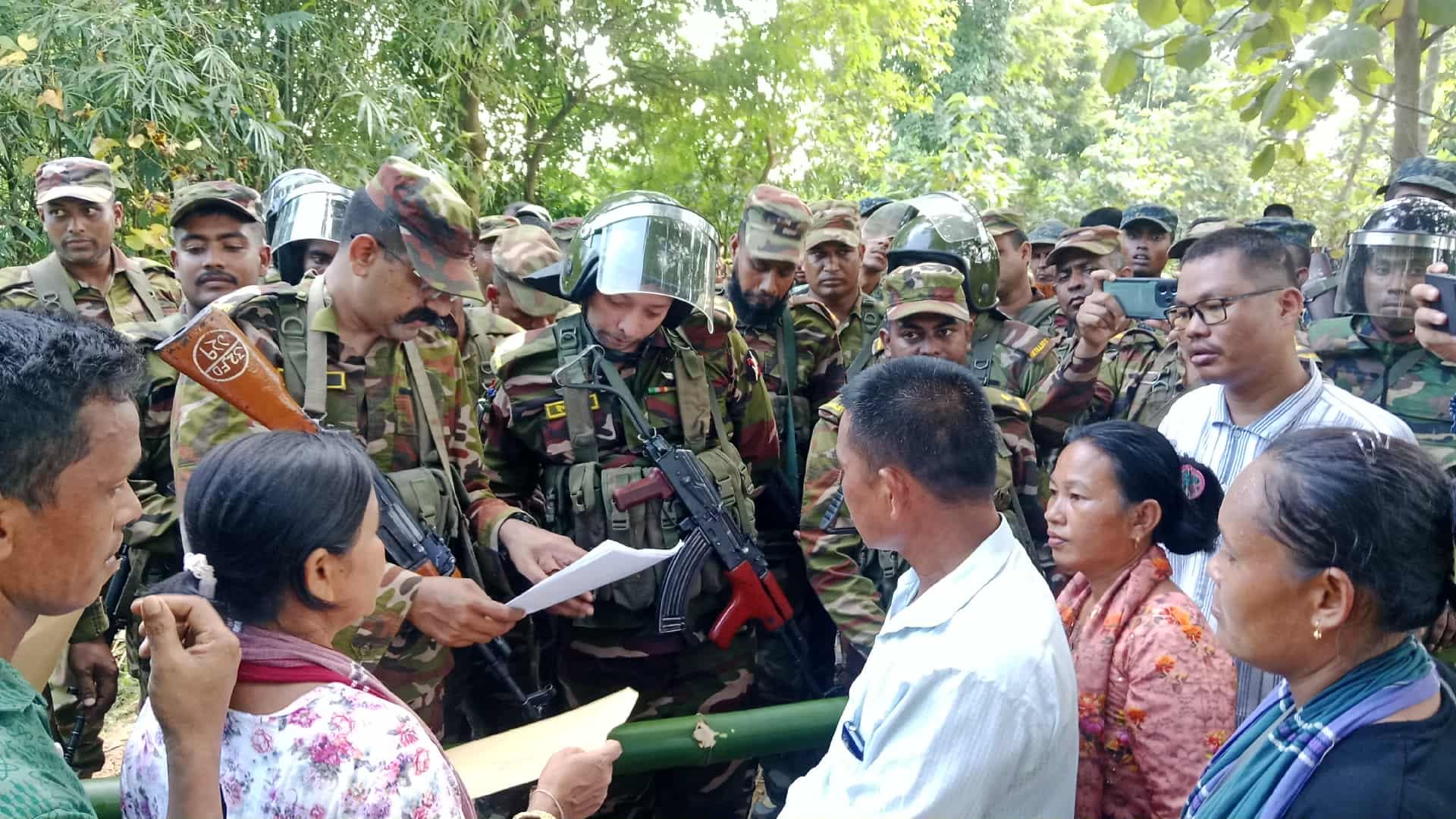
The CHT remains one of the most militarised zones in the world.
As part of the national strategy on the CHT, the DGFI is expected to continue intensification of security measures under the familiar framework of counter-terrorism, counter-separatism and national security while it keeps the PCJSS as the main State-sponsored militia group by retaining them in power of the CHT Regional Council. The government of Bangladesh has used the armed PCJSS in power of the CHT Regional Council for the last 27 years without elections to silence any movement by indigenous peoples. On the other hand, for political correctness, there has been palpable silence against the PCJSS enjoying statutory powers but its cadres being convicted for arms trafficking in India[31], being involved in drug trafficking[32] and other criminal activities.
The likely priorities of the Bangladesh for securitisation of the CHT include:
- construction and upgrading of border infrastructure;
- establishment of additional military and security camps;
- enhanced intelligence operations; and
- security corridors for strategic and tourism projects.
Sub-section 17(a) under Section (D) (Gha) relating to rehabilitation, general amnesty and other matters provided that “after signing of the agreement…, all the temporary camps of military, Ansar and Village Defence Party shall be taken back to permanent installations except the border security force (BDR) and permanent cantonments (three at the three District Headquarters and Alikadam, Ruma and Dighinala) by phases and with this in view, the time limit shall be determined”. It further provided that “(b) the lands of camps and cantonments to be abandoned by military or para-military forces shall be either returned to the original owners or to the Hill District Councils”.[33]
The government of Bangladesh not only failed to withdraw any of the camps and return the lands to indigenous peoples, in 2026 the Bangladesh Army has started building infrastructure essential for a new cantonment in Naikhongchari, close to the Bangladesh-Myanmar border and started “flag markings” to build the new cantonment.[34]
The securitisation is all set to intensify in the CHT.
The CHT is expected to undergo a fundamental demographic and political transformation within a relatively short period. The transformation of the CHT into a Muslim-majority region will cause ethnocide of the indigenous peoples in the short term.
The implications would extend beyond Bangladesh’s internal affairs and could have wider consequences for regional peace and security. In particular, demographic and security developments in the CHT could impact the indigenous Rakhine – Rohingya conflict in Arakan Province of Myanmar, including in circumstances where Rohingya armed groups were to resort to insurgency in pursuit of repatriation.[35] This will equally impact regional peace and security in the North East India too.
[1]. The gazette notification for establishment of the National Committee on CHT Affairs can be at https://www.dpp.gov.bd/upload_file/gazettes/62908_87607.pdf?fbclid=IwY2xjawUVvyxwZG9mBWV4dG4DYWVtAjEwAGJyaWQRMWwwdXVadXprcW9ETldKUWtzcnRjBmFwcF9pZBAyMjIwMzkxNzg4MjAwODkyAAEeZ7WdRa0tKLXcTetTkDuLO_Id5rz9kLkHxbxWZXqV10OAgzXiICEIFhqla9s_aem_mJpT7dTrLiLPrad5xpzKfw
[2]. The gazette notification for establishment of the Executive Committee on CHT Affairs can be at https://www.dpp.gov.bd/upload_file/gazettes/62909_83203.pdf?fbclid=IwY2xjawUVv3lwZG9mBWV4dG4DYWVtAjEwAGJyaWQRMWwwdXVadXprcW9ETldKUWtzcnRjBmFwcF9pZBAyMjIwMzkxNzg4MjAwODkyAAEeZ7WdRa0tKLXcTetTkDuLO_Id5rz9kLkHxbxWZXqV10OAgzXiICEIFhqla9s_aem_mJpT7dTrLiLPrad5xpzKfw
[3]. The gazette notification for establishment of the Advisory Committee on CHT Affairs can be at https://www.dpp.gov.bd/upload_file/gazettes/62910_45457.pdf?fbclid=IwY2xjawUVv4lwZG9mBWV4dG4DYWVtAjEwAGJyaWQRMWwwdXVadXprcW9ETldKUWtzcnRjBmFwcF9pZBAyMjIwMzkxNzg4MjAwODkyAAEeCBQ5cas8ZVVf0WoP0Vc5dKnBtW9VayxWidFEZCPrI7Y2djJ2y9ZAxntjrKA_aem_s0xw4iHYEKCkOx-n_75nOA
[4]. ‘Life Is not Ours’ – Land and Human Rights in the Chittagong Hill Tracts, Bangladesh, the Chittagong Hill Tracts Commission, 28 May 1991, https://www.iwgia.org/en/publications/life-is-not-ours-land-and-human-rights-in-the-chittagong-hill-tracts-bangladesh
[5]. The three Hill District Councils are Kharachari Hill District Council, Rangmati Hill District Council and Bandarban Hill District Council
[6]. The details of the CHT Regional Council can be found at https://chtrc.gov.bd/
[7] . Under the Hill District Council Act, “A-upajatiyo stayi bashida/non-tribal permanent resident is defined as “who is not a tribal and who has valid lands who has a definite address in the Hill districts”. Details can be seen under 2(ka) of the Bandarban Hill District Council Act at https://sorongbd.org/wp-content/uploads/2025/05/%E0%A6%AC%E0%A6%BE%E0%A6%A8%E0%A7%8D%E0%A6%A6%E0%A6%B0%E0%A6%AC%E0%A6%BE%E0%A6%A8-%E0%A6%AA%E0%A6%BE%E0%A6%B0%E0%A7%8D%E0%A6%AC%E0%A6%A4%E0%A7%8D%E0%A6%AF-%E0%A6%9C%E0%A7%87%E0%A6%B2%E0%A6%BE-%E0%A6%AA%E0%A6%B0%E0%A6%BF%E0%A6%B7%E0%A6%A6-%E0%A6%86%E0%A6%87%E0%A6%A8.pdf
Article 29 of the Constitution of Bangladesh relating to equality of opportunity in public employment states can be accessed at https://bdlaws.minlaw.gov.bd/act-367/section-24577.html
[9]. On Rohingya insurgency, refer to “The Dangers of a Rohingya Insurgency”, International Crisis Group, 19 June 2025, https://www.crisisgroup.org/vid/asia-pacific/myanmar/dangers-rohingya-insurgency
[10]. The gazette notification for establishment of the National Committee on CHT Affairs can be at https://www.dpp.gov.bd/upload_file/gazettes/62908_87607.pdf?fbclid=IwY2xjawUVvyxwZG9mBWV4dG4DYWVtAjEwAGJyaWQRMWwwdXVadXprcW9ETldKUWtzcnRjBmFwcF9pZBAyMjIwMzkxNzg4MjAwODkyAAEeZ7WdRa0tKLXcTetTkDuLO_Id5rz9kLkHxbxWZXqV10OAgzXiICEIFhqla9s_aem_mJpT7dTrLiLPrad5xpzKfw
[11]. Ibid
[12]. The gazette notification for establishment of the Executive Committee on CHT Affairs can be at https://www.dpp.gov.bd/upload_file/gazettes/62909_83203.pdf?fbclid=IwY2xjawUVv3lwZG9mBWV4dG4DYWVtAjEwAGJyaWQRMWwwdXVadXprcW9ETldKUWtzcnRjBmFwcF9pZBAyMjIwMzkxNzg4MjAwODkyAAEeZ7WdRa0tKLXcTetTkDuLO_Id5rz9kLkHxbxWZXqV10OAgzXiICEIFhqla9s_aem_mJpT7dTrLiLPrad5xpzKfw
[13]. Ibid
[14]. The gazette notification for establishment of the Advisory Committee on CHT Affairs can be at https://www.dpp.gov.bd/upload_file/gazettes/62910_45457.pdf?fbclid=IwY2xjawUVv4lwZG9mBWV4dG4DYWVtAjEwAGJyaWQRMWwwdXVadXprcW9ETldKUWtzcnRjBmFwcF9pZBAyMjIwMzkxNzg4MjAwODkyAAEeCBQ5cas8ZVVf0WoP0Vc5dKnBtW9VayxWidFEZCPrI7Y2djJ2y9ZAxntjrKA_aem_s0xw4iHYEKCkOx-n_75nOA
[15]. Ibid
[16]. Article 29 of the Constitution of Bangladesh relating to equality of opportunity in public employment states can be accessed at https://bdlaws.minlaw.gov.bd/act-367/section-24577.html
[17]. The Bandarban District Council Act is available at https://sorongbd.org/wp-content/uploads/2025/05/%E0%A6%AC%E0%A6%BE%E0%A6%A8%E0%A7%8D%E0%A6%A6%E0%A6%B0%E0%A6%AC%E0%A6%BE%E0%A6%A8-%E0%A6%AA%E0%A6%BE%E0%A6%B0%E0%A7%8D%E0%A6%AC%E0%A6%A4%E0%A7%8D%E0%A6%AF-%E0%A6%9C%E0%A7%87%E0%A6%B2%E0%A6%BE-%E0%A6%AA%E0%A6%B0%E0%A6%BF%E0%A6%B7%E0%A6%A6-%E0%A6%86%E0%A6%87%E0%A6%A8.pdf
[18]. The Khagrachari District Council Act is available at https://sorongbd.org/wp-content/uploads/2025/05/%E0%A6%96%E0%A6%BE%E0%A6%97%E0%A6%A1%E0%A6%BC%E0%A6%BE%E0%A6%9B%E0%A6%A1%E0%A6%BC%E0%A6%BF-%E0%A6%AA%E0%A6%BE%E0%A6%B0%E0%A7%8D%E0%A6%AC%E0%A6%A4%E0%A7%8D%E0%A6%AF-%E0%A6%9C%E0%A7%87%E0%A6%B2%E0%A6%BE-%E0%A6%AA%E0%A6%B0%E0%A6%BF%E0%A6%B7%E0%A6%A6-%E0%A6%86%E0%A6%87%E0%A6%A8.pdf
[19]. The Rangmati District Council Act is available at https://sorongbd.org/wp-content/uploads/2025/05/%E0%A6%B0%E0%A6%BE%E0%A6%99%E0%A7%8D%E0%A6%97%E0%A6%BE%E0%A6%AE%E0%A6%BE%E0%A6%9F%E0%A6%BF-%E0%A6%AA%E0%A6%BE%E0%A6%B0%E0%A7%8D%E0%A6%AC%E0%A6%A4%E0%A7%8D%E0%A6%AF-%E0%A6%9C%E0%A7%87%E0%A6%B2%E0%A6%BE-%E0%A6%AA%E0%A6%B0%E0%A6%BF%E0%A6%B7%E0%A6%A6-%E0%A6%86%E0%A6%87%E0%A6%A8.pdf
[20]. Article 29 of the Constitution of Bangladesh relating to equality of opportunity in public employment states can be accessed at https://bdlaws.minlaw.gov.bd/act-367/section-24577.html
[21]. The CHT 1900 Regulation can be accessed at https://bdlaws.minlaw.gov.bd/act-1313.html
[22]. The CHT Accord of 1997 can be accessed at https://peacemaker.un.org/sites/default/files/document/files/2024/05/bd971202chittagong20hill20tracts20peace20accord.pdf
[23]. BNP to pursue balanced regional dev for equitable wealth distribution, The Financial Express, 7 February 2026, https://thefinancialexpress.com.bd/national/politics/bnp-to-pursue-balanced-regional-dev-for-equitable-wealth-distribution
[24]. The CHT Regional Council Act can be accessed at https://faolex.fao.org/docs/pdf/bgd165438.pdf
[25]. CHT Regional Council: SC hearing on HC order adjourned for 4 weeks, The Daily Star, 6 March 2018, https://www.thedailystar.net/country/chittagong-hill-tracts-regional-council-supreme-court-hearing-on-high-court-order-adjourned-for-4-weeks-1544311
[26]. 28yrs of peace accord: Appeals on CHT regional council stuck for 14 years, The Daily Star, 1 December 2025, https://www.thedailystar.net/news/bangladesh/news/28yrs-peace-accord-appeals-cht-regional-council-stuck-14-years-4048411
[27]. 3 killed in gunfight between UPDF, JSS factions in Khagrachhari, Views Bangladesh, 3 July 2026, https://viewsbangladesh.com/3-killed-in-gunfight-between-updf-jss-factions-in-khagrachhari/
[28] . Bangladesh: Factional Killings In Chittagong Hill Tracts – Analysis, Eurasia Review, 21 December 2021, https://www.eurasiareview.com/21122021-bangladesh-factional-killings-in-chittagong-hill-tracts-analysis/
[29]. State Minister Helal vows to develop CHT as world-class ecotourism destination, The Business Standard, 21 February 2026, https://www.tbsnews.net/bangladesh/state-minister-helal-vows-develop-cht-world-class-ecotourism-destination-1367731
[30]. The communication of the Special Rapporteur on the right to food; the Working Group on the issue of human rights and transnational corporations and other business enterprises; the Special Rapporteur in the field of cultural rights; the Special Rapporteur on the human right to a clean, healthy and sustainable environment; the Special Rapporteur on the rights to freedom of peaceful assembly and of association; the Special Rapporteur on the right of everyone to the enjoyment of the highest attainable standard of physical and mental health; the Special Rapporteur on the situation of human rights defenders; the Special Rapporteur on the rights of Indigenous Peoples and the Working Group on the rights of peasants and other people working in rural areas on 24 September 2025 can be accessed at https://spcommreports.ohchr.org/TMResultsBase/DownLoadPublicCommunicationFile?gId=30359
[31]. Judgment of the Gauhati High Court (India) in the National Investigation Agency v. Rohmingliana @ Gauhati High Court dated 5 September 2024, https://www.casemine.com/judgement/in/66de966f8497f8199b7c1bfc
[32]. ‘New Golden Triangle’ of drug trafficking emerging across Burma, India, and Bangladesh, warns expert, Mid Day, 22 October 2025, https://www.mid-day.com/news/india-news/article/new-golden-triangle-of-drug-trafficking-emerging-across-burma-india-and-bangladesh-warns-expert-23599762
[33]. The CHT Accord of 1997 can be accessed at https://peacemaker.un.org/sites/default/files/document/files/2024/05/bd971202chittagong20hill20tracts20peace20accord.pdf
[34]. Bangladesh Army quietly laying groundwork for setting up new cantonment in Naikhongchhari, North East News, 1 August 2026, https://nenews.in/neighbours/bangladesh-army-quietly-laying-groundwork-for-setting-up-new-cantonment-in-naikhongchhari/59296/
[35]. On Rohingya insurgency, refer to “The Dangers of a Rohingya Insurgency”, International Crisis Group, 19 June 2025, https://www.crisisgroup.org/vid/asia-pacific/myanmar/dangers-rohingya-insurgency