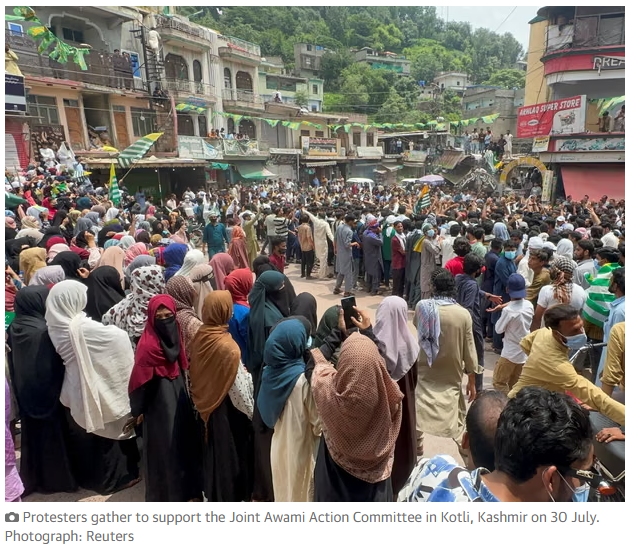
On 23 September 2026, a man identified as Faizan Shan, reportedly a resident of Chak Dhamni in Rawalakot, was killed and another man travelling with him on a motorcycle was reportedly injured following an incident involving Pakistan Rangers personnel near a checkpoint in the Rawalakot area. According to reports, Rangers personnel opened fire during the incident.[1] The circumstances surrounding the shooting, including the sequence of events and the justification for the use of force, remain to be independently verified.
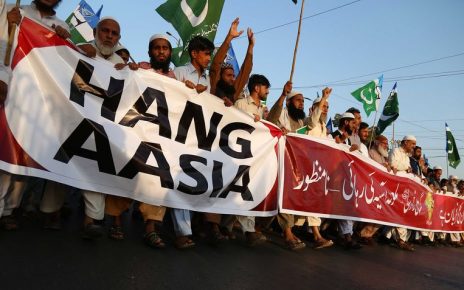
Following this incident involving personnel of the Pakistan Rangers, local residents reportedly gathered near the checkpoint and demanded that Faizan Shan’s body be handed over to his family. The incident has further heightened concerns regarding the security and human rights situation in Pakistan Administered Kashmir.
The reported killing takes place against the backdrop of a prolonged internet shutdown on 5 June 2026, amid the escalating confrontation between the authorities and the Jammu Kashmir Joint Awami Action Committee (JAAC) over the elections after the talks collapsed on 30 May 2026 over the elections. The three-phase elections held between 27 July and 10 August 2026 had witnessed unprecedented human rights violations unseen in the history of the region.[2] The full extent of alleged human rights violations during the controversial elections remains unknown as the region remains under wraps because of the internet shut down, directions to foreign journalists to leave the region and restrictions on the Pakistani journalists to report on the region.
Of the 45 directly contested constituencies, polling was held in 38 seats, with the Pakistan Muslim League (Nawaz) ( PML-N) securing 25 seats, the Pakistan Peoples Party (PPP) 12 seats and the Awami Dast-o-Bazu Party one seat.[3] Syed Iftikhar Ali Gillani of the PML-N was elected Prime Minister of Pakistan Administered Kashmir on 30 August. But the internet shutdown imposed since 5 June 2026 largely remains in place as on date. As of 14 September 2026, partial internet connectivity had been restored in Neelum and Bhimber, but restrictions continued in Muzaffarabad, Poonch and Mirpur divisions. In Kotli district, DSL access was allowed only for educational institutions, banks, civil administration, police and army offices, excluding Sehnsa, Sarsawa, Baloch and Tattapani. [4]
Access Now’s Shutdown Tracker Optimization Project (STOP) stated that the communications blackout had disrupted daily life, restricted access to information, impeded the documentation of potential human rights violations, and undermined public accountability by preventing independent reporting.[5]
1. The root causes of the protests by the JAAC
The Human Rights Commission of Pakistan (HRCP), an NGO in Pakistan attributed the recent unrest to longstanding political and socio-economic grievances, institutional distrust and governance deficits in Pakistan Administered Kashmir, compounded by an increasingly confrontational state response, including the disproportionate use of force, which deepened polarisation and eroded public trust.[6]
The HRCP’s fact-finding report, Civic Spaces under Strain in Azad Jammu and Kashmir, stated that the dispute over implementation of a 2025 agreement with the Jammu Kashmir Joint Awami Action Committee (JAAC), coupled with controversy over the 12 seats reserved for Kashmiri refugees in Pakistan, had become central to the political confrontation.[7]
2. Internet shutdown keeps the scale of human rights violations under wraps
On 5 June, Pakistan imposed an internet shutdown and restrictions on movement and communications, including a prolonged suspension of mobile internet services. The authorities also banned the JAAC which had functioned as a democratic organisation with no history of violence under the Anti-Terrorism Act 2014. Until 30 May 2026, the JAAC had operated as a democratic organisation, but following the failure of negotiations it was designated as a terrorist organisation within days.
Pakistan Administered Kashmir witnessed unprecedented violence during the elections held between 27 July and 10 August 2026.
The HRCP reported that the police chief had stated that around 38 security personnel had been killed and 742 police personnel injured since June. The names of those killed and injured were not provided.
The HRCP, however, did not provide the number of civilians allegedly killed by the security forces although it reported to have “received multiple accounts from families, alleging that protesters had been killed or seriously injured by the security forces.” It was unable to independently establish the full scale or circumstances of civilian casualties, particularly because it could not access Rawalakot, one of the main centres of violence. It therefore called for an independent and impartial investigation into all deaths and serious injuries since June, including whether the use of force was lawful, necessary and proportionate.[8]
In addition to allegations of extrajudicial executions, the HRCP stated that at least 147 JAAC activists were initially placed on the Fourth Schedule. A series of notifications issued between June and August reportedly brought the total number of political activists, journalists, residents and activists listed under anti-terrorism legislation to at least 157. The detainees were reportedly denied due process, including production before courts, access to lawyers and information about the grounds for their arrest.[9]
The JAAC, on the other hand, claimed 89 reported civilian deaths, more than 100 civilians injured, more than 200 persons reported missing or disappeared, and 800 persons subjected to arbitrary arrest and detention.[10]
3. Foreign media expulsion and national media restrictions keeps the scale of human rights violations under wraps
The HRCP noted restrictions on journalism and access to information, stating that journalists had faced arrests, legal action, restrictions on access to affected areas and special security requirements. The prolonged communications shutdown also severely constrained independent reporting and verification of deaths, injuries, arrests and alleged electoral irregularities.[11]
The situation further deteriorated following the introduction of the “Foreign Media Facilitation Guidelines 2026” on 4 August 2026 by Pakistan’s Ministry of Information and Broadcasting. Under these guidelines, as a Pakistani digital-rights activist explained:
“Anyone working for foreign media outlets, even if they are a Pakistani citizen, must obtain a no-objection certificate issued by the government in order to report from outside the country’s three major cities [in Pakistan], which are Karachi, Lahore and Islamabad. This is evidence of a further tightening of restrictions on press freedom in the country, where the government essentially decides who has access to information and under what condition.”[12]
On 2 August 2026, Al Jazeera’s website was blocked for alleged “sensational journalism” following its coverage of events in Pakistan Administered Kashmir after the second phase of the elections.[13] On 5 August 2026, journalists working for foreign media outlets were ordered to leave the region and further anyone working for foreign media, including Pakistani nationals, were directed to seek permission to report from anywhere except the cities of Islamabad, Karachi and Lahore.
Many journalists were also summoned including before the courts for their reporting with “false and fake information”. The rules subsequently introduced also restricted journalists reporting from Pakistan’s three key cities namely Islamabad, Karachi and Lahore.[14]
Several journalists were also detained. On 1 August, Razi Tahir and Muhammad Saif were taken from Islamabad to an unknown location by persons wearing police uniforms. Both were released after 40 days in detention. Tahir stated that he had been confined in a cell at Attock jail alongside between eight and ten other people, including young detainees aged 16, 17 and 18.[15]
4. The case of UN investigation
It is precisely because the scale alleged grave human rights violations in Pakistan Administered Kashmir and region being closed to the outside world including Pakistanis that the United Nations High Commissioner for Human Rights should seek access to the region to investigate gross human rights violations including violations of the right to life.
The HRCP reported the claims of the security forces that around 38 security personnel had been killed and 742 police personnel injured. At the same time, it was unable to independently establish the number of civilian deaths or the circumstances in which civilians were killed or injured.[16] The discrepancy between the reported security-force casualties and the absence of independently verified civilian casualty figures underscores the need for an independent and impartial investigation that can only be conducted by the United Nations.
Apart from the media personnel, the JAAC banned as a terrorist organisation too is unable to independently document and bring to public attention the full scale of the alleged human rights violations that took place during the elections. The United Nations should therefore seek access to Pakistan Administered Kashmir to investigate the recent unprecedented human rights violations.
[1]. Pakistan-occupied Kashmir protests: Man killed, another injured in fresh Rawalakot violence, Mathrubhumi, 23 September 2026, https://english.mathrubhumi.com/news/world/pakistan-occupied-kashmir-rawalakot-protests-fresh-violence-yb3ej4aj
[2]., “Pakistan: UN High Commissioner for Human Rights Should Follow Up His Call for Inquiry into Killings in Pakistan Administered Kashmir”, Written Statement (A/HRC/63/NGO/168) of Asian Centre for Human Rights to the 63rd session of the UN Human Rights Council, https://documents.un.org/doc/undoc/gen/g26/129/86/pdf/g2612986.pdf
[3].Nawaz Sharif nominates Najeeb Naqi Khan as AJK president candidate, The Express Tribune, 16 September 2026, https://tribune.com.pk/story/2629608/nawaz-sharif-nominates-najeeb-naqi-khan-as-ajk-president-candidate
[4]. Internet Starts Recovering in More Areas Across Azad Kashmir, ProPK, 14 September 2026, Internet Starts Recovering in More Areas Across Azad Kashmir
[5]. Counterterrorism: Governance-securitization and democratic backsliding in Pakistan-administered Jammu and Kashmir, EU Reporter, 3 August 2026, https://www.eureporter.co/world/pakistan/2026/08/03/counterterrorism-governance-securitization-and-democratic-backsliding-in-pakistan-administered-jammu-and-kashmir/
[6]. Civic Spaces under Strain in Azad Jammu and Kashmir – An HRCP fact-finding report, 29 August 2026, 2026-Civic-spaces-under-strain-in-AJK-1.pdf
[7]. Civic Spaces under Strain in Azad Jammu and Kashmir – An HRCP fact-finding report, 29 August 2026, 2026-Civic-spaces-under-strain-in-AJK-1.pdf
[8]. Civic Spaces under Strain in Azad Jammu and Kashmir – An HRCP fact-finding report, 29 August 2026, 2026-Civic-spaces-under-strain-in-AJK-1.pdf
[9]. Civic Spaces under Strain in Azad Jammu and Kashmir – An HRCP fact-finding report, 29 August 2026, 2026-Civic-spaces-under-strain-in-AJK-1.pdf
[10].Website of Jammu Kashmir Joint Awami Action Committee, https://jkjaac.co/ accessed on 22 September 2026
[11]. Civic Spaces under Strain in Azad Jammu and Kashmir – An HRCP fact-finding report, 29 August 2026, 2026-Civic-spaces-under-strain-in-AJK-1.pdf
[12].Pakistan: Protests continue in Azad Kashmir despite repression and internet blackout, France24, 27 August 2026, https://www.france24.com/en/asia-pacific/20260827-pakistan-protests-continue-in-azad-kashmir-despite-repression-and-internet-blackout
[13] . Pakistan: Protests continue in Azad Kashmir despite repression and internet blackout, France24, 27 August 2026, https://www.france24.com/en/asia-pacific/20260827-pakistan-protests-continue-in-azad-kashmir-despite-repression-and-internet-blackout
[14]. What Is Happening in Azad Jammu and Kashmir?, Amaliah Anonymous in World, 18th September 2026, https://www.amaliah.com/post/91351/azad-jammu-and-kashmir-protests
[15]. Razi Tahir, Muhammad Saif freed after 40-day detention | Journalism Pakistan, Journalism Pakistan, 10 September 2026, https://www.journalismpakistan.com/razi-tahir-muhammad-saif-freed-after-40-day-detention
[16]. Civic Spaces under Strain in Azad Jammu and Kashmir – An HRCP fact-finding report, 29 August 2026, 2026-Civic-spaces-under-strain-in-AJK-1.pdf