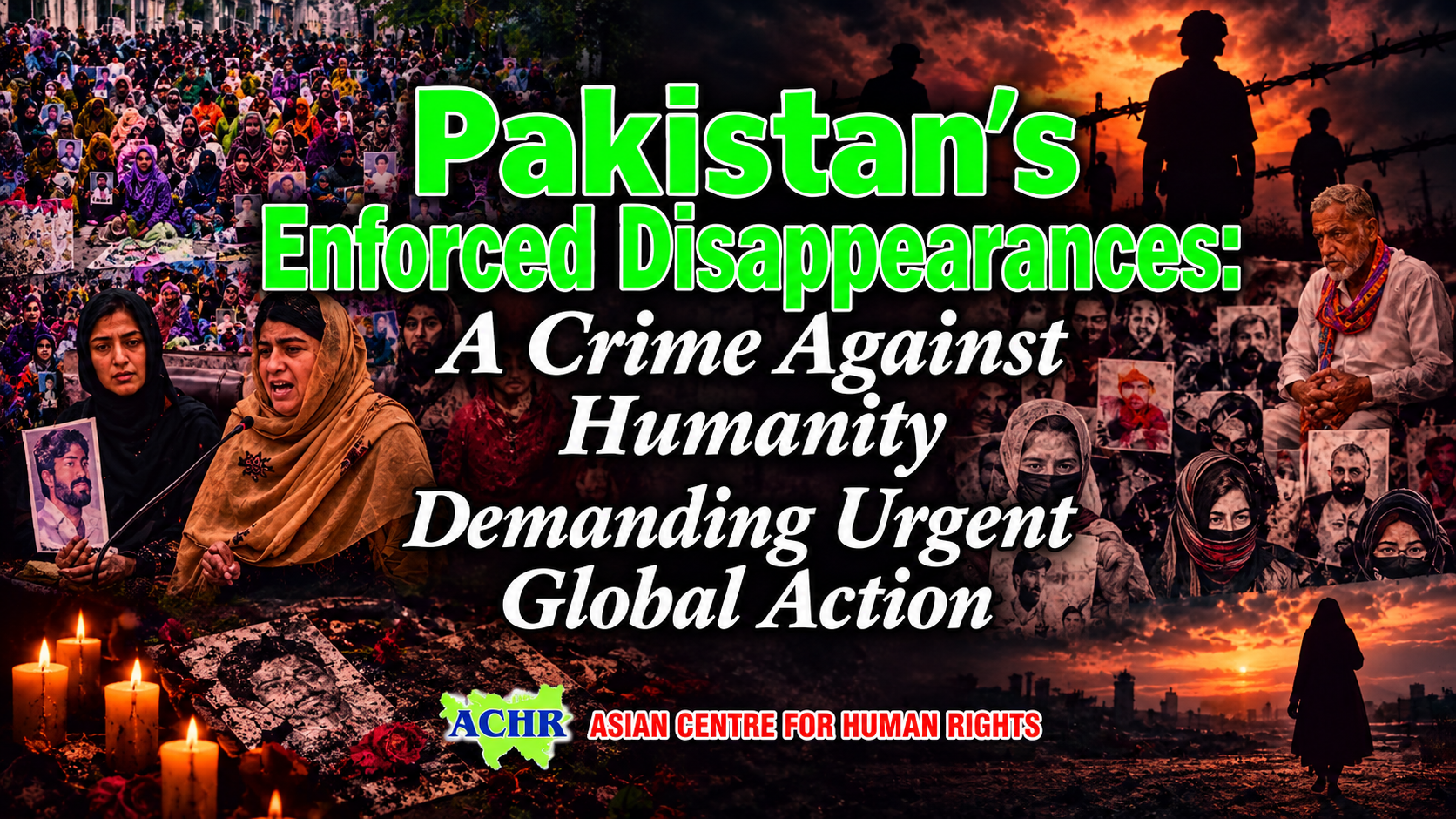
As internal armed conflicts intensify in Pakistan, especially in Khyber Pakhtunkhwa and Balochistan, enforced disappearances have been skyrocketing. The cases of enforced disappearances in Balochistan surged by over 308% in 2025 (1,482 cases) compared with 2020 (480 cases). This trend continues in 2026 with 793 cases of enforced disappearances from January to July 2026 i.e. about four persons disappearing every day.
The full report in PDF can be accessed here
Pakistan Government’s Commission of Inquiry on Enforced Disappearances (COIED) established in March 2011 had received 10,973 cases between March 2011 and July 2026 mainly from Khyber Pakhtunkhwa, Balochistan, Sindh and Punjab. The United Nations Committee against Torture in June 2026 stated that despite the COIED “disposing of” more than 9,000 of the over 10,000 cases of alleged enforced disappearance registered between 2010 and August 2025, not a single official was ordered to be prosecuted.
It is time for the international community to address the issue considering the gravity of the crime of enforced disappearances, a crime against humanity under Article 7(1)(i) of the Rome Statute of International Criminal Court. It is time for the United States to invoke the Global Magnitsky Human Rights Accountability Act of 2016 to contribute to the actions of the United Nations.
Table of Contents
1. Executive summary – Absolute impunity calls for effective interventions
2. Scale and Geographical Pattern of Enforced Disappearances
2.1. Enforced disappearance in Balochistan
2.2. Enforced disappearances in Khyber Pakhtunkhwa
2.3. Extrajudicial executions of victims of enforced disappearances
3.2. Allegations of financial payments to withdraw cases
3.3. Allegation of sexual harassment
3.4. Assessment of COIED by National Commission for Human Rights, Pakistan
4. UN actions & Pakistan’s no cooperation
4.1. Visit of WGEID to Pakistan, 2012
4.2. WGEID Follow-up Assessment, 2016
4.3. WGEID Annual Report, 2016
4.4. UN Communication concerning four human rights activists, 2017
4.5. UN Communication concerning Mudassar Mahmood and Matiullah Jan, 2020
4.6. UN Joint Communication concerning Akash Ramchandani, Sami Abraham and Imran Riaz Khan, 2023
4.7. WGEID General Allegation concerning Pakistan, 2023
4.8. UN Communication concerning enforced disappearances in Balochistan, 18 February 2025
4.9. WGEID General Allegation, 2025
4.10. Government of Pakistan’s response, 2026
5. Victimising the victim: Mahrang Baloch and the case for effective international interventions
ANNEX I: Special Focus – Analysis of enforced disappearances in Balochistan during 2026
1. Executive summary – Absolute impunity calls for effective interventions
Pakistan has been building up a narrative against enforced disappearances that plague the country with the aim to question the number of cases of enforced disappearances and further stopping reportage on enforced disappearances. In one hand, on 22 January 2026, Chief Minister of Balochistan Sarfraz Bugti declared that “The state should no longer be held responsible for cases of self-imposed disappearance,” referring to individuals who allegedly voluntarily associate with ‘militant’ or ‘separatist’ organisations.[1] On the other hand, on 22 June 2026, the most recognisable faces of a movement demanding answers about enforced disappearances in Balochistan, 33 year old Dr Mahrang Baloch, was sentenced to life imprisonment by a Pakistani anti-terrorism court along with her fellow activist Sibghatullah Shah on what were described as trumped up charges of terrorism, sedition and murder in connection with the death of a paramilitary soldier during a protest in the town of Gwadar in 2024.[2] Earlier, on 6 October 2024, the Pakistan government banned the Pashtun Tahaffuz Movement (PTM) of Khyber Pakhtunkhwa (KP) which Amnesty International described as “a grassroots movement peacefully advocating for human rights of Pashtuns who have long been subjected to harassment and violence by the Pakistani authorities”.[3] Documenting and reporting cases of enforced disappearances are not without consequences.
As internal armed conflicts intensify in Pakistan especially in Khyber Pakhtunkhwa and Balochistan, enforced disappearances have been skyrocketing. The cases of enforced disappearances in Balochistan increased by over 308% in 2025 (1,482 cases) compared with 2020 (480 cases). The Human Rights Council of Balochistan (HRCB) had documented 1,482 enforced disappearances in 2025;[4] 830 cases in 2024;[5] 601 cases in 2023;[6] 584 cases in 2022;[7] 442 cases in 2021;[8] and 480 cases of enforced disappearances in 2020.[9]
The trend of high numbers of enforced disappearances continues unabated during 2026. In the first seven months of 2026, there were about 793 cases of enforced disappearance from January to July 2026 i.e. about four persons per day. These include 107 cases of enforce in January 2026;[10] 234 cases in February 2026;[11] 65 cases in March 2026;[12] 124 cases in April 2026;[13] 95 cases in May 2026;[14] 63 cases in June 2026;[15] and 105 cases in July 2026.[16] The victims included 21 women, 3 girls and 56 children. The victims come from all walks of life including political activists, human rights defenders, journalists, students, lawyers, political opponents and members of ethnic and religious minorities and other perceived critics of the authorities. Often the victims are profiled[17], before being picked up for enforced disappearance. The HRCB stated that in 793 cases of enforced disappearances from January to July 2026, about 155 students became the victims.
Pakistan has provided absolute impunity for these enforced disappearances and this practice has further emboldened law enforcement personnel. Pakistan Government’s Commission of Inquiry on Enforced Disappearances (COIED) established in March 2011 had received 10,973 cases between March 2011 and July 2026[18] mainly from Khyber Pakhtunkhwa, Balochistan, Sindh and Punjab.
While human rights organisations have repeatedly stated that these official figures do not represent the full scale of enforced disappearances in Pakistan, the United Nations Committee against Torture in June 2026 stated that despite the COIED “disposing of” more than 9,000 of the over 10,000 cases of alleged enforced disappearance registered between 2010 and August 2025, not a single official was ordered to be prosecuted.[19] In a communication on 18 February 2025, a group of UN Special Procedures including the Working Group on Enforced or Involuntary Disappearances also stated that the COIED had yet to direct any perpetrator to be held accountable for an enforced disappearance.[20]
The question is who are the perpetrators of enforced disappearances in Pakistan? An analysis of the data of the HRCB from January to July 2026 show that out of the 793 cases of enforced disappearances, the Frontier Corps were responsible for 358 cases of enforced disappearances, followed by Intelligence Agencies with 262 cases, theCounter Terrorism Department (CTD) with 142 cases, state sponsored death squads with 27 cases and the Pakistani Rangers with four cases.
The menace of enforced disappearances in Pakistan is endemic as highlighted by governmental bodies like the National Commission for Human Rights of Pakistan,[21] the Commission of Inquiry on Enforced Disappearances,[22] national NGOs like the Human Rights Commission of Pakistan (HRCP),[23] the Human Rights Council of Balochistan,[24] Baloch Yakjehti Committee (BYC), the Pashtun Tahaffuz Movement,[25] the Defence of Human Rights;[26] international NGOs like Amnesty International,[27] Human Rights Watch[28] and International Commission of Jurists;[29] and finally, the United Nations bodies like the UN Committee Against Torture[30] and UN Special Procedures mandate holders. Pakistan has not shown any interest to ratify the International Convention for the Protection of All Persons from Enforced Disappearance (ICPPED) or in enacting a national law to criminalise enforced disappearances.[31]
Under similar circumstances, on 10 December 2021, the US Treasury Department imposed sanctions on Bangladesh’s elite paramilitary force, the Rapid Action Battalion including its seven officers due to serious human rights violations including enforced disappearances and extrajudicial executions.[32]
The situation of enforced disappearances in Pakistan has been equally worse and is worsening by day with systematic efforts to dilute the narrative.
It is time for the international community to address the issue considering the gravity of the crime of enforced disappearances, a crime against humanity under Article 7(1)(i) of the Rome Statute of International Criminal Court.[33] It is time for the United States to invoke the Global Magnitsky Human Rights Accountability Act of 2016 to contribute to the actions of the United Nations.
2. Scale and Geographical Pattern of Enforced Disappearances
Enforced disappearances intensified after 2006, when a key Baloch leader, Nawab Akbar Bugti, was killed in a military operation, leading to a rise in anti-state protests and armed insurgent activities.[34] It soon spread to the rest of Pakistan. By the end of February 2017, the highest number of enforced disappearances was reported from Khyber Pakhtunkhwa (684 out of 1,240) followed by Punjab (245), Balochistan (103), Sindh (102), Islamabad (44), Fata (43), Pakistan Administered Kashmir (13) and Gilgit-Baltistan (six).[35] It soon spread across the country.
In March 2011, the Government of Pakistan established the Commission of Inquiry on Enforced Disappearances (COIED) to investigate cases of alleged enforced disappearance, trace the whereabouts of disappeared persons, and identify those responsible. The Commission’s mandate has subsequently been extended several times.[36] The COIED was reconstituted in June 2025.[37]
According to figures recorded by the COIED, the Commission received 10,973 cases of alleged enforced disappearance between March 2011 and July 2026. Of these, about 7,034 persons were reported as traced, while more than 1,400 remained forcibly disappeared. Among those reported as traced, around 4,951 had returned home, 1,034 remained in detention in alleged illegal internment centres, 740 were in prisons and 309 had been killed with their bodies subsequently recovered.[38]
The geographical distribution of cases recorded by the COIED shows that Khyber Pakhtunkhwa and Balochistan accounted for the largest number of reported cases. KP recorded 3,822 cases, followed by Balochistan with 2,951, Sindh with 1,884, Punjab with 1,813, Islamabad Capital Territory with 422, Pakistan Administered Kashmir with 71, and Gilgit-Baltistan with 10 cases.[39]
The figures point to a significant concentration of reported enforced disappearance cases in Khyber Pakhtunkhwa and Balochistan since 2021, where allegations of disappearances have been repeatedly raised by families, human rights organisations and other civil society groups.
However, the official figures do not reflect the full scale of the problem because many cases remain unreported or unregistered, particularly where families face fear, intimidation, lack of access to authorities or other obstacles to seeking formal remedies. Consequently, the number of cases recorded by the COIED should not necessarily be understood as representing the total number of enforced disappearances in Pakistan.
2.1. Enforced disappearance in Balochistan
In Balochistan, the practice of enforced disappearances has been reportedly used as a tool to suppress dissent, particularly from the 1970s. Enforced disappearances have been allegedly used to silence the voices of those who were sympathetic to separatist or nationalist movements in Balochistan province, as well as human rights defenders, journalists, political opponents and activists, students, women and even children. Many cases reportedly have resulted in the extrajudicial killing of the victims.[40]
While the use of enforced disappearance in Balochistan is reportedly widespread, the exact number of enforced disappearances remains unknown, and there is a discrepancy between official Government figures and the number of cases recorded by non-governmental organisations (NGOs). Human rights organisations and families in Balochistan suggest much higher numbers of victims than those provided by the COIED and Government officials. They have also contested the number of cases that have been clarified. Between 2017 and 2024, there have been hundreds of reports of enforced disappearances of journalists, human rights defenders, students, political dissidents and families of political opponents, including women and girls. One non-profit organisation representing family members of those who disappeared in Balochistan indicates that, since 2004, it has registered approximately 7,000 cases. The NGO statistics are reportedly based on verified data, which the NGOs estimate to represent only one-third of the total incidents of enforced disappearances due to the difficulty of collecting information with limited internet access and in heavily militarized areas.[41]
Abductions are reportedly often carried out in daylight, often in busy public areas, and in the presence of multiple witnesses. Victims are taken away from shops and hotels, public buses, university campuses, homes and places of work. While the majority of the cases documented have involved men in their mid-20s to mid-40s, there have also been reports of victims over 60 years of age, women and even children as young as 12 years old. Most appear to have been targeted because of their alleged participation in or association with Baloch nationalist parties and movements, as well as Baloch student organizations.[42]
A. About 308% increase in 2025 from 2000
Enforced disappearances in Balochistan increased by over 308% in 2025 (1,482 cases) compared with 2020(480 cases). The HRCB has documented 1,482 enforced disappearances in 2025;[43] 830 cases in 2024;[44] 601 cases in 2023;[45] 584 cases in 2022;[46] 442 cases in 2021[47] and 480 cases of enforced disappearance in 2020.[48]
B. Four cases of enforced disappearances everyday during 2026
The trend of high numbers of enforced disappearances continues unabated during 2026. According to the data of Balochistan Human Rights Council in first seven months of 2026, about 793 cases of enforced disappearance were reported including 107 enforced disappearances in January 2026 including a woman and 11 children;[49] 234 enforced disappearances, including a woman and nine teenagers in February 2026;[50] 65 enforced disappearance cases including one woman and nine teenagers in March 2026;[51] 124 enforced disappearances including eight women and five teenagers in April 2026;[52] 95 enforced disappearances, including two women and eight teenagers in May 2026;[53] 63 cases of enforced disappearance in June 2026;[54] and 105 cases of enforced disappearance, including five women and three minor girls and 14 children in July 2026.[55]
In September 2026, a prolonged curfew and reported military operation in Zehri tehsil of Balochistan province triggered fresh allegations of enforced disappearances. According to a report by The Balochistan Post, Pakistani security forces detained around 25 residents from the Sunni area during the operation and allegedly subjected them to enforced disappearance.[56]
On 4 September 2026, the Office of the UN High Commissioner for Human Rights (OHCHR) raised concerns over the alleged enforced disappearance, torture and extrajudicial killing of Imran Ali. The UN experts said Ali was abducted from his apartment on 27 August 2025 by around 20 personnel from Pakistan’s Counter-Terrorism Department (CTD). They said people previously detained with him later confirmed that he had been held and allegedly tortured. On 6 August 2026, a police officer during a hearing before Pakistan’s Commission of Inquiry on Enforced Disappearances stated that Ali had been killed during an alleged encounter in May 2026. It took authorities approximately one month to identify his body. Authorities claimed they were unable to preserve Ali’s remains and therefore buried him in June 2026. Following this disclosure, Ali’s family visited the Civil Hospital in Quetta, where they identified his body from photographs on record. Imran Ali’s body was reportedly brought to the hospital alongside six other bodies, none of which were documented or reported by hospital staff or police. They were buried without proper identification or notification to the families. The UN experts called for an independent investigation, forensic examination and identification of the six other bodies reportedly brought to a hospital alongside his remains.[57]
On 3 September 2026, a Baloch youth, Ammar Baloch, was forcibly disappeared from Lahore. Ammar, who had pursued higher education abroad before returning to build his future, was taken away by Pakistani security forces and that his whereabouts remain unknown.[58]
On 2 September 2026, Adnan Baloch, a labourer from the Gebun region of Balochistan, was forcibly disappeared by Pakistani security forces during a late-night raid and his whereabouts reportedly remain unknown.[59]
On 2 September 2026, twin brothers Muhammad and Ahmad were allegedly kidnapped by Pakistani security forces in Gebun. Pakistani security forces entered their family home and forcibly took both brothers into custody before transferring them to an undisclosed location. Pakistani authorities have provided no information about their whereabouts, legal status, or physical condition. Muhammad and Ahmad are daily wage labourers who support their family through manual work. Neither of them has any political affiliation or criminal record. They were taken without a warrant, without being informed of any charges, and without access to lawyers, family members, or a court.[60]
On 23 August 2026, Ali Baloch, son of Abul Hayee, was allegedly detained and forcibly disappeared by the security forces in Mastung. The family accused personnel from the Inter-Services Intelligence (ISI) and the Counter-Terrorism Department (CTD) of involvement in his disappearance. The family members have received no information about the whereabouts of Ali Baloch.[61]
On 16 April 2026, Shakeel Baloch, son of Zardad, was forcibly disappeared from his home in Killi Goharabad on Sariab Road, Quetta. The family accused personnel from the Inter-Services Intelligence (ISI) and the Counter-Terrorism Department (CTD) of involvement in his disappearance. The family members have received no information about Shakeel Baloch.[62]
On 24 July 2026, Jiand Baloch, an activist and chair of the Baloch Students Organization, was forcibly disappeared from his home after being picked up by the security forces. His whereabouts remain unknown. This is the third time Jiand has been forcibly disappeared, as part of a pattern targeting Baloch students for their peaceful activism.[63]
On 21 April 2026, Dad Shah (38), the brother of prominent human rights defender Fozia Baloch affiliated with the Baloch Yakjehti Committee (BYC), was forcibly disappeared allegedly by the Counter Terrorism Department from his home in Karachi, Sindh. Eyewitnesses reported that the officers did not provide a warrant or justification for his abduction. Since the abduction, security officers have refused to provide information regarding his whereabouts, a reason for the abduction, or official confirmation of his detention, despite public appeals for his release and information. Karachi police refused to register a First Information Report (FIR) regarding the abduction. Daad Shah has been targeted before in reprisal for Fozia Baloch’s human rights work. He was forcibly disappeared and held in detention for 27 days in August 2023.[64]
On 12 March 2026, Abdullah, son of Billar and a resident of Sorak, Bilnagor in Kech district, was allegedly detained and forcibly disappeared by Pakistani forces on 12 March 2026. His whereabouts remain unknown. According to the family, Ghulam Haider Kurd, son of Jumma Khan, was detained on 12 March 2026 by personnel of the Counter-Terrorism Department (CTD) and other agencies from Street No. 19 near Killi Pirkani on Quetta’s Eastern Bypass. They alleged that he was subsequently transferred to an undisclosed location and has remained missing since.[65]
On 7 February 2026, Mir Balach, a resident of Karachi’s Faqir Colony, was detained by authorities at Karachi Airport after arriving from the UAE. Balach was working as a labourer in Dubai and had returned to Pakistan for his wedding and a vacation. Authorities detained him under the pretext of a visa check, but he has since gone missing. Family members reported that after several hours of waiting, they inquired with airport officials about his whereabouts, but were told that the authorities had no information. Since then, there has been no trace of Mir Balach, leading relatives to fear that he has been subjected to enforced disappearance.[66]
On 4 February 2026, six members of the British Parliament moved a motion expressing grave concern at the enforced disappearance of Mohammad Bakhsh Sajidi, Naeem Sajidi, and Rafeeq Baloch, who were reportedly abducted from their home in Sky Blue, Hub Chowki, Balochistan, at approximately 3:30am on 2 February 2026 by Pakistan’s Counter Terrorism Department and Army personnel. Mohammad Bakhsh Sajidi is the father, and Naeem Sajidi and Rafeeq Baloch are uncles, of Dr Naseem Baloch, Chair of the Baloch National Movement and all three of them are retired public servants and were taken without warrant, charge, or due legal process, and with their current whereabouts remaining unknown.[67] The British parliamentarians expressed alarm at public statements made by the Chief Minister of Balochistan indicating that family members of those accused of militancy may be held responsible, raising serious concerns about collective punishment and called on the UK Government to raise this case urgently with the Pakistani authorities.[68]
On 8 July 2025, Saeed Baloch, a Defence and Strategic Studies student at Quaid-i-Azam University (QAU) was dragged off a bus in broad daylight. Saeed’s case moved to the centre of the national conversation after a second wave of student-led demonstrations at QAU in late November. The protesters were calling for an end to the racial profiling of Baloch students, and to have the university to conduct a transparent investigation into Saeed’s disappearance. Azam Baloch, Saeed’s older brother, insists that his brother had been “racially profiled and harassed on campus days before his abduction”. Jahanzaib Baloch, a fellow QAU student who was travelling with Saeed when he was apprehended, said the bus was intercepted on the 890-kilometre road from Islamabad to Balochistan. Men in plain clothes boarded the bus, confiscated everyone’s mobile phones, conducted an intensive search, and then dragged Saeed away.. They blindfolded him and whisked him away within seconds.”[69]
C. The perpetrators
The Human Rights Council of Balochistan stated that out of the 793 cases of enforced disappearances from January to July 2026, the Frontier Corps were responsible for 358 cases of enforced disappearances followed by Intelligence Agencies with 262 cases, Counter Terrorism Department with 142 cases, state sponsored death squads with 27 cases and the Pakistani Rangers with four cases.
| Perpetrators of Enforced Dispappearances in Balochistan during 2026 | ||||||
| Month | No of cases | FC | Intelligence Agencies | CTD | Death Squads | Rangers |
| Jan-26 | 107 | 56 | 32 | 12 | 7 | |
| Feb-26 | 234 | 65 | 123 | 41 | 5 | |
| Mar-26 | 65 | 35 | 19 | 7 | 3 | 1 |
| Apr-26 | 124 | 66 | 18 | 36 | 3 | 1 |
| May-26 | 95 | 35 | 35 | 24 | 1 | |
| Jun-26 | 63 | 36 | 16 | 5 | 6 | |
| Jul-26 | 105 | 65 | 19 | 17 | 2 | 2 |
| Total | 793 | 358 | 262 | 142 | 27 | 4 |
2.2. Enforced disappearances in Khyber Pakhtunkhwa
Banning of the Pashtun Tahaffuz Movement (PTM) of Khyber Pakhtunkhwa, “a grassroots movement peacefully advocating for human rights of Pashtuns who have long been subjected to harassment and violence by the Pakistani authorities” as per Amnesty International,[70] appears to have had significant impact on documentation.
While year-wise data on enforced disappearances in Khyber Pakhtunkhwa is not available, according to official sources, Khyber Pakhtunkhwa (KP) has consistently recorded the highest number of cases of enforced disappearances.
The Commission of Inquiry on Enforced Disappearances established in 2011 had recorded 3,822 cases by July 2026 from Khyber Pakhtunkhwa.[71] These figures represent cases registered by the Commission and should not be considered the total number of enforced disappearances, as human rights organisations and families have repeatedly warned of significant under-reporting.
The pattern has persisted for many years. The Human Rights Commission of Pakistan (HRCP) reported that 2,472 cases had been registered in Khyber by December 2019, when the province already accounted for the largest number of cases recorded by the COIED. HRCP subsequently continued to document cases involving persons who disappeared between 2012 and 2024. During a fact-finding mission in September 2025, HRCP met families of at least 11 missing persons and identified a recurring allegation that multiple members of the same household had been taken.[72]
A few of the emblematic cases in 2026 are given below:
The case of Idris Khattak:
One of the best-documented cases is that of Idris Khattak, a human rights researcher who disappeared on 13 November 2019 near Swabi Interchange in Khyber Pakhtunkhwa. The enforced disappearance of Idris Khattak was considered by the Working Group on Enforced or Involuntary Disappearances and transmitted to the Government of Pakistan under the Working Group’s humanitarian procedure on 4 June 2020. The case was clarified, in accordance with the Working Group’s Methods of Work, on the basis of information provided by the Government on 21 May 2021.
Mr. Khattak was allegedly abducted on 13 November 2019 near Swabi, Khyber Pakhtunkhwa, by men in plain clothes suspected of being linked to a military agency. His electronic devices and project-related data were subsequently taken from his home. His family filed an FIR and a habeas corpus petition in the Peshawar High Court. Although the court ordered the government to disclose his whereabouts and produce him, the authorities failed to do so. In June 2020, the authorities acknowledged that he was being held by Military Intelligence and would face trial in a military court under the Pakistan Army Act and Official Secrets Act. Despite this acknowledgment, his location remained undisclosed. He was reportedly held incommunicado and in solitary confinement for more than 18 months until 5 December 2021. His family, lawyer and an independent doctor were reportedly denied access to him. Despite being a civilian, Khattak was later tried by a military court under the Official Secrets Act and reportedly sentenced to 14 years in prison.[73]
Several UN experts have continuously called for the release of Mr Khattak since his enforced disappearance in November 2019 and subsequent detention. They have sent numerous communications to the Pakistan Government highlighting the egregious violations of his human rights, with regard to his unfair trial and unjust sentencing by a military court and arbitrary detention and imprisonment. In November 2025, the Working Group on Arbitrary Detention confirmed that Mr Khattak had been arbitrary detained, including in violation of his freedom of expression and stated that “the appropriate remedy would be to release Mr. Khattak immediately and accord him an enforceable right to compensation and other reparations”, and to ensure accountability for the violations he suffered.[74]
On 4 February 2021, in response to Idris Khattaks’ enforced disappearance, the Government of Pakistan rejected the allegations of enforced disappearance and arbitrary or incommunicado detention, stating that Mr. Idris Khattak had been produced before a judicial magistrate and was being tried for espionage and unlawful activities prejudicial to national security. It maintained that he was receiving due-process guarantees, legal representation, family access and medical care and had access to judicial appeals.[75]
On 2 April 2026, a group of UN human rights experts raised grave concerns about the deteriorating and life-threatening health risks of Mr Idris Khattak and reiterated that the Government of Pakistan must immediately release him from his unjust detention.[76]
The case of Hanif Pashteen and Noor Ullah Tareen:
More recent cases indicate that the practice has not ended. Amnesty International reported that Hanif Pashteen and Noor Ullah Tareen, activists associated with the Pashtun Tahafuz Movement (PTM), were forcibly disappeared after leaving a provincial-government-organised meeting in Peshawar on 12 November 2025. They reportedly disappeared together with five other people, who were released on 18 January 2026. However, the whereabouts of Pashteen and Tareen remained unknown. On 30 April 2026, Amnesty International called on the Pakistani authorities to disclose their whereabouts and ensure their immediate release.[77]
The continuing reports from KP demonstrate that enforced disappearance cannot be treated solely as a legacy of earlier military operations. The cases documented in recent years involve human rights defenders, political activists and members of civil society.
2.3. Extrajudicial executions of victims of enforced disappearances
The fears of families of victims of enforced disappearance that their loved ones may have been killed in custody are not new.
Baloch activists alleged that 525 victims of enforced disappearance were reportedly killed in Balochistan in 2023 alone, including 52 women and 193 unidentified persons. Victims, their relatives and Baloch rights groups have accused Pakistani security forces, particularly the Frontier Corps and intelligence agencies, of perpetrating these killings. These incidents occurred across 41 different areas with Kech, Mastung, Quetta, Awaran and Khuzdar emerging as the most affected regions. Many of the bodies were reportedly identified as those of previously disappeared persons, while others were buried without being identified. Further, at least 27 individuals who had previously been subjected to enforced disappearance were reportedly killed in military encounters in 2023, according to reports attributed to the Counter Terrorism Department and Frontier Corps (CTDFC). In many cases, these military encounters were allegedly fabricated or staged by the CTDFC to justify the extrajudicial killing of individuals who had previously been forcibly disappeared and detained by security forces. It is further alleged that the circumstances surrounding these deaths have not been adequately investigated and that extrajudicial killings of this nature continue to occur with impunity.[78]
Similarly, according to data from HRCP, in November 2024, the bodies of five persons, who had been missing since July 2024, were recovered from a field in village Kotarpan in Nowshera, Khyber Pakhtunkhwa. The bodies were thrown in gunny bags and a post mortem revealed that the cause of death was poison administered through injections. They were identified through their identity cards in their shirt pockets. All wore the same clothes they had worn when they had disappeared four months earlier. Two of these men, namely, Asghar Ali and Irshad Ali, had been charged with numerous crimes but had been acquitted by the Anti Terrorism Court in 2010. A third, Zulfiqar s/o Fazal Ilahi was charged with car lifting but was on bail when he was picked up in July 2014. The remaining two, Mushtaq Ahmad Jan and Noor Rahman, had no cases registered against them. The case was unlikely to make much headway in the courts, especially in terms of convictions for the perpetrators though it was a clear case of extra-judicial killing and enforced disappearance.[79]
3. Pakistan Providing Absolute Impunity – Not A Single Prosecution In 10,000 Cases Of Enforced Disappearances
Pakistan has repeatedly refused to address the menace of enforced disappearances.
Pakistan established the National Commission of Inquiry on Enforced Disappearances (COIED) but it has faced criticisms regarding its independence, investigative powers and effectiveness.
3.1. Absolute impunity
The United Nations Committee against Torture, in its June 2026 concluding observations on the second periodic report of Pakistan, expressed concern over reports that the COIED is not sufficiently independent and lacks the resources necessary to carry out its mandate. The Committee also noted reports that the COIED had recently “disposed of” more than 9,000 of the over 10,000 cases of alleged enforced disappearance registered between 2010 and August 2025, while its work to date had not resulted in any criminal convictions in cases of enforced disappearance![80]
In a communication dated 18 February 2025 to the Government of Pakistan, a group of UN Special Procedures, including the Working Group on Enforced or Involuntary Disappearances, stated that, to date, the COIED had yet to direct that any perpetrator be held accountable for an enforced disappearance. The communication further noted that the COIED had faced heavy criticism from civil society and victims, who pointed to the difficulties it had encountered in responding adequately to the high number of enforced disappearances due to the lack of effective and prompt investigations in these cases; its lack of structural and functional independence; its limited powers and authority; its insufficient resources; the inadequate protection afforded to witnesses and victims; concerns about its own protection; and the lack of public reporting of its work. Other limitations include the COIED’s limited powers to hold alleged perpetrators of enforced disappearances to account, the persistent under-reporting of cases and the lack of involvement of victims’ and civil society organisations in its operational processes.[81]
Earlier, in August 2022, Amnesty International reported that the COIED had not directed that perpetrators be held accountable for enforced disappearances.[82] The International Commission of Jurists (ICJ) similarly criticised the COIED’s lack of structural and functional independence, limited scope and authority, inadequate protection for victims and witnesses, insufficient staffing and resources and failure to hold perpetrators accountable.[83]
On 29 May 2022, the Islamabad High Court, while hearing a case concerning six enforced disappearances, ordered notices to be served on a former President and all former and incumbent Prime Ministers, requiring them to submit affidavits explaining why they should not be tried for breaching the Constitution in connection with their alleged “undeclared tacit approval of the policy regarding enforced disappearances”. With reference to the COIED, the High Court stated that it was “a forum which contributes towards making the agony and pain of the victims more profound” and described it as “no more than a bureaucratic post office.”[84]
3.2. Allegations of financial payments to withdraw cases
There have also been allegations that financial payments were offered to families in connection with the withdrawal or closure of cases.
According to Defence of Human Rights (DoHR), almost all families registered with the organisation stated that the COIED had contacted them and encouraged them to accept a support package and withdraw their cases. According to DoHR records, at least seven individual cases were closed following the provision of a PKR 5 million (50 lakh) “support package,” while the COIED was reported to have made 22 such offers.
DoHR stated that such a practice risks turning serious violations of human rights and dignity into a financial transaction rather than providing truth, justice and effective redress. It further argued that such a mechanism could deepen mistrust and contribute to a continuing culture of impunity.[85]
3.3. Allegation of sexual harassment
In its 2025 General Allegation concerning Pakistan, the WGEID, while raising concerns about the functioning of the COIED, highlighted allegations that the Commission had become ineffective and lacked adequate independence, transparency and resources. It also highlighted serious allegations against the former chairperson of the COIED, including an allegation of sexual harassment involving an individual who had been in contact with him regarding a case of enforced disappearance.[86]
3.4. Assessment of COIED by National Commission for Human Rights, Pakistan
In its report “Left Behind: The Human Cost of Enforced Disappearances” published in June 2026, the National Commission for Human Rights, Pakistan (NCHR), stated that the COIED continues to face significant institutional and procedural shortcomings. Families of disappeared persons experience prolonged delays, repeated hearings and limited progress, with many cases remaining pending for extended periods. According to NCHR, “On paper, the Commission represents the State’s response to a longstanding issue. In practice, however, its effectiveness has remained a point of concern for both families and civil society.”[87]
NCHR also highlighted a distinction between procedural disposal and meaningful resolution. Cases recorded as “disposed of” do not necessarily provide families with an explanation of what happened to their relatives, identify those responsible or result in accountability. Cases may be closed when a person is traced to a detention facility or released, while questions of responsibility remain unresolved.[88]
The report further pointed to the low compliance rate with the COIED’s production orders, reportedly below 8%, which limits the Commission’s ability to secure the production of detained persons and weakens its effectiveness. The NCHR expressed concern regarding the COIED’s transparency and independence, including its operation under the Ministry of Interior, limited public reporting and restricted access to information. The UN Working Group on Enforced or Involuntary Disappearances has also raised concerns about the Commission’s structural and functional dependence on the Ministry and the barriers to meaningful participation in its proceedings.[89]
According to the NCHR, for many families, engagement with the COIED results in prolonged procedural uncertainty rather than a clear determination of the fate and whereabouts of disappeared persons, accountability or effective redress.[90]
The NCHR’s 2026 report, “Left Behind: The Human Cost of Enforced Disappearances”, recommended strengthening the COIED through greater institutional independence, adequate resources, stronger investigative and referral powers, standardised case procedures, improved compliance with production orders, transparent case-tracking and regular communication with families. It specifically called for cases not to be treated as “disposed of” without establishing the fate or whereabouts of the disappeared person and pursuing responsibility and accountability where appropriate.[91]
The report also highlighted the continuing impact of enforced disappearances on families, including financial hardship, legal uncertainty, chronic anxiety and unresolved grief, social isolation and stigma, as well as, serious consequences for children, including disruption of education, psychological distress, child labour and early marriage. NCHR recommended legal recognition of missing persons, financial and legal assistance, protection from reprisals, psychosocial support, education assistance and broader social-protection measures. The NCHR emphasised that compensation should not substitute for truth, justice and accountability.[92]
4. UN actions & Pakistan’s no cooperation
The UN’s engagement with Pakistan regarding enforced disappearances has persisted for more than a decade. The 2012 WGEID visit, the 2016 follow-up, subsequent individual communications, the 2023 General Allegation, the 2025 General Allegation and the 18 February 2025 Special Procedures communication repeatedly raised concerns regarding secret or unacknowledged detention, inadequate investigations, impunity, weaknesses in the COIED, the protection of victims and families and the absence of a distinct criminal offence of enforced disappearance.
The UN has consistently called for the determination of the fate and whereabouts of disappeared persons, independent investigations, accountability of those responsible, protection of victims and their families, and effective remedies, including truth, justice and reparation. However, Pakistan has denied the existence of a state-sanctioned policy of enforced disappearance and has referred to the COIED and existing legal mechanisms as the basis for addressing such cases.
4.1. Visit of WGEID to Pakistan, 2012
The UN Working Group on Enforced or Involuntary Disappearances (WGEID) visited Pakistan from 10 to 20 September 2012 at the invitation of the Government of Pakistan to examine the situation of enforced and involuntary disappearances. During the visit, the Working Group met government authorities, judicial institutions, the Commission of Inquiry on Enforced Disappearances (COIED), families of disappeared persons, lawyers and civil-society organisations.[93]
Following the visit, the Working Group concluded that enforced disappearances remained a serious human-rights concern in Pakistan. It expressed particular concern regarding allegations involving law-enforcement and intelligence agencies, secret or unacknowledged detention, inadequate investigations, weak accountability mechanisms and the difficulties faced by families in obtaining information concerning the fate and whereabouts of their relatives. The Working Group stressed that no exceptional circumstances could justify enforced disappearance.[94]
The Working Group recommended that Pakistan criminalise enforced disappearance as a separate offence and bring its legal framework into conformity with international human-rights standards. It called for an end to secret detention, official registration of all persons deprived of liberty, prompt production of detainees before judicial authorities and effective civilian oversight of security and intelligence agencies. It further recommended that allegations of enforced disappearance be promptly, independently and thoroughly investigated and that perpetrators be prosecuted and appropriately punished.[95]
The Working Group also recommended strengthening the COIED by providing it with adequate powers, resources and institutional independence. It emphasised the need to protect families, lawyers and witnesses from intimidation and to establish effective mechanisms to determine the fate and whereabouts of disappeared persons. It further called for assistance and comprehensive reparations for victims and their families and for guarantees of truth, justice and reparation. Pakistan was also encouraged to ratify the International Convention for the Protection of All Persons from Enforced Disappearance (ICPPED).[96]
4.2. WGEID Follow-up Assessment, 2016
In 2016, the WGEID conducted a follow-up assessment of the recommendations made after its 2012 visit. The Working Group found that most of its recommendations had not been implemented. It remained concerned about the absence of a specific criminal offence of enforced disappearance, Pakistan’s failure to ratify the ICPPED and weaknesses in the COIED.[97]
The Working Group also expressed serious concern regarding impunity and the lack of effective accountability. It noted that judicial orders concerning disappeared persons were not always complied with by law-enforcement and intelligence agencies and that those responsible for disappearances were not consistently brought to justice. It therefore reiterated the need for independent investigations, prosecution and punishment of perpetrators, stronger oversight of security and intelligence agencies, protection of victims and their families and effective remedies, including truth, justice and reparation.[98]
4.3. WGEID Annual Report, 2016
The WGEID’s 2016 annual report (A/HRC/33/51) recorded a significant number of cases concerning Pakistan during the reporting period. The Working Group transmitted 321 new cases under its urgent-action procedure and 37 cases under the standard procedure. At the end of the reporting period, 511 cases remained outstanding, while 623 cases had been transmitted to Pakistan historically.[99]
The Working Group expressed particular concern that many of the new urgent-action cases involved persons allegedly abducted in Sindh, several of whom were reportedly affiliated with the Muttahida Qaumi Movement (MQM). Although the Government had responded to a number of cases, many remained unresolved. The Working Group reiterated that no exceptional circumstances could justify enforced disappearance and called for prompt disclosure of the fate and whereabouts of persons deprived of liberty, as well as effective investigation and accountability.[100]
4.4. UN Communication concerning four human rights activists, 2017
On 11 January 2017, the WGEID, together with the Special Rapporteurs on freedom of opinion and expression and on human-rights defenders, brought to the attention of the Government of Pakistan the alleged enforced disappearance of four human rights activists who went missing between 4 and 7 January 2017. The UN mandate holders expressed concern that the disappearances might have been connected to the individuals’ legitimate exercise of freedom of expression and their human rights work, including reports that mainstream media had accused them of promoting blasphemy.[101]
Waqas Goraya and Asim Saeed: On 4 January 2017, Waqas Goraya and Asim Saeed, both human rights activists and co-administrators of the Facebook page Mochi and Group: Citizens for Secular Democracy, were reportedly picked up by unknown persons in Lahore. Their whereabouts remained unknown at the time of the communication.
- Salman Haider: On the night of 6 January 2017, Salman Haider, a human rights activist, academic and lecturer at Fatima Jinnah Women University, failed to return home after informing his wife that he would be back by 8 p.m. His car was subsequently found in Korang Town. A text message reportedly instructed his wife to collect it from Koral Chowk. An FIR was registered and the police investigated the matter as a possible kidnapping.
- Ahmed Raza Naseer: On 7 January 2017, Ahmed Raza Naseer, a human rights activist and administrator of a Facebook page reporting alleged human rights violations by security forces and religious extremists, was reportedly taken by unknown persons from his family’s shop in central Punjab and had not been heard from thereafter.
The UN requested Pakistan to provide information concerning the fate and whereabouts of the four individuals, the grounds and locations of any detention, the investigations undertaken and the measures adopted to protect human rights defenders.[102]
4.5. UN Communication concerning Mudassar Mahmood and Matiullah Jan, 2020
In a joint communication dated 22 December 2020, the WGEID and other UN Special Procedures brought the alleged enforced disappearances of Mudassar Mahmood alias Naaru and Matiullah Jan to the attention of the Government of Pakistan.[103]
- Mudassar Mahmood alias Naaru: On 20 August 2018, Mudassar Mahmood, a journalist, writer, poet and human rights defender, was allegedly abducted near Kamal Bun, Khyber Pakhtunkhwa, by persons suspected of being State agents. A police investigation was reportedly closed after three days without any result, and the police initially refused to register an FIR. The COIED subsequently instructed the police to register an FIR. There were also reports that he might have been held in a military prison in Abbottabad, although this was not confirmed. Persons associated with him were reportedly threatened and harassed. At the time of the UN communication, his fate and whereabouts remained unknown.
- Matiullah Jan: On 21 July 2020, Matiullah Jan, a prominent journalist who had publicly criticised the Government, military establishment and judiciary, was allegedly abducted in Islamabad by unidentified men in plain clothes. He was reportedly handcuffed, blindfolded, hooded and beaten and questioned about his family and activities. CCTV footage allegedly showed a coordinated operation involving the abductors and police personnel. He was released on a roadside after several hours. The UN communication raised concerns regarding the possible connection between his abduction and his critical views as well as the adequacy of the subsequent investigation.
4.6. UN Joint Communication concerning Akash Ramchandani, Sami Abraham and Imran Riaz Khan, 2023
On 22 November 2023, the WGEID, the Working Group on Arbitrary Detention and the Special Rapporteurs on freedom of expression and peaceful assembly issued a joint communication concerning the alleged enforced disappearances of Akash Ramchandani, Sami Abraham and Imran Riaz Khan. The UN mandate holders expressed concern that the individuals may have been targeted in connection with their political expression and exercise of freedom of expression, particularly in the context of the political developments surrounding the ousting and arrest of former Prime Minister Imran Khan. The UN called for investigations into the cases, determination of the fate and whereabouts of the individuals, accountability and effective remedies and reparations.[104]
- Akash Ramchandani: On 11 April 2023, Akash Ramchandani, Head of Marketing at BOL News, was allegedly abducted from his apartment in Karachi. Armed individuals reportedly entered the apartment at about 5:30 a.m., tied, gagged and blindfolded him and took him away. Two security guards and an assistant were also reportedly abducted, while his wife was locked in a room. CCTV footage reportedly captured four vehicles involved in the incident. A police complaint was filed the following day. The WGEID transmitted his case under its urgent humanitarian procedure on 28 April 2023.
- Sami Abraham: On 23 May 2023, Sami Abraham, President of BOL News, was allegedly abducted while leaving his office in Islamabad. Approximately eight to ten men in plain clothes reportedly stopped his vehicle and took him and his driver to an unknown location. His driver was subsequently released. Mr. Abraham returned home on 30 May 2023. His relatives had approached the police and the Islamabad High Court seeking information concerning his fate and whereabouts. The WGEID transmitted his case under its urgent humanitarian procedure on 5 June 2023.
- Imran Riaz Khan: On 11 May 2023, Imran Riaz Khan, a BOL News editor and journalist, was arrested at Sialkot airport and reportedly faced 17 charges under the Prevention of Electronic Crimes Act and the Pakistan Penal Code. Although released later that day, he was reportedly forcibly disappeared shortly afterwards. A petition concerning his whereabouts was filed on 12 May 2023. The Lahore High Court ordered that he be produced before the court, but the order was reportedly not complied with. An FIR was registered on 16 May 2023 under Section 365 of the Penal Code. During subsequent hearings, police, Inter-Services Intelligence, Military Intelligence and the Ministry of Defence reportedly stated that they could not establish his whereabouts or that he was not in their custody. On 25 September 2023, Sialkot police announced that Mr. Khan had been safely recovered and was with his family. According to the UN communication, however, there had been no public disclosure regarding the circumstances of his disappearance or any action against those responsible.
4.7. WGEID General Allegation concerning Pakistan, 2023
In its 2023 General Allegation concerning Pakistan, the WGEID expressed concern over the continuing pattern of enforced disappearances and the lack of accountability. It noted information that 8,701 cases had been officially registered by Pakistan’s Ministry of Interior and the COIED since 2011. Other sources provided figures for 2006-2022, including 711 victims from Punjab, 188 from Sindh and 79 from Balochistan.[105]
The Working Group noted that many reported victims were opposition political activists, journalists and human rights defenders. It highlighted concerns regarding ineffective investigations, lack of accountability, and threats and reprisals against families of disappeared persons, human rights defenders, civil-society organisations and lawyers. It also sought information concerning investigations and prosecutions, witness protection, safeguards against enforced disappearance during protests and the fate of five persons reportedly disappeared during the May 2023 Lahore protests.[106]
4.8. UN Communication concerning enforced disappearances in Balochistan, 18 February 2025
In a communication dated 18 February 2025, ten UN Special Procedures mandate holders expressed grave concern over continuing reports of enforced disappearances in Balochistan. The communication referred to allegations concerning Baloch political activists, human rights defenders, journalists, students and others and raised concerns regarding impunity, inadequate investigations and the ineffectiveness of the COIED.[107]
According to information received by the UN, authorities or their agents allegedly abducted individuals, took them into custody and subsequently denied responsibility or withheld information concerning their fate or whereabouts. The communication stated that enforced disappearance had reportedly been used for decades as a means of suppressing dissent in Balochistan, including against persons associated with Baloch nationalist or separatist movements, human rights defenders, journalists, political opponents, activists and students, as well as women and children.[108]
The UN noted that the exact number of enforced disappearances remained unknown and that there were significant discrepancies between official figures and those documented by civil-society organisations. One organisation representing families of disappeared persons in Balochistan had indicated that approximately 7,000 cases since 2004. The UN noted that these figures might represent only a portion of the actual incidents because of restricted access to information, limited internet connectivity and the heavily militarised environment in affected areas.[109]
The communication also documented allegations that disappearances occurred in public places, homes, workplaces, universities, shops and hotels. Witnesses and relatives commonly described perpetrators as armed men in civilian clothing believed to be members of intelligence agencies. In some cases, members of the Frontier Corps, police or Balochistan Levies were reportedly present or allegedly assisted in the abductions. The UN also referred to “short-term enforced disappearances”, in which individuals were allegedly held in unacknowledged detention for days, weeks or months before being released or charged under other laws. Some activists and human rights defenders were reportedly subjected to repeated disappearances.[110]
The UN expressed concern over the lack of accountability and noted that the COIED had reportedly not succeeded in holding any perpetrator accountable for an enforced disappearance. It also referred to criticism concerning the Commission’s independence, investigative capacity, resources, witness and victim protection, transparency and the participation of victims and civil-society organisations.[111]
The UN further noted that Pakistan had not ratified the ICPPED and that previous efforts to criminalise enforced disappearance through amendments to the Pakistan Penal Code had failed to meet international standards and ultimately lapsed. The UN Special Procedures urged Pakistan to criminalise enforced disappearance, establish effective accountability and reparation mechanisms, ensure prompt and independent investigations, effectively search for disappeared persons, uphold families’ right to truth and protect victims, relatives and human-rights defenders from reprisals.[112]
4.9. WGEID General Allegation, 2025
In its 2025 General Allegation concerning Pakistan, the WGEID expressed serious concern over the continuing and widespread use of enforced disappearances, particularly in Balochistan and the lack of effective accountability. The Working Group raised concerns regarding the functioning of the COIED, including allegations that it had become ineffective and lacked adequate independence, transparency and resources. It also referred to serious allegations concerning the former chairperson of the COIED, including an allegation of sexual harassment involving an individual who was in contact with him concerning a case of enforced disappearance.[113]
The WGEID further highlighted the absence of a comprehensive legal framework criminalising enforced disappearance as an autonomous offence and continuing allegations concerning the involvement of State security and intelligence agencies. It sought information from Pakistan concerning measures to prevent enforced disappearances, investigations and prosecutions, the functioning of the COIED, the fate and whereabouts of disappeared persons and safeguards for families, human rights defenders and others seeking information about missing persons.[114]
4.10. Government of Pakistan’s response, 2026
On 9 February 2026, the Government of Pakistan responded to the UN Special Procedures’ communication of 18 February 2025. The Government categorically denied the existence of any state-sanctioned policy of enforced disappearance and referred to the COIED as the mechanism for addressing complaints. The Government stated that 2,905 cases relating to Balochistan had been registered, of which 2,748 had been resolved and 157 remained under investigation. It also referred to an approved support package of PKR 5 million each for 1,000 deserving families of missing persons.[115]
The Government denied the existence of unconstitutional or extra-legal “internment centres”, stating that detention facilities were established under the Actions in Aid of Civil Power Regulation, 2011 and were subject to legal and constitutional safeguards and judicial review.[116]
5. Victimising the victim: Mahrang Baloch and the case for effective international interventions
The most recognisable face of the movement demanding answers about enforced disappearances in Balochistan is that of 33-year-old Dr Mahrang Baloch. On 22 June 2026, she and her fellow activist, Sibghatullah Shah, were sentenced to life imprisonment by a Pakistani anti-terrorism court on charges of terrorism, sedition and murder in connection with the death of a paramilitary soldier during a protest in the town of Gwadar in 2024. She was leading a protest in Quetta after 13 unclaimed bodies believed to be those of missing persons were buried in the city. Authorities claimed that the bodies were those of militants killed following the Bolan Pass train hijacking, though this could not be independently verified.[117]
Dr Mahrang’s father, Abdul Ghaffar Langove, a political activist, disappeared in 2009, when she was 16. Three years later, Mahrang’s family received a phone call informing them that his body had been found in Lasbela district, in the south of the province.[118]
“When my father’s body arrived, he was wearing the same clothes, now torn. He had been badly tortured,” she told the BBC in her last interview before her arrest in 2025.[119]
Mahrang Baloch has been campaigning since her teens, following her father’s enforced disappearance. A trained doctor, Mahrang Baloch rose to prominence through the Baloch Yakjehti Committee (BYC), a movement that campaigns against enforced disappearances and alleged human rights abuses, while also advocating greater control over Balochistan’s natural resources. In late 2023, she led hundreds of women on a 1,000-mile (1,600-km) march to the capital, Islamabad, to demand information on the whereabouts of their family members. She was arrested twice during the journey. [120]
Pakistan has now silenced her by imprisoning her, just as thousands of victims of enforced disappearances have been silenced.
ANNEX I: Special Focus – Analysis of enforced disappearances in Balochistan during 2026
The data collated by the Human Rights Council of Balochistan establish the trend of high numbers of enforced disappearances during 2026.
In the first seven months of 2026, there were about 793 cases of enforced disappearance from January to July 2026 i.e. about four persons per day. These include 107 cases of enforce in January 2026;[121] 234 cases in February 2026;[122] 65 cases in March 2026;[123] 124 cases in April 2026;[124] 95 cases in May 2026;[125] 63 cases in June 2026;[126] and 105 cases in July 2026.[127] The victims included 21 women, 3 girls and 56 children.
The victims usually come from all walks of life including political activists, human rights defenders, journalists, students, lawyers, political opponents and members of ethnic and religious minorities and other perceived critics of the authorities. Often the victims are profiled[128] before being picked up for enforced disappearance. The Human Rights Council of Balochistan stated that in 793 cases of enforced disappearances from January to July 2026, about 155 students became the victims.
The information collated by the Human Rights Council of Balochistan are given below to show that these cases are not “cases of self-imposed disappearance,” as expounded by Chief Minister of Balochistan Sarfraz Bugti [129] but actual cases where the victims often been picked up after profiling them.
A. Enforced Disappearances in January 2026
Of the total 107 enforced disappearances, six were from previous months. One hundred six victims were male, and one was female. Only 31 of those taken have reappeared, and 2 of them were shifted to jail on false charges, while the majority remain unaccounted for.
Among the 107 documented cases, 78 individuals were abducted through house raids, while 29 were taken into custody through other forms of detention. In terms of perpetrators, the Frontier Corps (FC) was identified in 56 cases, followed by intelligence agencies in 32 cases, the Counter Terrorism Department (CTD) in 12 cases, and death squads in 7 incidents; the FC accounted for the largest share of the reported violations.
In terms of profession, 24 victims were students, followed by fishermen (11) and shopkeepers (10). Others included labourers, drivers, graduates, tailors, doctors, teachers, and individuals from various other professions. In 26 cases, the victims’ professions could not be confirmed.
Geographically, Kech recorded the highest number of cases with 28 incidents, followed by Quetta (20), Gwadar (17), and Panjgur (14). Additional cases were reported from Kharan (9), Khuzdar (6), Karachi (4), Hub (3), Awaran (3), Dera Bugti (2), and Mastung (1).
Cases of enforced disappearances:
January 01
- Nazeeer Ahmed, son of Sanjar Khan, government servant, resident of Quetta, was forcibly disappeared from Saryab Road, Quetta, by CTD and Military Intelligence.
- Shabir Ahmed, son of Kareem Dad, 57-year-old doctor, resident of Tasp, Panjgur, was forcibly disappeared from his home by FC, and was later released on January 27.
- Shahzaib Zehri, son of Muhammad Yousaf Zehri, a 17-year-old unemployed youth, and Jameel Badozai, son of Muhammad Noor Badozai, 17, residents of Baghbana Bhatar, Khuzdar, were forcibly disappeared together from Jaadaghar Baghbana, Khuzdar, by FC, and were later released on January 18.
January 02
- Jamal Murad, son of Murad Jan, a 17-year-old FSc student, resident of Essai, Panjgur, was forcibly disappeared from Gwadar by CTD and Military Intelligence.
- Jangi Khan, son of Abdul Qadir, 53-year-old watchman, resident of Juzhan, Kharan, was forcibly disappeared from Karachi Bus Terminal, Kharan, by FC.
- Fazal, son of Moula Bakhsh, resident of Gumazi area, Kech, was forcibly disappeared from his home by FC during a raid.
- Umid Ali, Alam, Adil, Anas, and Owais, five brothers, and their uncle Ashraf, son of Din Muhammad, residents of Bonstan Chungi Sar area of Panjgur, were forcibly disappeared together from their home by FC during a raid.
January 03
- Waleed, son of Abdul Majeed, 30-year-old cook, resident of Tulak Lain Liyari, Karachi, was forcibly disappeared from his home by Rangers and Military Intelligence.
- Karim Jan, son of Malang, 35-year-old driver, resident of Meerabad Gadagi Baalgathar, Panjgur, was forcibly disappeared from Star Plus Market, Turbat, Kech, by ISI, and his dead body was later recovered on February 01 from the Balgetar area of Kech.
- Khalid Bugti, son of Baggha Bugti, resident of Dera Bugti, was forcibly disappeared by CTD and ISI.
January 04
- Sameed, son of Abdul Hameed Baloch, 25, fisherman, Rizwan, son of Rasheed Baloch, 26, fisherman, and Sameer, son of Imam Bakhsh, 36, fisherman, residents of Panwan, Jiwani, Gwadar, were forcibly disappeared from their homes by FC and intelligence agencies. This was the second enforced disappearance of Sameed. However, he was later released on January 23, but the whereabouts of Rizwan and Sameer remain unknown.
- Naseebullah, son of Shahdad Khan, 40-year-old political worker, and a member of the National Party, Umer Baloch, son of Haji Shah Bakhsh, 23-year-old BS student, Dawood Baloch, son of Haji Shah Bakhsh, 21-year-old mechanic, residents of Killi Suhrab Khan, Quetta, and Ghoram Baloch, son of Faiz Muhammad, 13-year-old student, resident of Killi Qambrani, Quetta, were forcibly disappeared from Qambrani House, Killi Suhrab Khan, by FC and CTD. All of them were released the next night.
January 05
- Israj, son of Noor Baksh, 22, and Shabbir, son of Abdullah Baloch, 25, were forcibly disappeared during separate house raids in the Panwan area of Jiwani, Gwadar, by FC and MI. Both were fishermen.
January 06
- Peeri Assa, 28, and his brother Asif, 35, both fishermen from Rober Jiwani, were reportedly abducted during a house raid at around 2:00 AM by personnel of the FC and MI.
January 07
- Shah Bakhsh Umar, son of Umar, 33, fisherman, resident of Rober, Jiwani, Gwadar, was forcibly disappeared from his home by FC and MI.
- Sagheer Illahi, son of Ellahi Baksh, 23, student, Salam, son of Khalid, 25, shopkeeper, Dad Karim, son of Khuda Bakhsh, 24, Jalil Ahmed, son of Khuda Bakhsh, 22, driver, Fuzail Rafiq, son of Muhammad Rafiq, 22, student, and Siraj Barkat, son of Barkat Ali, 20, student, were forcibly disappeared from their homes in Hotabad area of Kech by FC. Sagheer Illahi, Salam, Fuzail Rafiq, and Siraj Barkat were later released on January 14. Jalil Ahmed was later released on January 19. Dad Karim was later released on January 29.
- Hasrat Hasil, son of Hasil, 20, air force member, Kashif Ayuob, son of Muhammad Ayuob, 22, and Riaz Yaqoob, son of Muhammad Yaqoob, 36, were forcibly disappeared together from their homes in Hotabad, Kech, by FC. Kashif Ayuob and Riaz Yaqoob were later released on January 19.
- Riaz Hassan, son of Hassan, 32, and Sajjad Barkat, son of Barkat, 22, labourers working in Qatar, were forcibly disappeared during a house raid in Hotabad, Kech, by FC. Both were later released on January 10.
- Abdul Baqi, son of Imam Bakhsh, and Ganj Bakhsh, son of Merok, residents of Gishkaur, Awaran district, were forcibly disappeared from Gishkaur market by FC.
- Shoaib Ahmed Parkani, son of Haji Pir Aqa, 20, student, and Haji Pir Aqa were forcibly disappeared from Hazarganji Chowrangi, Quetta, by MI. Haji Pir Aqa was released shortly after the incident. Shoaib Ahmed Parkani was later released on February 18.
January 08
- Abdullah Baloch, son of Iqbal Baloch, 15, student, resident of Gayab, Mand, Kech, and Umar Baloch, son of Liaqat Gohram, 17, student, resident of Koh Post, Mand, were forcibly disappeared from their homes by FC.
- Kaleem Ulah, son of Assad Ullah, 40, school peon, resident of Khudabadan, Panjgur, was forcibly disappeared from Hub Chowki by FC.
- Ilyas, son of Haji Ghulam Hussain, resident of Washbod, Panjgur, was forcibly disappeared from Chidagi by FC.
January 09
- Saleem Ahmed, son of Karim Jan, Naib Qasid, and Zubair Ahmed, son of Akbar, nursing student, residents of Tobro area of Naal, Khuzdar, were forcibly disappeared from Main Bazar of Naal, Khuzdar, by FC. Zubair Ahmed was later released on January 19.
January 10
- Arsalan Shahwani, son of Haji Muhammad Yaqoob, resident of Killi Choto, Mastung, was forcibly disappeared from Airport Road, Quetta, by FC. He was residing in Quetta due to employment at a local bakery factory.
January 12
- Rameez, son of Nawab, 25, student, resident of Kambro, Awaran, was forcibly disappeared from Bolan Plaza, Brewery, Quetta, by CTD.
January 13
- Fatima, daughter of Muhammad Jan, 30, housewife, resident of Essai, Panjgur, was forcibly disappeared from Akram Colony, Hub Chowki, by MI and CTD.
- Zohaib Ahmed, son of Muhammad Azum, graduate student and part-time shopkeeper, resident of Washbood, Panjgur, was forcibly disappeared from the Municipal Committee Office, Washbood, Panjgur, by armed men. He was subjected to physical assault before being taken away. His mutilated body, bearing multiple bullet wounds and signs of severe torture, was recovered from the Bonistan area of Panjgur on January 14.
- Munir, son of Jan Muhammad, a fisherman from Panwan, Jiwani, Gwadar, was forcibly disappeared from his home by FC. He was later released on January 15.
- Talib Hussain, minor, son of Lal Jan, resident of Reko Tehsil, Buleda, was forcibly disappeared from his family home by FC. He had previously been physically assaulted and repeatedly threatened with death by state-backed death squads prior to his enforced disappearance.
January 14
- Mulla Razak, son of Dad Mohammad, resident of Newano, Zamuran, was forcibly disappeared for the second time by a state-backed Death Squad. He was killed on January 15, and his body was later recovered from Semswari Kaur, Zamuran.
- Dr. Zareef Baloch, son of Muhammad Yaqoob, medical dispenser, was forcibly disappeared from his medical store in Reakchai by a state-backed Death Squad. He was killed the same day, and his body, bearing visible signs of violence, was later recovered from the Hotan River in Gishkore.
- Sohail, son of Lal Baksh, 31, shopkeeper, resident of Jaeen Paroom, Panjgur, was forcibly disappeared from his home by FC and Death Squad. He was later released on January 21 from the Panjgur FC camp.
January 15
- Musawir Qambrani, son of Afzal Qambrani, 25, shopkeeper, resident of Killi Qambrani, Qambrani Road, Quetta, was forcibly disappeared from his home by CTD.
- Mehran Baloch, son of Baig Muhammad, 18, nursing student, resident of Kaleero, Bal Nigwar, Kech, was forcibly disappeared in front of Kech Hospital, Turbat, Kech, by MI.
January 17
- Ahmed Siyapad, son of Haji Abdullhah Siyapad, 22, tailor, resident of Babu Mohala, Kharan, was forcibly disappeared from his home by FC.
- Maghfir Abid, son of Habib Ullah Siyapad, 30, vegetable seller, resident of Kili Sargurdhan, Kharan, was forcibly disappeared from Sabzi Market, Kharan, by MI.
- Munib Ul Rehman, son of Rehmat Ullah Siyapad, 16, shopkeeper, resident of Juzhan, Kharan, was forcibly disappeared from Main Market, Kharan, by FC.
- Awais Qambrani, son of Mehboob Ali Qambrani, 28, tailor, resident of Sarawan, Kharan, was forcibly disappeared from Mohala Baloch Abad, Dairy Farm, Kharan, by FC. He was later released on January 26.
- Muhammad Arif, son of Muhammad Ashraf, 26, tailor, resident of Kharan, was forcibly disappeared from his shop at the Shopping Center, Kharan, by FC. He was later released on January 26.
- Abdul Qahar Qambrani, son of Abdul Jabbar Qambrani, 25, shopkeeper, resident of Killi Qambrani, Qambrani Road, Quetta, was forcibly disappeared from his home by CTD. He was later released on January 22.
- Imran, son of Muhammad Akram, 18, student, and Rizwan, son of Muhammad Akram, 16, student, residents of Tasp, Panjgur, were forcibly disappeared from their home by FC.
January 18
- Musadiq, son of Muhammad Assa, 28, shopkeeper, resident of Mundi, Gwadar, was forcibly disappeared from Chaglli Chowki, Gwadar, by FC and Army personnel. This was the third enforced disappearance of Musadiq, son of Muhammad Assa. He was later released on January 27.
- Rahimdil, son of Muhammad Baksh, 20, student, resident of Karki Tejaban, Kech, was forcibly disappeared from Gowand Sareen, Kech, by FC and MI.
- Abdullah, son of Hafizullah Siyapad, was forcibly disappeared from his home by FC.
January 19
- Masoom Qambrani, son of Shah Jahan Qambrani, 19, student, resident of Killi Qambrani, Quetta, was forcibly disappeared from his home by CTD and MI.
January 20
- Farhad Baloch, son of Ahmed Siyapad, 17, labourer, resident of Rab E Pat, Juzhan, Kharan, was forcibly disappeared from his home by CTD. He was later released on January 23.
- Hasnain Qambrani, son of Noroz Khan Qambrani, 23, student, resident of Killi Qambrani, Quetta, was forcibly disappeared from his home by CTD and MI. He was later released on February 16.
January 21
- Jasim Jan, son of Muhammad Adam, 28, labourer, resident of Panjgur, was forcibly disappeared from Washbood, Panjgur, by a local Death Squad. His body was later recovered on February 2.
January 22
- Balach, son of Muhammad Hassan, 28, graduate of Federal Urdu University of Karachi, and Ahsan, son of Muhammad Hassan, 29, graduate of Turbat University, residents of Kohsar Bazar, Jiwani, Gwadar, were forcibly disappeared together from their home by MI and CTD.
- Muhammad Hassan, son of Habib Ullah, 36, Pesh Imam, resident of Muhallah Killi Qambrani, Quetta, and Irfan, son of Kamal Deen, 29, shopkeeper, were forcibly disappeared from their homes by FC, MI, and CTD. This was the second enforced disappearance of Muhammad Hassan, son of Habib Ullah.
January 23
- Junaid Ahmed, son of Ali Ahmed, 22, student, resident of Hathyari Giddar, Surab, was forcibly disappeared from Children Hospital, Quarry Road, Quetta, by Eagle Force and CTD.
- Balach Yousuf, 29, graduate of University of Marine Sciences, Uthal, and Beebarg Yousuf, 25, student, residents of Pasni, Gwadar district, were forcibly disappeared together from their home by a local Death Squad accompanied by the Army.
- Saeedullah, resident of Gharib Abad, Chatkan, Panjgur, was forcibly disappeared by the Army.
January 24
- Ali Ahmed Reki, son of Rasheed Ahmed, 40, teacher, and Shahzain Ahmed, son of Ghulam Haider, 25, doctor, residents of Hathyari Giddar, Surab, were forcibly disappeared together from Ganjh Chowk, Ispani Road, Quetta, by CTD. Their whereabouts have remained unknown.
- Suleman Baloch, son of Fida Ahmed, 23, student, resident of Balicha, Tump, Kech, was forcibly disappeared from his home by FC and Army. He was later released on January 27.
- Yasin, son of Bahram, and Yousuf, son of Muhammad Karim, residents of Ornach, Khuzdar district, were forcibly disappeared during a raid by FC and a state backed Death Squad.
- Eido, son of Allah Bakhsh Nothani Bugti, resident of Pirkoh, was forcibly disappeared by FC.
- Yaseen, son of Haji Nabi Bakhsh, Basheer, son of Haji Hamza, and Abdullah, son of Mulla Atta Mohammad, residents of Shuleeg, Dasht area, Kech district, were forcibly disappeared during a house raid by FC.
- Nako Ameer, an elderly civilian, father of Saeed Baloch, resident of Talkan, Tump, Kech, was forcibly disappeared from his home by FC.
- Wajo Jan Muhammad, resident of Josak area, Kech district, was forcibly disappeared by a Death Squad. His vehicle was taken along with him.
- Abdullah, son of Muhammad Khan, resident of Balicha Zamuran Bazar, Kech, was forcibly disappeared and later released on February 4 in Tump, Kech.
January 27
- Zahid Barakzai, son of Muhammad Naseem, 48, social activist, resident of Gul Muhammad Len Lyari, Karachi, was forcibly disappeared from his home by ISI and MI.
January 28
- Ismail Malik, son of Malik Muhammad, 25, teacher, resident of Mehnaz Buleda, Kech, was forcibly disappeared from Kharan by FC.
January 29
- Afzal, son of Sowali, 22, driver, resident of Daki Bazar, Apsar, Turbat, Kech, was forcibly disappeared from his home by Army and MI.
January 30
- Arif Dashti, son of Meer Muhammad Hassan, 26, shopkeeper, resident of Dashti Bazar, Turbat, was forcibly disappeared from his shop by a Death Squad. He was later released on February 5.
- Muhammad Asif, son of Abdul Ramdan, 21, student, resident of Killi Ismail Gafoor Abad, Quetta, was forcibly disappeared from his area by CTD.
- Abdul Qadeer, son of Zulfaqar Ali, 25, oil pump worker, resident of Qazi Abad, Nushki, was forcibly disappeared from Liaqat Park Chowk, Quetta, by ISI.
January 31
- Mohammad Hussain, son of Ali Mohammad Omar, 17, resident of Hub Chowki, was forcibly disappeared while returning to Karachi after being taken off a passenger bus by Rangers.
B. Enforced Disappearances in February 2026
Out of the total 234 cases of enforced disappearances, 100 involve individuals whom the government claimed to have detained as “suspects,” yet no details have been disclosed regarding their identities or current status. It remains unclear whether they have been released, formally charged, or continue to be held incommunicado, similar to thousands of others. Three of these cases were carried over from the previous month and year.
Of the total victims, 233 were male, and one was female. Only 37 of those taken have reappeared; among them, two were shifted to jail on false charges, while the majority remain without a trace.
The most common mode of abduction was detention, accounting for 136 out of 234 cases. House raids were the second most frequent method, recorded in 92 cases. Abductions at check-posts (5 cases) and through summons to camps (1 case) were also documented.
Among perpetrators, the Counter Terrorism Department (CTD) was identified as the leading alleged perpetrator, linked to 123 of the 234 cases, accounting for more than half of all incidents. The Frontier Corps (FC) followed with 65 cases, while intelligence agencies were linked to 41 cases. Death squads were implicated in 5 cases.
Looking at the backgrounds of those affected, students were the most affected group, with 32 cases, followed by labourers (11), shopkeepers (9), and farmers (8). Other affected groups include fishermen (6) and police constables (4), as well as mechanics, drivers, and tailors. Overall, most victims come from ordinary civilian and working-class backgrounds.
Geographically, abductions were heavily concentrated in Quetta, which alone accounts for 119 out of 234 cases, more than half of all reported incidents. Other districts, including Nushki (19), Kech (18), and Hub (17), also recorded significant numbers, followed by Gwadar (12) and Panjgur (10). Cases were also documented in Awaran, Karachi, and Kalat, along with single reported incidents from Multan and Islamabad.
Cases of enforced disappearances
February 01
- Umair Baloch, son of Abdul Rauf, 20, a student and resident of Kili Qambrani, Quetta, was forcibly disappeared by intelligence agencies from the Burma Hotel near Munir Ahmed Chowk, Quetta.
February 02
- Mohammad Bakhsh Sajidi, retired Deputy Commissioner and father of Dr. Naseem Baloch, Chairman of the Baloch National Movement, his brother Naeem Sajidi, and Engineer Rafeeq Baloch, former Chief of Sui Gas Balochistan and uncle of Dr. Naseem Baloch, were forcibly disappeared by FC and intelligence agencies during coordinated raids on their residences in Hub Chowki, Balochistan.
- Miran, son of Asghar, 25, a fisherman and resident of Suhrabi Ward, Gwadar, was forcibly disappeared by FC.
- Yasir Arfat, son of Arfat, 25, a resident of Miani Kalat, Mashkay Awaran, and a seventh-semester student at Gomal University, Dera Ismail Khan, was forcibly disappeared by FC while traveling from Hub Chowki to Karachi.
- Khuda Bakhsh, son of Dilwash, 18, a student and resident of Gaddani, Hub Chowki, was forcibly disappeared by intelligence agencies from Karachi.
- Ilyas Baloch, son of Mir Sultan Mullazai, a student and resident of Killi Ghazgi, Mastung, was forcibly disappeared by intelligence agencies from his home.
- Dawood Lehri, son of Muhammad Azum, 15, and Yasir Lehri, son of Muhammad Hanif, both tailors from Mastung, were fired upon by FC in Lakpass, Mastung. Yasir Lehri was shot dead, and his body was not returned to the family, while Dawood Lehri was forcibly disappeared.
February 03
- Hasnain Baloch, son of Babul Jan, 15, a student and resident of Killi Asgharabad, Sariab Customs area, Quetta, was forcibly disappeared by FC.
- Tariq Hussain, son of Muhammad Shareef Bugti and a resident of the Pat Feeder area of Dera Bugti, was forcibly disappeared by intelligence agencies from Shaikh Zayed Hospital, Larkana, where he had gone for his children’s medical treatment.
- Usman Baloch, son of Mehboob, 20, a shopkeeper and resident of Mastung, was forcibly disappeared by FC from his shop on Dasht Mastung Road, Mastung.
- Imdad Seyad, son of Seyad Muhammad, 25, a customs employee and resident of Balgatar, Kech, was forcibly disappeared by intelligence agencies from Koh e Murad Zeyarat, Turbat.
- Bakshi Baloch, a resident of Hoshap Talsar, was abducted by FC from Shapuk, killed in custody, and his body was later dumped.
- Tanveer Ahmed, 17, and Bashir Ahmed, 15, were forcibly disappeared by FC from Killi Bangulzai near Saryab Customs, Quetta.
February 04
- Zahid, son of Abdul Rahman, 26, a fisherman and resident of Gowatri Bazar, Jiwani, Gwadar, was forcibly disappeared by FC and intelligence agencies from his home.
- Faizuddin Shah, son of Sayyed Yaqoob Shah, 26, a teacher and resident of Kharan, was forcibly disappeared by intelligence agencies from Ghaos Abad, Quetta. He was later released on 20 February.
February 05
- Asadullah, son of Zafarullah Kurd, 25, a BS student at the University of Balochistan and a resident of Quetta, was forcibly disappeared by intelligence agencies from the Brewery Road area, Quetta.
- Wahid, son of Muhammad Karim and a resident of Kotu, Jaho, Awaran, was forcibly disappeared by FC during a late-night raid on his house, during which household property was destroyed, and valuables were looted.
February 06
- Siraj, son of Ghafoor, 20, a student and resident of Khosar Bazar, Jiwani, Gwadar, was forcibly disappeared by FC and intelligence agencies from his home. He was later released on 11 February.
- Zafar Ullah, son of Umar Shah, 18, a driver and resident of Qazi Abad, Nushki, was forcibly disappeared by FC.
- Mahmood, son of Haji Noor Ahmed, 24, a resident of Killi Badal Karez, Nushki, was forcibly disappeared by FC from his home.
February 07
- Nadil Baloch, son of Khair Mohammad, a labourer and resident of Kuhado Jaho, was forcibly disappeared by FC during a house raid in Daro Hotel, Hub Chowki. He had previously been forcibly disappeared in 2019 and remained in detention until 2021, after which he continued to face harassment.
- Mir Balach, son of Ghulam Jan and a resident of Faqir Colony, Karachi, was forcibly disappeared by intelligence agencies from Karachi Airport after arriving from Dubai under the pretext of visa verification. He had returned to get married and spend the holidays, and when his family inquired with airport authorities, they denied having any information about him.
February 08
- Nisar, son of Adena and a resident of Alandoor, Buleda, was forcibly disappeared by a Death Squad and was killed. His mutilated body was later found in Kochag, Buleda, Kech.
- Fazal Kareem, son of Muhammad Ameen, 48, a police employee, his son Nawaz Shareef, son of Fazal Kareem, 28, a police clerk, and his wife Hayat Bibi, daughter of Ahmed, 42, residents of Nokjow Mashkay, Awaran, were forcibly disappeared by FC and intelligence agencies from their home in Gazgi, Khuzdar.
- Abdul Rab, son of Jumma Khan, 49, a former Session Court Superintendent, Muhammad Raheem, son of Jumma Khan, 50, a Senior Clerk at the Session Court, Abdul Raziq, son of Jumma Khan, 41, a former Session Court watchman, Abdul Malik, son of Jumma Khan, 40, Nawroz Khan, son of Abdul Raziq, a student, Jahangeer, son of Muhammad Raheem, a student, Shameer, son of Abdul Raziq, a student, Shaziab, son of Abdul Rab, a student, and Dad Shah, son of Fazal Kareem, a student and resident of Gazgi, Khuzdar, were forcibly disappeared by FC and intelligence agencies during a raid in Gulshan Ameer Abad, Hub Chowki. Most were residents of Gulshan Ameer Abad, Hub Chowki, while their permanent address was Nokjow Mashkay, Awaran.
- Sohrab Baloch, son of Muhammad Amin, 33, a laborer and resident of Dazin Tump, Kech, was forcibly disappeared by FC and intelligence agencies from Baloch Colony, Hub Chowki. He had previously been subjected to detention in 2017 and 2018.
February 09
- Shehroz Baloch, son of Obaid Ullah, 22, an auto mechanic and resident of Lore Karez, Sariab, Quetta, was forcibly disappeared by intelligence agencies from his home.
- Taimoor, son of Imam Bakhsh, 26, and Murtaza, son of Yahya, 31, farmers from Marap, Surab, were forcibly disappeared by FC from Mall FC Chowki on Main RCD Road, Surab. However, they were killed in custody, and the body was found on February 20 in the Surab district.
- Ghalib, son of Haji Badal, a student and resident of Gajjar, Mashkay, Awaran, was forcibly disappeared by FC and intelligence agencies during a house raid in Allangi, Mashkay, Awaran. He had returned from Quetta to attend a relative’s wedding.
- Murad Bakhsh, son of Mahmood Baloch, and his two sons, Amjid Baloch and Lateef Baloch, were forcibly disappeared by FC and intelligence agencies during a house raid in Awaran. The family had previously been forced to relocate from their native village, Doliji, Jhao.
February 10
- Ghaffar Baloch, son of Abdul Jabbar, 16, a student and resident of Sheesha Daghar, Kalat, was forcibly disappeared by FC from Shopping Road, Kalat.
- Yasir Lehri, son of Abdullah Lehri, 26, a police constable and resident of Khardan, Kalat, was forcibly disappeared by intelligence agencies from Mughalzai Main RCD Road.
- Khuda e Raheem, son of Haji Ghulam Mustafa, 33, a farmer and resident of Sheesha Daghar, Kalat, was forcibly disappeared by FC and intelligence agencies from Mughalzai on Main RCD Road, Quetta.
February 11
- Abdul Haq, son of Ghulam Nabi, 21, and Kamram Baloch, son of Haji Muhammad Hassan, 22, students and residents of Killi Jamal Abad, Nushki, were forcibly disappeared by FC and intelligence agencies during a house raid.
February 12
- Shah Zaman, son of Abdullah, 18, and his brother Naseer Ahmed, son of Abdullah, 24, students and residents of Killi Jamal Abad, Nushki, were forcibly disappeared by FC and intelligence agencies from their home.
- Agha Shahid Ali and Agha Lal Shah were forcibly disappeared by FC and intelligence agencies in Quetta. Both are nephews of Agha Muhammad Shah, vice president of the National Party from Sariab, Quetta.
- Muneer Ahmed, son of Shakar Khan, 23, a shopkeeper and resident of Ornach, was forcibly disappeared by intelligence agencies from Sattar Hotel, Khuzdar.
- Fazal Jan, son of Abdul Ghaffar, and Gul Muhammad, son of Barkat, residents of Bal Nigwar, Dasht, Kech, were forcibly disappeared by FC at the Doro Kandag checkpoint while returning from Gwadar. Both were involved in the oil trade.
- Ijaz Baloch, son of Abdul Ghafoor, 18, a resident of Kolwa Aashal, Kech, was forcibly disappeared by FC from his home. He is the younger brother of Nawaz Baloch, who was forcibly disappeared on February 15 while traveling from Turbat to Kolwa.
February 13
- Zulfiqar, son of Hameed, 23, was forcibly disappeared by a Death Squad from Tasp Bazar, Panjgur.
- Mudasir, son of Faiz Ullah, 18, a mechanic and resident of Killi Jamaldini, Nushki, was forcibly disappeared by FC and intelligence agencies.
- Nabi Bakhsh Baloch, son of Behram Baloch, 25, a shopkeeper and resident of Killi Qambrani, Quetta, was forcibly disappeared by intelligence agencies from his home.
February 14
- Mir Abdul Razzaq, son of Haji Azad Khan Badini, 54, a landlord and resident of Qadirabad, Nushki, was forcibly disappeared by FC and intelligence agencies from his home.
- Jaleel Buzdar, son of Mohammad, 20, a labourer, Mohammad Lateef Buzdar, 20, a labourer, Ghulam Din Buzdar, son of Mohammad Khan, 37, a businessman, and Muhammad Ismail Buzdar, son of Khuda Bakhsh, residents of Fala Kach Tunsa, Dera Ghazi Khan, were forcibly disappeared by intelligence agencies from Tibba, Multan.
- Hafiz Abdul Sattar Mengal and Mir Abdul Razaq Badini were forcibly disappeared by FC and intelligence agencies during house raids in Killi Mengal and Qadirabad, Nushki.
- Inayat and Rashid were forcibly disappeared by FC and intelligence agencies during raids in Pul Abad, Panjgur. Several others were also abducted, but their identities remained undisclosed.
- Mohsin Baloch, son of Master Jannat Gul, a resident of Killi Mengal, Nushki, was forcibly disappeared by FC and intelligence agencies from his home. He was later released on February 22.
February 15
- Sarfaraz Barech, son of Muhammad Jan, 27, a shopkeeper, Rauf Khan Barech, son of Muhammad Rafique, 30, a union counselor, and Muhammad Saleh Barech, son of Raaz Muhammad, 28, a laborer, residents of Ghareebabad, Nushki, were forcibly disappeared by FC and intelligence agencies during a house raid.
- Shazaib Baloch, son of Muhammad Hayat, 18, a mechanic, and Sameer Ahmed, son of Zahoor Ahmed, 14, a student, residents of Ghareebabad, Nushki, were forcibly disappeared by FC and intelligence agencies from their homes.
- Abdul Rahman, son of Haji Hafeez Ullah, 20, a student and resident of Killi Qazi Abad, Nushki, was forcibly disappeared by FC and intelligence agencies from Chaghi Stop Bazaar, Nushki.
- Ali Asghar, son of Sanjar Khan, 21, a student, and Irfan, son of Mir Khan, 21, a mechanic, residents of Burma Hotel, Gareeb Abad, Saryab, Quetta, were forcibly disappeared by intelligence agencies from their residence.
- Nawaz Baloch, son of Abdul Ghafoor and a resident of Kolwa, Kech, was forcibly disappeared by FC while traveling in a local vehicle from Turbat to Kolwa.
February 16
- Saddam, son of Abdul Hayed, 18, a student and resident of Monguchar, Kalat, was forcibly disappeared by intelligence agencies from Brewery Road, Quetta.
- Abdullah, son of Abdul Hameed Baloch, 17, a student and resident of Koh e Sar Bazaar, Jiwani, was forcibly disappeared by FC and intelligence agencies from his home.
- Sudais, son of Suleman Khan, 17, a student and resident of Sasoli Town, Ziarath Dastageer, Nushki, was forcibly disappeared by FC and intelligence agencies from Killi Batto, Nushki.
- Adil, son of Saleh, 23, a mobile repairer and resident of Kohsar Bazaar, Jiwani, was forcibly disappeared by FC and intelligence agencies from his home.
- Daniyal Nasir, son of Abdul Nasir, 26, a student, Mohammad Iqbal, son of Khaliq Dad, 28, a doctor, and Irshad Ali, 26, a student, residents of Jaffarabad, were forcibly disappeared by intelligence agencies from NCCI Hospital, Karachi.
- Ilyas Murad, son of Murad Bakhsh, a labourer and resident of Awaran, was forcibly disappeared by FC and intelligence agencies after being summoned to a military camp in Awaran.
February 17
- Nazeer Ahmed, son of Ali Hassan, 35, a farmer and resident of Sheerinza Patk, Basima, Washuk, was forcibly disappeared by a Death Squad from his home.
February 18
- Kashif, son of Yaqoob, 30, a shopkeeper and resident of Kalri Lyari, Karachi, was forcibly disappeared by FC and intelligence agencies from his home. He had previously forcibly disappeared and was released on February 19 after being held in illegal custody.
- Yasir, son of Aziz Baloch, 24, a fisherman and resident of Paleri, Gwadar, was forcibly disappeared by FC and intelligence agencies from his home.
- Saadullah and Lal Jan, sons of Peer Jan, farmers and residents of Kuhado Jahoo, Awaran, were forcibly disappeared by FC and intelligence agencies during a house raid while they had been working on their land.
- Najeeb Ullah, son of Muhammad Hassan, a labourer and resident of Gilli Kochag, Buleda, Kech, was forcibly disappeared by FC and was later released on February 26.
- Manzoor, son of Murad, a resident of Tump Korju, Kech, was forcibly disappeared by FC, while his father was threatened.
February 19
- Jawad, son of Abdul Rasheed, 20, a farmer and resident of Monguchar, Kalat, was forcibly disappeared by FC from his home.
- Amir Baloch, son of Ahmed Yar, 24, a student and resident of Killi Khuda Raheem, Dalbandin, Chaghi, was forcibly disappeared by intelligence agencies from Killi Qasum Khan, Dalbandin, Chaghi.
- Haleem, son of Muhammad Sadiq, 30, a shopkeeper and resident of Panjgur, was forcibly disappeared by a Death Squad from Khudabadan Masjid, Panjgur. On March 6, his bullet-riddled body was found in the Panjgur Airport area and was later identified by his family at Civil Hospital Panjgur.
- Abid Abidi, son of Haji Huzoor Bakhsh and a resident of Killi Khairazai, Kishangi, Nushki, was forcibly disappeared by FC and intelligence agencies and was later released on February 19.
- Junaid Baloch, son of Shah Muhammad, 32, a government servant and resident of Killi Qambrani was forcibly disappeared by intelligence agencies from his home.
- Baba Jan, son of Muhammad Jan, 29, a driver and resident of Killi Qambrani, Quetta, was forcibly disappeared by FC and intelligence agencies.
- Qamar Zehri, son of Haji Qadir Bakhsh, 26, a student and resident of Zehri Shar, Khuzdar, was forcibly disappeared by intelligence agencies from BMC Labour Colony, Quetta.
February 20
- Saeed Baloch, son of Muhammad Gull, 23, a laborer and resident of Killi Qambrani, was forcibly disappeared by intelligence agencies from his home.
- Majid, son of Faqir, Hammal, son of Basham, Ismail, son of Khalil, Wahab and Khaliq, sons of Abdul Wahid, Raza, son of Yousuf, and Jasim were forcibly disappeared by FC and intelligence agencies during house raids in Rudbon Hishkabad, Kech.
- Amanullah, son of Inayatullah Bangulzai, 13, a resident of Kuljio, Quetta, was forcibly disappeared by intelligence agencies. His father, Inayatullah Bangulzai, had also been forcibly disappeared on May 23, 2014.
February 21
- Ghulam Sarwar, son of Eidoo, 33, a labourer and resident of Abdullah Bizeno Goth Sakuran, Hub, was forcibly disappeared by intelligence agencies.
February 24
- Three brothers, Bakhtiar, 37, and Bilal, 35, police constables, and Irfan, 40, an employee of the Forest Department, sons of Muhammad Hassan, and their nephew Owais Ahmed, son of Muhammad Yar, a student in his early twenties, residents of Khudabadan, Panjgur, were forcibly disappeared by FC, intelligence agencies and a Death Squad during a house raid. Owais Ahmed was shot during the raid, and his body was later dumped at Civil Hospital Panjgur.
- Imdad, son of Ibrahim, 35, a shopkeeper and resident of Kolwahi Bazar, Apsar Turbat, Kech, was forcibly disappeared by intelligence agencies from his home.
- Hassan Khalil, son of Khalil Ahmed, 23, a student at the University of Panjgur and a resident of Khudabadan, Panjgur, was forcibly disappeared by FC, intelligence agencies and Death Squads during a house raid. He was later released on February 26.
February 25
- Akhtar Qambrani, son of Muhammad Qasim, 22, a shopkeeper residing in Hub Chowki, originally from Nimargh, Kalat, was forcibly disappeared by intelligence agencies from his shop at Chowrangi, Hub Chowki.
- Nabeel Ali, son of Ali Jan, 24, a student and resident of Siyah Gazzi, Awaran, was forcibly disappeared by intelligence agencies from G7, Islamabad. He was later released the next day.
February 26:
- Delip, son of Mohammad, 42, a labourer and resident of Jaeen Paroom, Panjgur, was forcibly disappeared by FC from Jeerak Crossing Point, Paroom, Panjgur.
- Azizullah Khetran Baloch, Vice Chairman of the Barkhan Youth Alliance and a resident of Barkhan, and his cousin Mirjan were forcibly disappeared by FC and intelligence agencies from their homes.
- Faqir Muhammad, son of Jalal Khan, 60, a resident of Dasht Hasadig, was forcibly disappeared by FC from his shop in Turbat. This was the second time he had been forcibly disappeared.
- Zakria Baloch and Rehan Baloch, sons of Haji Awaz and residents of Gulshan Abad, Turbat, Kech, were forcibly disappeared by FC and intelligence agencies during a raid on their home.
February 27
- Shakir, son of Saki Dad, 35, a laborer and resident of Panwan Jiwani, Gwadar, was forcibly disappeared by FC and intelligence agencies from his home.
- Brothers Adnan, 26, and Ahsan, 28, sons of Dil Murad, were forcibly disappeared by FC and intelligence agencies from their home. Both were fishermen and residents of Kohsar Bazar, Jiwani, Gwadar,
February 28
- Awais Baloch, son of Khalid, a tailor and resident of Tump, Kech, was forcibly disappeared by FC from his shop. He was later released on March 9.
Previously Unreported Cases:
- On December 24, 2025, Zubair, son of Khalil Ahmad, 28, a farmer and resident of Monguchar, Kalat, was forcibly disappeared by FC from his home.
- On January 15, 2026, Amjid, son of Gohram, 30, a fisherman and resident of Maripur, Karachi, was forcibly disappeared by intelligence agencies in Ormara.
- On January 30, 2026, Abdul Qadeer Baloch, son of Zulfiqar Baloch, a diesel pump operator and resident of Qaziabad, Nushki, was forcibly disappeared by FC from Liaquat Park, Quetta. He had come to Quetta for business purposes. He was later released on March 17, 2026.
C. Enforced Disappearances in March 2026
During the reporting period, a total of 65 cases of enforced disappearance were documented, including 10 cases carried over from previous months. Among the victims, 64 were men and one was a woman. As of the end of the reporting period, 16 individuals had resurfaced, while the majority remain unaccounted for.
House raids constituted the primary method of abduction, accounting for 50 of the 65 cases.
A smaller number of incidents occurred during formal detention (10 cases), while 5 individuals were taken from checkpoints.
Regarding attribution, Frontier Corps (FC) personnel were linked to 35 cases, followed by intelligence agencies in 19 cases. The Counter Terrorism Department (CTD) was involved in 7 cases, death squads in 3, and Rangers in 1 case.
Students represent the most affected group, with 25 cases recorded. They are followed by drivers and shopkeepers (4 cases each), labourers (3), and businessmen (2). The remaining victims belong to a range of individual professions, each recorded only once. In 19 cases, the professional background of the victims could not be verified.
Geographically, Kech reported the highest number of cases (17), followed by Gwadar (9) and Panjgur (8). Nushki and Karachi each accounted for 6 cases, while Quetta recorded 4. Hub and Khuzdar reported 3 cases each. Lower numbers were recorded in Sibi, Surab, Punjab, Lasbela, and Kharan.
Cases of enforced disappearances:
March 01
- Faheem Sumalani, son of Muhammad Usman, a 25-year-old student, resident of Gelani Road, Quetta, was forcibly disappeared from his home by FC and MI.
- Ayesha, daughter of Lal Jan, and Dawood, son of Ibrahim, students, residents of Ali Muhammad Mohalla, Kalari area, Lyari, Karachi, were taken into custody during a raid conducted by FC.
March 02
- Safar Khan Baloch, son of Muhammad Ali, 27, shopkeeper, resident of Killi Qambrani, Quetta, was forcibly disappeared from his home by CTD.
- Ali Ahmad, son of Altaf, 17, student, Rahim Bakhsh, son of Kareem Bakhsh, 45, businessman, Abdul Rehman, son of Barkat Ali, 18, shopkeeper, Asif, son of Chairman Islam, 17, student, and Yasir, son of Baloch Khan, 19, student, residents of Minaz Buleda, Kech, were forcibly disappeared from their homes by FC.
- Shoaib Ahmed Qambrani, son of Muhammad Bakhsh Qambrani, 17, student, resident of Killi Qambrani, was forcibly disappeared from his home by CTD.
- Shams Baloch, son of Haji Qadir Bakhsh, 22, student, resident of Zehri Shar, Khuzdar, was forcibly disappeared from his home by FC.
March 03
- Zameer Ahmed, son of Nasir Baloch, student, resident of Taar Office area, Panjgur, was forcibly disappeared after being taken by MI, his body was later recovered on March 11, 2026, in Washap, Panjgur.
- Muhammad Amir and Liaqat Ali, sons of Jumma Khan, Muhammad Amir, labourer in Saudi Arabia, and Liaqat Ali, shopkeeper, residents of Killi Shekhan Dernali, Naal, Khuzdar, were forcibly disappeared from their home by CTD.
- Hazib, son of Shaukat, 17, student, resident of Panwan Jiwani, Gwadar, was forcibly disappeared from his home by FC and MI.
- Murad Ameen, son of Muhammad Ameen, 17, and Munwar Akhtar, son of Akhtar Ghulam, 15, both students and residents of Apsar, Turbat, Kech, were forcibly disappeared from their home by FC and MI.
- Yahya Baloch, son of Fazal Karim, 17, student, resident of Khudabadan Mawach, was forcibly disappeared from Khudabadan Kohe Metag by FC and death squads, his body was later recovered at FC Camp, Panjgur.
- Abdul Basit, son of Muhammad Saeed, 23, a driver from Gowak Mand, Kech, was forcibly disappeared from Baloch Hospital, Turbat, by MI. He was later released on April 21.
March 04
- Durra, son of Qadir Bakhsh, and Mehraj Baloch, son of Shikari Ahmed, resident of Basol Kahn Pidark, Kech, were forcibly disappeared from their home by FC.
March 07
- Abdul Wahab, son of Abdul Ghani, 27, student, resident of Saraij Gresha, Naal, Khuzdar, was forcibly disappeared from Faisal Town Block D, Lahore, by CTD, ISI, and MI, he was later released on March 10.
- Ismail Rachar, son of Hassan, resident of Hoor Geshkore, Awaran, and Israr Baloch, were forcibly disappeared in Hub Chowki, Balochistan, by FC while traveling from Hub City to Nival, Karachi.
March 09
- Abdullah, son of Hakeem Baloch, 16, student, resident of Panwan, Jiwani, Gwadar, was forcibly disappeared from his home by FC and MI.
- Fahad, son of Akhtar, 20, peon, resident of Patan e Kahoor, Turbat, Kech, was forcibly disappeared from Dannuk area of Turbat, by FC.
March 10
- Kambar, son of Imam Baloch, 18, resident of Panwan Jiwani, Gwadar, was forcibly disappeared from his home by FC and MI.
- Zaeem, son of Muhammad Raheem, 18, student, resident of Panwan, was forcibly disappeared from his home by FC and MI.
March 11
- Jasif, son of Arif, 22, resident of Dumb Irap, Tasp, Panjgur, was forcibly disappeared by a death squad from his hometown.
- Khalid Habib, son of Habib Ullah, 39, real estate dealer, resident of Solo Buleda, Kech, was forcibly disappeared from Jusak Sari Kahn area of Turbat, Kech, by FC.
March 12
- Saifullah, son of Attaullah, 21, mechanic, resident of Killi Qambrani, Saryab Road, Quetta, was forcibly disappeared from Manojan Road, Khalifa Chowk, Quetta, by CTD, ISI, and MI.
- Nizam Baloch, son of Muhammad Bajar, resident of Sangabad, Kech, was forcibly disappeared from his home during a late night raid by FC.
March 13
- Majid, son of Ghulam Muhammad, 20, student, resident of Panwan, Jiwani, was forcibly disappeared from his home by FC and MI.
March 14
- Balach, son of Piral, and Balach, son of Naseer, residents of Nasirabad, Turbat, were taken away by FC during a night operation and shifted to an unknown location.
- Abdul Ghani, son of Abdul Hafeez Kabadani, resident of Kharan city, was forcibly disappeared near a police station in Kharan city by intelligence agencies who arrived in a Surf vehicle.
March 16
- Muhsin, son of Muslim, 21, driver, Yahya, son of Muhammad Yaseen, 20, driver, and Abdul Ahad, son of Mullah Nizar, 24, driver, residents of Suleman Bazar Paroom, Panjgur, were forcibly disappeared from Jeerak Crossing Point in Paroom, by FC.
- Asim, son of Asgar, 23, businessman, resident of Panwan Jiwani, Gwadar, was forcibly disappeared from a football ground in Shahali Goth Sharafi, Karachi, by Rangers.
March 17
- Muhammad Marri, son of Jawan Sal, and Lehru Marri, son of Mattu, residents of Lodi, Gajak, and Galu areas of Sibi district, were forcibly disappeared during a raid by FC after house searches.
March 18
- Mumtaz Baloch, son of Dilbod, 26, student of Balochi literature at UoB, resident of Zeek Gishkore, Awaran, was forcibly disappeared from Kolowahi Bazar Apsar, Turbat by FC and was later released on April 1.
March 21
- Abdullah, son of Abul Wahid, 19, student, resident of Kahn Zangi area, Panjgur, was forcibly disappeared from Washbod area, Panjgur, by state backed death squad members.
March 26
- Abid Baloch, son of Dil Murad, 18, student, resident of Jaho, Awaran, was forcibly disappeared for the second time from Bypass Road, Hub Chowki by CTD.
- Zeeshan, son of Khaleel Ahmed, 20, a student from Tasp, Panjgur, was forcibly disappeared from his home by FC.
March 27
- Advocate Yasir Lal, son of Dr. Aziz Lal, resident of Pasni tehsil, Gwadar, was forcibly disappeared from his home by FC.
March 28
- Noor Khan, son of Nazar Muhammad, 21, student, resident of Sardasht area of Kulanch, Pasni, Gwadar, was forcibly disappeared for the second time from Van Stop Pasni, Gwadar by MI.
- Zafar Baloch, son of Ghulam Hussain, shopkeeper, originally from Gandchai Kolowa, Awaran, was forcibly disappeared from his residence in Windar area, Lasbela.
- Waheed Baloch, son of Muhammad Iqbal, Akram Baloch, son of Haji Alam Khan, Sattar Baloch, son of Abdul Khaliq, and Abdul Ghaffar Baloch, son of Abdul Khaliq, residents of Surab, were forcibly disappeared during a raid by FC. Sattar Baloch and Abdul Ghaffar Baloch belonged to the Surkh area. They were held in custody for three days and were later released on March 31 at Main RCD Road, Surab.
March 31
- Shayhaq, son of Rahim Baksh, 17, student, resident of Minaz, Buleda, Kech, was forcibly disappeared from Main Bazar, Turbat by a death squad, and his bullet riddled body was later recovered from Pasni Link Road area, Banok e Chadai, Turbat on April 5.
- Sharoz, son of Abdul Qayoum, 31, labourer, resident of Shali Methag Malir, Karachi, was forcibly disappeared from his home by Rangers.
Undocumented Cases from the Previous Months and Year:
- Ehsan, son of Rasheed Ahmed, 22, unemployed, Farhan, son of Master Ismail, 19, Umair, son of Meer Ahmed, 18, labourer, Sadiq Baloch, son of Aziz Ahmed, 33, head Moharir in police, and Zia Ullah, son of Master Mubarak, 26, police sepoy, residents of Killi Jamaldini, Nushki, were forcibly disappeared in separate incidents from Killi Jamaldini, Nushki between 13 and 20 February 2026 by FC, and police.
- Syed Naveed Ahmed Shah, son of Syed Tahir Shah, resident of Killi Qazi Abad, Nushki, was forcibly disappeared from his residence on 9 February 2026.
- Jumait Lal, son of Lal Bakhsh, 22, resident of Rek Pusht Pasni, Gwadar, was forcibly disappeared from Ward No 7, by the FC on 4 February 2026.
- Haseeb Baloch, son of Wahid, graduate student of Lasbela University, resident of Pasni area, Gwadar, was forcibly disappeared by FC from his residence on 4 February 2026.
- Imran, son of Khadim Hussain, 26, student of MLT at Sindh University, resident of Naal, Khuzdar, was forcibly disappeared from Surab Ghot, Karachi, by CTD on 20 December 2025.
- Shabir Baloch, son of Haji Qadir Bakhsh, 24, health worker, resident of Zehri Shar, Khuzdar, was forcibly disappeared from Nursing Hostel, Karachi, by CTD and MI on 13 November 2025.
D. Enforced Disappearances in April 2026
The 124 documented enforced disappearance cases include eleven incidents linked to previous months but reported in April. The victims comprised 116 males and eight females, with only 23 individuals released during the month; the remaining continue to be missing.
Most enforced disappearances occurred through house raids, which account for the overwhelming majority of cases (98 out of 124). Detentions (16 cases) and road interceptions (8 cases) were also documented, while summonses to camps were recorded in 2 cases. Overall, the data shows a heavy reliance on direct home-based operations compared to other methods.
Frontier Corps (FC) was identified as the primary alleged perpetrator, accounting for 66 cases (53.7%). The Counter Terrorism Department (CTD) was implicated in 36 cases (29%), making it the second most frequently reported actor. Intelligence agencies were allegedly involved in 18 cases (14.5%), while death squads were linked to 3 cases (2.4%). The Rangers were reported in 1 case (0.8%).
Among the victims whose professions were known, students were the largest group with 24 cases, followed by labourers with 15 and drivers with 9. Other affected groups included shopkeepers (6), farmers (5), housewives (4), and singers (3). A small number of cases involved fishermen, security guards, and merchants (2 each), along with a wide range of individual professions such as teachers, healthcare and government workers, skilled tradespeople, and others, each recorded in single cases.
Kech recorded the highest number of abductions with 20 cases, followed closely by Dera Bugti (19) and Panjgur (16). Significant numbers were also reported from Karachi (15), Gwadar (14), and Quetta (13), while Mastung accounted for 10 cases. Some cases were recorded in Khuzdar and Kharan (4 each), Dera Ghazi Khan, Nushki, Barkhan, and Surab (2 each), and Jhal Magsi (1).
Cases of enforced disappearances:
April 02
- Iqbal, son of Haider, a 38-year-old labourer from Faqir Colony, Karachi, was forcibly disappeared from his home by the Rangers. He was later released on May 10, 2026.
- Kareem, son of Abdul Rasheed, a 28-year-old Zamyad driver from Parom, Panjgur, was forcibly disappeared for the second time from Jusak, Turbat, Kech, by FC personnel and Death Squad members. According to reports, he was taken away after an identity check conducted by armed men in plain clothes.
- Noor Ahmed Khajani, son of Haji Omar Khajani Khetran, an agriculture officer, and Noor Zaman Khajani, son of Haji Lal Khajani, a shopkeeper, were forcibly disappeared from their homes in Baghow, Barkhan, during a raid carried out by FC personnel and the CTD, without any legal warrant or due process.
April 03
- Fida Taj, son of Taj Muhammad, an 18-year-old student at the University of Turbat and resident of Jamak, Kech, was forcibly disappeared after being abducted along with a friend by FC personnel.
April 05
- Hatim, son of Haji Mohammad, a 17-year-old student, and Marwan, son of Hamza, an 18-year-old student, both residents of Shapatan, Panjgur, were forcibly disappeared from Legork Parom, Panjgur, by FC personnel.
- Abdulla Adil was forcibly disappeared from his home in Kuddan Dasht, Kech, during a raid carried out by FC personnel and other law enforcement agencies.
April 06
- Ilyas, son of Meyad Dad, a 21-year-old labourer from Gokdan, Turbat, Kech, was forcibly disappeared from his home by FC personnel. He was later released on April 12, 2026.
April 07
- Muhammad Siddique Lango was forcibly disappeared after being taken away from his home in Killi Ismail, Quetta, by FC.
April 08
- Adnan, son of Faiz, a 25 year old security guard, Bilal, son of Khair Muhammad, a 22 year old police constable, Sabir, son of Faiz, Rizwan, son of Faiz, Imran, son of Faiz, and Naseer, son of Khair Muhammad, all labourers, Salman, son of Sharif, 18, and Shahzad, son of Jamil, 16, both students and residents of Panwan, Jiwani, Gwadar, and Shakeela, wife of Naseer, a 24 year old Quran teacher, were forcibly disappeared from Haji Shah Ali Goth Sharafi, Karachi, by Counter Terrorism Department personnel. Bilal was later released on April 15, 2026.
- Najeeb Ashraf, son of Muhammad Ashraf, a 20-year-old FSc student from Marap, Surab, and Allah Bakhsh, son of Abdul Karim, a 30-year-old labourer from Rodeni, Surab, were forcibly disappeared from Main RCD Road, Surab, by FC. Both were later released on April 15, 2026.
April 09
- Sultan Saeed, son of Saeed Baloch, 38, a labourer from Gul Muhammad Lane, Lyari, Karachi, was forcibly disappeared for the second time from his home by Rangers and Counter Terrorism Department personnel.
- Bilal Baloch, son of Abdul Haq, 24, a rickshaw driver from Killi Jamaldini, Nushki, was forcibly disappeared from his home by FC personnel. He was later released on April 29, 2026.
- Wahid Baksh, son of Kareem Baloch, 65, from Dandal Shapuk, Kech, was forcibly disappeared from Kech Tower, Turbat, Kech, by MI and ISI personnel.
April 10
- Muhammad Abid, son of Noor Muhammad, 25, a vegetable vendor from Qadir Abad, Nushki, was forcibly disappeared by FC. He was later released on April 29, 2026.
- Amir, son of Kareem, 24, a resident of Kulanch Kwahne Door, was forcibly disappeared from Kulanch Karwat, district Gwadar by FC.
April 11
- Jaleel, son of Yaqoob, 14, was forcibly disappeared from his home in Pasni, district Gwadar.
April 12
- Niaz Ahmed, 25, and his brother Riyaz Ahmed, 27, sons of Master Ayaz and merchants from Taaslan, Kharan, were forcibly disappeared from their hometown by FC. Niaz Ahmed was later released on April 16, 2026.
- Mehraj, son of Allah Bakhsh, 19, an FSC student from Badrang Greshag, Khuzdar, was forcibly disappeared from Green Plaza near the Children’s Hospital, Quetta, by CTD.
- Muaib Ullah, son of Abdul Baqi, 21, a student from Kardegaap, Mastung, was forcibly disappeared from Munir Ahmed Road, Quetta, by CTD.
- Nabi Sher, son of Jangiyan Bugti, Nabi Bakhsh, son of Banna Bugti, Usama, son of Naik Mohammad Bugti, Meer Gul, son of Band Ali Bugti, Kareem, son of Raheem Bugti, Siddiq, son of Nazar Ali Bugti, Nabi Bakhsh, son of Mahwat Bugti, were forcibly disappeared from different areas of Sui town, Dera Bugti, during coordinated operations carried out by FC personnel, intelligence agencies, and CTD.
April 13
- Mulla Bakhsh, son of Sakhi Dad, 46, Hussan, son of Nasir, 18, Babo, son of Fazal, 16, and Sabir, son of Ghulam Hussain, 31, all labourers, Muktar, son of Ghulam Rasool, 26, Shakeel, son of Ghulam Hussain, 29, and Shareef, son of Ghulam Hussain, 33, all drivers and residents of Khuda Hakeem Bazar Parom, Panjgur, were forcibly disappeared from their homes by FC personnel.
- Khurshed Murad, son of Nasir, 20, a driver from Khalag Dan Mand, Kech, was forcibly disappeared from his home by FC personnel.
- Shera, son of Younis, 21, a farmer from Gayab Mand, Kech, was forcibly disappeared from his home by FC.
- Jan Muhammad Kurd, son of Abdul Rahim, was forcibly disappeared after being taken away from his home near Burma Hotel in the Kali Lawar Kariz area of Quetta by FC in the presence of his family and shifted to an unknown location. This was the second time he was subjected to enforced disappearance; he was previously abducted on 25 July 2015 and was released on 28 December 2023.
April 14
- Gull Banuk, daughter of Taj Muhammad, 22, a housewife from Singabad Karki, Kech, was forcibly disappeared from her home during a late-night raid carried out by FC and CTD personnel.
- Noordin Karim, son of Karim Bakhsh, a DVM student at LUAWMS, Uthal, and resident of Sayad Abad Keelkore, Kech, was forcibly disappeared from Masjid Road, Quetta, by MI and CTD personnel.
April 15
- Zubair Baloch, son of Ghulam Fareed, 26, a student from Bhutta Colony, Dera Ghazi Khan, was forcibly disappeared from his home by MI personnel.
- Riaz Syed, a resident of Kosar Bazar, and Jahanzeb, son of Jamal, a resident of Solan Bazar, were forcibly disappeared from their homes in Jiwani, Gwadar, during night raids carried out by FC.
April 16
- Haseena Baloch, daughter of Noor Bakhsh and originally a resident of Reckchai Kolowa, Awaran, currently residing in Naval, Karachi, was forcibly disappeared after being taken from her home by intelligence agencies.
- Abdul Rasool, son of Abdul Baqi, 32, a polio field worker, Pervaz Ahmed, 44, a WAPDA employee, Hasnan Ahmed, 20, a student, Naqeeb Ullah, 22, a student, and Zeeshan Ahmed, 28, a student, all residents of Kardegaap, Mastung, were abducted from Sardari Kardegaap during the same incident, by FC and CTD personnel. Their whereabouts remain unknown.
- Ali Asghar, son of Noor Muhammad, 19, a fisherman from Panwan Jiwani, Gwadar, was forcibly disappeared after being taken from his home during a raid carried out by MI personnel.
- Safeer Sumalani, Amanullah Sumalani, and Irfan were detained during a blockade near Ledi Gasht in Mastung and were taken into custody by FC. They were subsequently subjected to enforced disappearance and were later extrajudicially killed in custody. Their bodies were transferred to Civil Hospital, where they were reportedly withheld from their families by the authorities.
April 17
- Zubair Ahmed, 36, a farmer, and Abdul Jabbar, 40, a shopkeeper, both residents of Kardegaap, Mastung, were forcibly disappeared from the Sardari Kardegaap area by FC and CTD.
- Muhammad Taj, son of Taj Muhammad, a young singer from Shapuk, Kech, was forcibly disappeared after being taken from his home by security personnel accompanied by armed individuals.
- Suleman, son of Aman Ullah, a resident of Khudabadan, Panjgur, and former Finance Secretary of BP Awami, was forcibly disappeared after being taken from his home by FC, accompanied by a state-backed death squad.
- Abdul Wahid Dad, son of Dad Mohammad, and Ashfaq Adam, son of Mohammad Adam, were forcibly disappeared for the second time during a raid carried out in Khudabadan, Panjgur, by FC and local death squads. They were taken into custody from the residence of Dad Mohammad and disappeared.
April 18
- Noman, son of Haji Assa, 29, a shopkeeper, and his brother Ikram, 27, a student, both residents of Gokdan, Turbat, Kech, were taken away from their home by FC and subjected to enforced disappearance.
April 19
- Akhter Hussain, son of Abdul Hameed, 20, a mechanic from Shapatan, Panjgur, was taken into custody by FC and subjected to enforced disappearance.
- Abidin, son of Islam, 25, a farmer from Sayedabad, Balgatar, was abducted from Kilkhar Road by MI and ISI.
- Sohail Kareem, son of Abdul Kareem, 19, a fisherman, Nadil Baloch, son of Muhammad Naeem, 20, a student, Ali Fazal, son of Fazal Baloch, a pickup driver, and Dilshad Dad, son of Dad Kareem, 14, a student, all residents of Panwan, Jiwani, Gwadar, were taken away from their homes during raids by FC and MI and subjected to enforced disappearance.
- Dilawar, son of Qudratullah Bugti, was taken into custody in Sui, Dera Bugti, by CTD and forcibly disappeared.
April 20
- Pervez Baloch, son of Musafir and a resident of Ornach, Khuzdar, was taken into custody by security agencies after returning from Muscat and exiting the airport in Karachi, and was subsequently subjected to enforced disappearance.
April 21
- Khadija, daughter of Peer Jan Sardo, 24, a nursing student from Hirronk, Kech, was taken into custody from the Girls Hostel at BMC, Quetta, by CTD and forcibly disappeared.
- Fahad Hussain Baloch, son of Saeed Lashari and a resident of Jhal Magsi district, was taken from Gandawah city by FC, CTD, and other law enforcement agencies and was subsequently subjected to enforced disappearance.
- Dad Shah, son of Sabar Khan, 28, a Balochi writer originally from Saraj, Gresha, Khuzdar, was forcibly disappeared for the second time after being taken from his residence in Abdul Rahman Goth, Hawkesbay, Karachi. He had previously been subjected to enforced disappearance on 11 August 2023 and was released after 25 days with signs of severe mental and physical torture.
April 22
- Samina, daughter of Dostain, 24, a teacher candidate originally from Ornach Mulla e Chakkoli, and Qambar, son of Abdul Latif, 27, a student from the same area, were abducted in Istakhali Nall, Khuzdar, by CTD and subjected to enforced disappearance. Both were later released on April 25.
- Khalid Aktar, son of Haji Aktar, 35, a shopkeeper and resident of Apsor, Turbat, Kech, was taken away from Jusak, Turbat, by intelligence agencies.
April 23
- Dost Muhammad, son of Abdullah, 45, a resident of Taunsa Sharif, Dera Ghazi Khan, a retired Pakistan Army employee and security guard at Fauji Cement Factory, was taken away from the factory premises in Shadan Lund, Dera Ghazi Khan, by CTD and subjected to enforced disappearance. His whereabouts remain unknown.
- Tahir, son of Yousuf, 25, a mobile repair technician from Reksar Line, Lyari, Karachi, was abducted from his home by CTD.
- Kiyya, son of Muhammad Assa, 33, a resident of Shaykahn, Turbat, Kech, and employed as a driver in the UAE, was taken from his home by FC and forcibly disappeared.
April 24
- Siraj Qambrani, son of Ghani Qambrani, 20, and Lal Khan Qambrani, son of Jaffar Khan Qambrani, 22, both students and residents of Killi Qambrani, Quetta, were taken away from their home on Qambrani Road by CTD.
- Asadullah, son of Muhammad Jan, 35, a shopkeeper from Katagri, Panjgur, was abducted from his shop by a state-backed death squad. His whereabouts remain unknown, and he is considered at serious risk.
- Munwar Qambrani, son of Ghulam Ali, aged 38 years, resident of Killi Qambrani, Qambrani Road, Quetta, a security guard, was abducted from his home in Killi Qambrani, Qambrani Road, Quetta by (CTD). He was later released on May 04.
April 25
- Alim, son of Suwali, a driver and resident of Pir Jahlag, was taken into custody from the diesel market in Chitkan by a state-backed death squad.
- Ghulam Kareem Bugti and his teenage son, Bada Bugti, were taken away in Zainkoh town, Dera Bugti, by FC.
- Shahzad, son of Hussain, and Uzair, son of Umar, both residents of Jiwani, were forcibly disappeared during a night by FC.
- Dr. Shah Jahan Baloch, a local doctor from Lijjay, Kharan district, was forcibly disappeared after being taken away by FC personnel during a military operation in the area. His home was reportedly set on fire during the operation.
April 27
- Sakhi, son of Balach, a resident of Kalanch, Pasni was taken away in the Ormara area of Gwadar by intelligence agencies while working at a petrol pump. He had previously been subjected to enforced disappearance in 2018 and remained missing for four years before being released in 2022.
- Razaq Baloch, son of Qadir Bakhsh, 26, a singer from Mill Colony, Saryab Road, Quetta, was abducted from the main Saryab Road area by FC and shifted to an undisclosed location. He was later released on April 30.
April 28
- Malik Babul Baloch, son of Takari Malik Baig Shahwani, 32, a student from Tal Dary Khan, Mastung, was taken away from the hostel of the Polytechnic College of Technology in Saryab, Quetta, by FC and CTD.
- Abdul Ghaffar Baloch and his brother Ali Raza Baloch, sons of Rasool Bakhsh, were abducted from the Main Gate area of Karkhasa, Quetta. Abdul Ghaffar Baloch worked in the Forest Department, while Ali Raza Baloch was a shopkeeper. They were residents of Barowrey Road, Qurban Ali Street, Quetta.
April 29
- Zubaida, wife of Haji Badal, and her daughter-in-law Zarnaaz, widow of Daulat and resident of Tejaban, Kech, were taken away during a raid by FC. The next morning, Shafeeq Baloch, 60, son of Lahdad and father of Zarnaaz, and Kamal, 50, son of Lahdad, were taken into custody after being summoned to an FC camp and subsequently subjected to enforced disappearance. Daulat, son of Haji Badal, and Zubaida’s son had previously been killed by a state-backed death squad on 18 February 2026.
- Javid Baloch, son of Qadir Bakhsh, 23, a bus driver and owner from Zeek Gishkore, Awaran, was abducted from Dhoor Checkpoint, Gwadar, by MI.
April 30
- Ameen Ullah, a cricket player, was abducted near his residence in Nokabad Tasp by a state-backed death squad.
- Qadeer Majeed, son of Abdul Majeed, 24, a farmer from Kocha Greshag Naal, Khuzdar, and Irshad, son of Allam Khan, 18, a student from Badrang Greshag, Khuzdar, were taken away from Badrang Greshag by CTD.
- Bohair Dost, son of the martyred Chairman Dost Muhammad and son-in-law of Abdul Kareem, was taken away during a late-night raid in Gomazi, Tump, by FC from the residence of Abdul Kareem. He was later released.
- Shah Ji Fazal, son of Haji Sualeh Muhammad, 53, a farmer from Sarawan, Kharan, was taken into custody by FC from his home. He was later released on 07 May 2026.
- Khalil, son of Karim Baloch, 20, a singer from Chahsar, Turbat, Kech, was taken away from Mir Imam area, Chahsar by MI
Undocumented Cases from the Previous Months
- On 31 March 2026, in Dera Bugti, FC and CTD carried out a crackdown during which multiple individuals were subjected to enforced disappearance amid heightened security operations linked to military activity and resource exploration. In Pirkoh town, a 65-year-old woman, the wife of Shahal Mamdazi Bugti, was taken away by FC. In Dera Bugti town, Arbaz, son of Akram Khan Bugti; Qasim Ali, son of Lemo Khan Bugti; Jabbar Khan, son of Hayat Bugti; Mateen, son of Hayat Bugti; Sajjad, son of Bilal Bugti; Amin, son of Noor Din Bugti; Rahzan, son of Dad Mohammad Bugti; Deen Mohammad, son of Raheem Bux Bugti; and Dost Ali, son of Malook Bugti were abducted by CTD.
- On 04 February 2026 Jamait Lal, a barber and resident of Pasni Ward 7, was forcibly disappeared after being taken away during a raid on his house.
E. Enforced Disappearances in May 2026
Of the total 95 enforced disappearances, five were from previous months. Ninety-three victims were male, and two were female. Only 15 of those taken have reappeared, while the majority remain unaccounted for. Among the cases, 78 individuals were abducted through house raids, while 9 were taken into custody through other forms of detention, and 8 were summoned to FC camps. In terms of perpetrators, the Frontier Corps (FC) and the Counter Terrorism Department (CTD) were each identified in 35 cases, followed by intelligence agencies in 24 cases and state-backed death squads in 1 case.
In terms of profession, 17 victims were students, followed by labourers (9), shopkeepers (5), and drivers (4). Others included teachers, police constables, farmers, tailors, security guards, retail workers, an education department employee, a fisherman, a writer/poet, a retired NADRA officer, and a dental surgeon. In 45 cases, the victims’ professions could not be confirmed.
Geographically, Quetta recorded the highest number of abduction cases with 20 incidents, followed by Kohlu (12), Kech (10), and Dera Bugti (9). Additional cases were reported from Nushki (7), Awaran (6), Panjgur (5), Gwadar (5), Hub (4), Lasbela (4), Chagai (2), Karachi (2), Barkhan (2), Khuzdar (2), Washuk (1), Islamabad (1), Mastung (1), Lahore (1), and Harnai (1).
Cases of enforced disappearances:
May 02
- Kahuda Peer Muhammad, son of Haji Abdullah Rasheed, a 55-year-old farmer and respected elder from Dambani Syahgesi, Zamuran, Kech, and his 25-year-old son Abdullah, a driver, were forcibly disappeared during an FC raid on their home. Family members were assaulted during the operation. Local sources stated that Kahuda Peer Muhammad had openly opposed the burning and destruction of civilian homes by the FC. Approximately five hours after they were taken away, the bodies of both father and son were found dumped near an FC camp.
- Altaf Hussain Baloch, 27, son of Ellahi Bakhsh, was abducted by CTD from Hub Chowki. He is a resident of Geshkore, Awaran.
- Jan Khan, 40, son of Sher Khan, and his 20-year-old son Abdul Sattar were picked up by CTD from their home in Marri Camp, Hazar Ganji, Quetta, and were subjected to enforced disappearance.
- Nasrat Khan, 27, a student from Paroom, Panjgur, was forcibly disappeared after being picked up by CTD from the A One City area on Brewery Road, Quetta.
May 03
- Ghulam Rasool, 41, son of Haji Nizam Uddin, a retired NADRA officer, and Abdulla Jan, 47, a laborer, were taken away by CTD from their residence in Gadai Mohala, Barkhan, and were subjected to enforced disappearance for a second time. Both had previously been abducted last year and were later released. Their whereabouts remain unknown.
May 04
- Ishaq, son of Abdul Kareem, a 39-year-old labourer from Washbood, Panjgur, was abducted by FC and a death squad from Chakar Abad, Washbood, and was subjected to enforced disappearance.
May 05
- Abdul Hameed, 45, son of Abdul Rahim, and Nasir Ali, 36, son of Haibitan, both teachers from Paroom, Panjgur, were taken away by FC after being summoned to FC Camp in Paroom. Abdul Hameed was later released on May 23, while Nasir Ali was released on June 3.
May 06
- Rehan Baloch, 15, son of Sultan Baloch, and Sarfraz Baloch, 15, son of Muhammad Khan, both students, were taken away by CTD from their homes in Killi Almas, Airport Road, Quetta, and were subjected to enforced disappearance.
- Saeed Baloch, 15, son of Lal Muhammad, a student from Faizabad Killi Habib, Saryab Road, Quetta, was abducted by FC from Killi Almas, Airport Road, Quetta.
- Irfan Ullah, 22, son of Abdul Jabbar, a student from Killi Habib Faizabad, Saryab Road, Quetta, was picked up by CTD from his residence and was subjected to enforced disappearance.
- Muhammad Sharif, 22, son of Kabeer Ahmed, a student from Kardegaap, Mastung, was abducted by CTD from Munir Ahmed Road, Quetta.
May 07
- Zafarullah, son of Bugra Bakhlani Bugti, Bugti, son of Mir Khan Bakhlani Bugti, Muhammad Rahim, son of Huzoor Bakhsh Bugti, Dhaman Khan, son of Maula Bakhsh Hotkani Bugti, Nouz Ali, son of Walo Khan Bugti, and Riaz Muhammad, son of Dhaman Khan Bugti, were taken away by FC from Bugti Colony Bazaar, Sui, Dera Bugti.
May 09
- Umer Baloch, 18, son of Majeed Baloch, a labourer from Dasht, Kunchati, Kech, was abducted from his home by CTD and MI.
- Zameer Baloch, 19, son of Ameer Baloch, a student from Dasht Kunari, Kech, was taken away by FC from his home and was subjected to enforced disappearance.
May 10
- Sarbaz, 15, son of Balach Khan, a student from Qaziabad, Nushki, was abducted from his home by CTD and FC.
May 11
- Dr Zaheer Yaqoob, 27, a dental surgeon from Hoshab, Kech, was picked up by CTD from Essa Nagari, Quetta. He was released on May 12.
- Yahya Baloch, 18, son of Ameer Bakhsh, a fisherman from Panwan Jiwani, Gwadar, was abducted from his home by MI and FC and was subjected to enforced disappearance.
May 13
- Shahab Baloch, 18, son of Haji Atta Ullah, a student from Naag, Rakhshan, district Washuk, was taken away by FC from his home.
May 14
- Mir Chakar Marri, 23, son of Elahi Bakhsh, a tailor from Jalalabad, Harnai, was abducted by CTD from Main Bazar, Harnai. He was released on June 3, 2026.
- Siraj, son of Banna Khan Bugti, a police sepoy, and Gull Mohammad, son of Zar Khan Bugti, an Education Department employee, were taken away by CTD in Sui, Dera Bugti. Siraj was picked up while on duty, while Gull Mohammad was abducted from Tehsil Bazaar.
May 16
- Kambeir Khan, 23, son of Ali Muhammad, a student from Zehri, Surab, was abducted by MI near I-8 Markaz, Islamabad. He was released on May 19, 2026.
May 17
- Haleem Baloch, 24, son of Abdul Qadir, a student from Zehri, Surab, was taken away by Rangers, MI, and CTD from Hub Chowki.
- Ahmed Shah, Nabi Lal, Baz Muhammad, Surat Khan, Sobat Khan, Haider Khan, Jamali, Noor Khan, Mazar Khan, Faiz Muhammad, Bazu, and Jamir Khan were abducted by FC from Chamalang Tehsil, Kohlu.
- Qudratullah Baloch, 15, son of Safar Khan Baloch, a labourer from Killi Almas Airport Road, Quetta, was whisked away from his home by CTD and ISI.
May 19
- Mukhtiar Baloch, son of Saleh Baloch, was forcibly disappeared from his home in Panwan, Jiwani, Gwadar, by the FC and MI.
May 20
- Sudais Baloch, 20, son of Muhammad Ashraf, a student, was abducted by CTD from his home in Killi Ismail, Quetta.
- Razaq, son of Shah Mir Bugti, was taken away by CTD from Bugti Colony Bazaar, Sui, Dera Bugti.
May 21
- Nawab, son of Dad Muhammad, from Singk Rahig Nagor, Panjgur, was abducted by FC and a death squad from Chitkan Bazaar, Panjgur, while returning home.
May 22
- Haji Muhammad Karim, 19, son of Muhammad Khair, a master tailor, was abducted by CTD from his home in Killi Ismail, Quetta.
- Dawood Ahmed, son of Lal Bakhsh, originally from Awaran Niabath, was taken away by FC, CTD, and MI from his residence in Winder, Balochistan. He is suffering from a brain tumour.
- Najam, son of Abdul Raheem, a 27-year-old resident of Washbood, Panjgur, was abducted by a death squad from his home.
May 23
- Imdad, son of Baig Muhammad, from Kalero e Ballangor, Kech, was summoned to Ballnigwar FC camp and was subsequently subjected to enforced disappearance. His brother, Mehran, was abducted by intelligence agencies on 15 January 2026.
May 24
- Ikram, 25, son of Shabeer, a retail worker from Jussak, was abducted by MI from Main Bazaar, Turbat, Kech.
- Raziq, 28, son of Barkat, and his cousin Dadshah Baloch, 25, son of Master Saleem Baloch, both shopkeepers from Shahi Tump, Turbat, were taken away by FC and MI from their home. Dadshah Baloch had previously been subjected to enforced disappearance on 3 September 2024 and was released after one week, while Raziq had also previously been detained and later released.
May 25
- Rehan, a student and scholar, was taken away after his family handed him over to FC following assurances that Dadshah Baloch and Raziq would be released in exchange. While Dadshah Baloch and Raziq were later released, Rehan remains missing.
- Habiba Peerjan, a poet and writer, was forcibly disappeared for the second time after CTD and MI raided her residence in Baldia Town, Karachi. Her son, Yasir Baloch, was also detained during the raid and was released several hours later. Habiba Peerjan had previously been abducted on 19 May 2022 and released on 22 May 2022. Her whereabouts remain unknown.
- Aziz Baloch, 16, son of Muhammad Sultan, a rickshaw driver, was abducted by CTD, ISI, and MI from his home at Awami Pump, Killi Husainabad, Saryab Road, Quetta.
- Saif Ur Rehman, 25, son of Muhammad Yahqoob, a shopkeeper from Khuzdar, was abducted by CTD and MI from Doctor Colony, Khuzdar.
- The mother, two brothers, Babil and Omar, cousin Rashid, and two other relatives of train attacker Bilal were taken away by FC from their home in Quetta and were subjected to enforced disappearance.
May 26
- Abdul Aziz, Abdul Hakim, Pazo, son of Shahdad, Arif, son of Hassan, Qasim, son of Lakko, Naik Muhammad, and his brother Wajo were taken away by the FC in Jhao, Awaran. Naik Muhammad and Wajo are residents of Tubukad village, while the others were summoned to Jhao FC camp before being subjected to enforced disappearance.
- Ahmad, his brother Javed, 19, sons of Abdul Qayyum, and Shahzad, 15, son of Muhammad Sharif, were abducted by CTD and FC during house raids in Windar, Lasbela.
- Ahmed Mengal was taken away from Jafarabad, Khuzdar, and was subjected to enforced disappearance by forces.
May 28
- Jamal Bulushi, 41, son of Jalal, from Gatar Bagicha, Purana Golimar, Karachi, was abducted by FC, MI, and police from Ramazan Hotel, Hub Chowki.
- Saad Ullah, 58, son of Naseer Khan, and Saddam, 29, son of Baaz Muhammad, a driver, were taken away by FC and CTD from their homes in Qazi Abad, Nushki.
- Haji Ghulam, 56, son of Dostain Khan, and Ali Muhammad, 40, son of Saad Ullah, both residents of Qazi Abad, Nushki, were abducted by FC, CTD, and ISI from their homes.
May 29
- Allah Nazar, 36, son of Abdul Ghayas, a security guard, and Tayyab, 17, son of Agha Muhammad, a student, were abducted by FC and CTD from their homes in Killi Jamaldini, Nushki.
- Mehrab Khalid, 21, son of Muhammad Khalid, an NCA filmmaking student from Overseas Colony, Turbat, Kech, was abducted by CTD, ISI, and MI from Anarkali, Lahore. He was released on June 8, 2026.
- Abdul Rauf, 38, son of Haji Abdul Raziq, a farmer from Ameen Abad, Chaghi, was abducted for the second time by CTD and FC from his hometown. He had previously been subjected to enforced disappearance on 8 September 2018 and was released on 19 December 2020. He was released again on June 17, 2026.
- Habibullah, 28, son of Nosherwan, a laborer and passenger vehicle conductor from Mand Gawak, Kech, was forcibly disappeared for the second time while travelling between Mand Gawak and Soro by FC. He had previously been subjected to enforced disappearance in 2017 and was held in a torture cell for one year and two months.
- Sartaj, son of Saleh Muhammad, a shopkeeper, and Shiraz Shareef, a student, were taken away during raids in Khudadad Mola, Ward No. 7, Pasni. Sartaj was subjected to enforced disappearance for the third time.
- Zari Khan, son of Ellahi Baksh, a police constable, was detained but was later released.
May 31
- Ghulam Qadir, 45, son of Abdul Kareem, a labourer, was abducted by ISI, MI, and Rangers from his home in Haji Ibrahim Goth, Malir, Karachi. He was released on June 9.
- Hasnain Baloch, 20, son of Abdul Rasheed, a student, was abducted by CTD from his home in Ameen Abad, Brewery Road, Quetta.
Undocumented Cases from Previous Months
- Muhammad Hanif, 37, son of Suleman, a shopkeeper from Jangi Goth, was abducted by CTD from Daroo Hotel, Hub Chowki.
- Nizam Baloch, son of Khuda Raham, from Harmage, Chagai, was taken away by FC from Nokundi Bazaar and was subjected to enforced disappearance. He had been working as a Zamyad driver.
- Shahid Baloch, son of Muhammad Afzal Baloch, a 21-year-old labourer from Jhal Magsi, and Noor Muhammad Baloch, son of Hazoor Bakhsh Baloch, a 26-year-old labourer from Marrow Dasht, Mastung, were forcibly disappeared together on 8 April 2026 at approximately 3:00 AM from Killi Khali, Quetta, by personnel of the Counter Terrorism Department (CTD).
- Zakria Baloch, son of Dil Murad, a 19-year-old labourer from Killi Karez Sur, Mastung, was forcibly disappeared on 21 March 2026 during a raid on his home by FC.
F. Enforced Disappearances in June 2026
Among the 63 documented victims of enforced disappearance, two were women and three were teenagers. Only 17 of those forcibly disappeared were released during the month, while the remaining victims continue to be held incommunicado.
The FC remained the primary perpetrator, accounting for 36 cases (57.14%), followed by intelligence agencies with 16 cases (25.40%), state-backed death squads with 6 cases (12.2%), and the CTD with 5 cases (10.2%).
House raids continued to be the primary method used to carry out enforced disappearances, accounting for 27 cases (42.86%). Detentions accounted for 20 cases (31.75%), while 10 victims (15.87%) were forcibly disappeared during military operations. Three victim was disappeared after being summoned to an FC camp (4.76%), and another three was detained at a security checkpoint (4.76%).
Victims came from diverse civilian backgrounds. The occupations of 26 victims (41.3%) could not be confirmed. Among those identified, students and drivers were the most affected groups, with 8 cases each (21.6%), followed by labourers with 7 cases (18.9%) and farmers with 6 cases (16.2%). Shopkeepers accounted for 4 cases (10.8%), while master tailors, petrol pump owners, security guards, and housewives each accounted for 1 case (2.7%).
Panjgur recorded the highest number of enforced disappearance cases, with 15 incidents, followed by Khuzdar with 10. Kech documented 9 cases, while Gwadar recorded 8 cases. Quetta reported 6 cases, followed by Karachi with 4 cases. Kharan and Chagai each recorded 3 cases, while Surab reported 2 cases. Awaran, Mastung, and Dera Bugti each documented 1 case.
Cases of enforced disappearances:
June 01
- Ubaid Ullah, 23, son of Muhammad Yaqoob, and Khuda Bakhsh, 54, son of Saleh Muhammad, both farmers from Hajika, Surab, were abducted from their homes by FC. Ubaid Ullah was released on June 12.
June 02
- Sardar Naseer Ahmed Musiyani, Qadeer, grandson of Sardar Naseer Ahmed Musiyani, Abbas, a security guard, Mir Zehri Khan Musiyani, Mir Khalil Ahmed Musiyani, Shakar Khan, Sanaullah Musiyani, Hameed Ali Khan, Dost Muhammad, and Irshad Ahmed were taken away during a military operation by FC in Bulbul, Zehri, Khuzdar. Sardar Naseer Ahmed Musiyani, Qadeer, and Abbas were later released, while the remaining individuals remain subjected to enforced disappearance. Among them, Mir Khalil Ahmed Musiyani was subjected to torture and gunshot injuries while in custody and was later killed. His body was handed over to his family several hours later.
- Muhammad Raheem, 23, son of Abdul Rasheed, a student, was abducted by CTD and MI from his home in Ameen Abad, Brewery Road, Quetta. His brother, Hasnain Baloch, was abducted on May 31, 2026. Muhammad Raheem was released on July 21.
- Baheyan Rahmat was abducted by FC from his home in Bit Kaur, Dambani, in Kech, on Eid night. While he was being held in an FC camp, his two sons, Muhammad Akram and Muhammad Anwar, were summoned to the same camp. When they arrived, Baheyan Rahmat was released, but the FC detained the two brothers and forcibly disappeared. Their whereabouts remain unknown.
June 04
- Shukrullah, 19, son of Abdul Khaliq Notezai, and Zubair Baloch, 20, son of Khuda Bakhsh, both students from Dalbandin, Chagai, were abducted by ISI and MI from Airport Road, Dalbandin.
June 05
- Shahzad Qambrani, 32, son of Abdul Rehman Qambrani, a shopkeeper, was abducted by FC and MI from his home in Killi Qambrani Road, Quetta.
- Nabeel Rahim, 22, son of Rahim Baksh, a student at Balochistan University of Engineering and Technology (Khuzdar), and a resident of Chitkan, Panjgur, was abducted by a death squad from Haji Yaseen Market, Panjgur. He was released on June 9.
- Ehsan Bizenjo, son of Bashir Ali, a resident of Bangla Bazar village in Pasni, Gwadar, was forcibly disappeared by FC from his home at 1:00 a.m.
June 06
- Adil Baloch, 21, son of Muhammad Shareef, a labourer from Killi Loher Karez, Saryab, Quetta, was abducted by CTD and MI from his home. He was released on June 25.
June 07
- Mujahid, 22, son of Habib, a driver from Kaleri Paroom, Panjgur, was abducted by a death squad from CPEC Road, Panjgur. He was killed in custody, and his mutilated body was found in Panjgur on June 18.
June 08
- Mumtaz Ahmad, 18, son of Sultan Ahmed, a rickshaw driver from Killi Khousam, Mastung, was abducted by MI from Chambali Road.
- Muhammad Zaman, son of Haji Waheed and a resident of Asiabad, Tump, Kech, was forcibly disappeared by Pakistani intelligence officials from Karachi Airport while returning to Kech from Dubai. He is a Balochi language writer
June 09
- Shahnawaz, 25, son of Manzoor Ahmed, a Zamyad driver from Khudabadan, Panjgur, was abducted by MI and a death squad from his home.
- Sabir Hussain, a resident of Lanjar Jhao, was forcibly disappeared by FC while he was traveling from district Kech to Waja Bag after being summoned by the forces. His family confirmed his disappearance and stated that he had relocated from Awaran to district Kech in 2015 due to the military operation in the area.
June 10
- Fida, 25, son of Tahir, a labourer from Gomazi Paroom, Panjgur, was abducted by FC from Legork area.
- Zahid Baloch, 23, son of Khuda Dost, a student from Chitkan, Panjgur, was abducted by FC from his university in Panjgur.
June 11
- Ahmed Aaqif Baloch, 14, son of Fazul Ur Rehman, a 9th grade student from Killi Qambrani, Quetta, was abducted by CTD and FC during a raid on his home. He was released the following day.
- Nargis Baloch and her husband, Mayar, were taken away by intelligence agencies from Gulistan e Johar, Karachi, while staying at her brother-in-law’s house with their children. Both were released several days later.
June 12
- Kambar Hamza, 26, son of Master Hamza, a labourer from Asiabad Korjo, Tump, was abducted by FC and MI from his home.
- Riaz Baloch, 35, son of Sajin Baloch, a tractor driver from Dera Bugti, was abducted by CTD during a raid on his home. He was subjected to severe torture in custody and was released on June 13 in critical condition. He was shifted to Aga Khan University Hospital, Karachi, where he succumbed to his injuries on July 10 due to the torture sustained during detention.
- Mehraj, son of Abdullah, a resident of Gomazi in Tump, Kech, was forcibly disappeared by FC from Shankan Bazar, Gomazi, on 12 June 2026, amid military incursions and violence in the area.
June 14
- Ubaid Baloch, 18, son of Abdul Zahir Notezai, a labourer from Dalbandin, Chagai, was abducted by ISI, MI, and CTD from Danno Mehdan, Dalbandin.
June 15
- Saadullah, son of Ghulam Jan, and Ziyab, son of Kahda Karim Jan, were abducted by FC from Kahda Hakim Bazar, Panjgur. Both were released on June 26.
June 17
- Hafeez Iqbal, 25, son of Muhammad Iqbal, a student at Peshawar University from Paroom, Panjgur, was abducted by ISI and MI from Gulshan Iqbal, Karachi. He was later released on July 13.
- Sher Zaman Baloch, 15, son of Abdul Samad Baloch, a master tailor from Killi Almas Airport Road, Quetta, was abducted by CTD from his tailor workshop. He was released on June 24.
June 18
- Anees, son of Ghulam, was forcibly disappeared by FC from Jewani Panwan, Gwadar, while several other residents were beaten during the raid.
June 20
- Lateef, 51, son of Haji Saleem, a farmer; Sadeeq, 36, son of Jan Muhammad, a farmer; and Aziz, 24, son of Hassan, a shopkeeper, all residents of Legork, Paroom, Panjgur, were abducted by FC from their homes. Sadeeq was released on June 26.
June 25
- FC forcibly disappeared three youths from the same family after abducting them from Killi Sarawan, Kharan, and later killed them in a staged encounter. The victims were identified as two brothers, Kapal and Imran, sons of Inayatullah Mullazi, and Daduk. After killing them, the FC discarded their bodies and presented them as fighters
June 26
- Siddique, 23, son of Rasool Jan, a shopkeeper from Legork, Paroom, was taken away by FC after being summoned to FC Camp Resh Pesh, Paroom.
- Adil, 30, son of Abdul Rasheed, a farmer from Legork Bazar, Paroom, Panjgur, was abducted by FC from his home.
June 28
- Abdullah Mussa, an elderly farmer, was abducted by FC at the Dhor military checkpoint in Gwadar and was subjected to enforced disappearance.
- Rahim Lal and his brother Amir Lal, sons of Lal Bakhsh, were abducted by FC and a death squad during a raid on their home in Rek Pusht, Ward No. 7, Pasni, Gwadar.
- Sadiq, son of Miskan, was abducted by FC and a death squad during a raid on his home in Khuda Dad Mohalla, Ward No. 7, Pasni, Gwadar.
- Rizwana, 16, daughter of Gul Jan, a first-year student from Killi Teri, Mastung, was abducted by CTD from Samungli Road, Quetta.
June 29
- Islam Yousuf, 25, son of Muhammad Yousuf, a driver from Paroom, was abducted by a death squad from Gareeb Abad, Panjgur.
- Azizullah, 20, son of Rashid, a driver from Haji Sabzal Bazaar, Paroom, was abducted by a death squad from his home.
- Shareef Babua and Maqbool Wahid, both drivers from Sayedabad village, Ormara, were abducted by intelligence agencies and FC from their home.
- Umar Jan Baloch was abducted from his shop in Chitkan Bazaar, Panjgur, by FC.
June 30
- Ali, 24, son of Niaz Ahmed, a petrol pump owner from Jusak, Turbat, was abducted by MI and a death squad from his petrol pump. His body was recovered near the CPEC Road in Jusak, Turbat, on July 6. The body bore multiple bullet wounds and visible signs of severe torture, indicating that he was tortured before being extrajudicially killed.
Unreported cases of last month:
- On 21 May 2026, Dilwash Baloch, son of Mohammad Karim, and Latif Baloch, son of Gul Muhammad, were forcibly disappeared by Pakistani intelligence agencies from Turbat while they had gone to Turbat Bazaar to purchase Eid goods.
- On 23 May 2026 around 5:00 p.m., Zakir Ali, a resident of Kolwahi Bazar, was forcibly disappeared by FC from Bazar Park Hotel in Turbat, Kech.
- On 29 May 2026 Ghulam Rasool, also known as Baba Nasir and a resident of Minaz, district Kech, was forcibly disappeared by FC from the Turbat main highway.
Custodial Killings of Previously Forcibly Disappeared Persons
Previously forcibly disappeared persons continued to be found dead across Balochistan during the June, reinforcing concerns over custodial killings and the practice of dumping bodies after prolonged periods of incommunicado detention.
- On June 02, Mir Khalil Ahmed Musiyani, who had been detained by FC personnel during a military operation in Bulbul, Zehri, Khuzdar, on June 2 along with several others, died in custody after being subjected to torture and gunshot injuries. His body was handed over to his family several hours later.
- On June 8, the bodies of Irshad Alam, son of Alam Khan, an 18-year-old businessman, and Shabeer Ahmed, son of Sabro Khan, a 19-year-old farmer, both from the Gresha area of Khuzdar, were recovered from Basima, Washuk. Irshad had been forcibly disappeared on April 30, 2026, while Shabeer was disappeared on April 27, 2026.
- On June 12, the body of Saddam, a mechanic from Sari Shapak, Kech, was recovered from the D-Baloch area of Turbat, nearly a year after he was forcibly disappeared by Pakistani forces on July 21, 2025.
- On June 15, the body of Faqir Ali, son of Ali Bakhsh, a resident of Jamak Gwarkop, Kech, was found in Dasht. He had been forcibly disappeared by Pakistani forces in 2025 and remained missing despite repeated appeals by his family.
- On 16 June 2026, the body of Habibullah, son of Ahmad, a resident of Sang Kalat, Panjgur, was found in Gwargo after more than eight months of enforced disappearance. He was abducted by state agencies on 24 September 2025.
- On June 18, the mutilated body of Mujahid, son of Habib, a 22-year-old driver from Kaleri Paroom, Panjgur, was recovered after he was forcibly disappeared by a state-backed death squad on June 7.
- On June 20, the mutilated body of Rahmdil, son of Muhammad Bakhsh, a 24-year-old labourer from Singabad Tejaban, Kech, was recovered after he had been forcibly disappeared by security forces on January 18, 2026. Despite protests by his family, his whereabouts remained unknown for five months.
- On June 29, the body of 15-year-old student Saif Jan, son of Faiz Muhammad, from Chitkan, Panjgur, was recovered after he had been forcibly disappeared during the month of Ramadan. He was extrajudicially killed by members of a state-backed death squad.
- On July 6, the body of Ali, 24, son of Niaz Ahmed, a petrol pump owner from Jusak, Turbat, was recovered near the CPEC Road in Jusak. He had been forcibly disappeared by Military Intelligence (MI) personnel and members of a state-backed death squad from his petrol pump on June 30. His body bore signs of torture and multiple bullet wounds.
Fake Encounter of Forcibly Disappeared Persons
Concerns over the use of staged encounters persisted during June, with cases indicating that previously forcibly disappeared persons were later presented as alleged militants killed in security operations.
- On June 6, the mutilated body of Jahanzaib was recovered alongside another victim. Jahanzaib had initially been abducted in Dalbandin in September 2025 during the incident in which Advocate Zubair and Nisar were killed. Although he was acquitted of all charges by a court in February 2026, he was subsequently abducted again before his body was found dumped.
- On June 12, the CTD claimed that five alleged militants were killed in an encounter in the Naseerabad region and identified them as Sal, son of Khair Muhammad; Sonu Khan, son of Imam Dad; Abdul Razaq, son of Abdul Ghani; Sardar Ali, son of Mithan; and Abad, son of Mir Khan. However, it later emerged that Abdul Razaq, a resident of Mariabad Mach, Kachhi, had been forcibly disappeared by Pakistani forces on January 10, 2026, and had remained missing until he was presented among those allegedly killed in the encounter.
- On June 25, FC forcibly disappeared three youths from the same family after abducting them from Killi Sarawan, Kharan, and later killed them in a staged encounter. The victims were identified as two brothers, Kapal and Imran, sons of Inayatullah Mullazi, and Daduk. After killing them, the FC discarded their bodies and presented them as fighters.
G. Enforced Disappearances in July 2026
Of the total 108 enforced disappearances, four were from previous months. Ninety-seven victims were male, and eight were female. Only 47 of those taken have reappeared, and 3 were killed in custody, while the majority remain unaccounted for.
House raids were the predominant mode of abduction in July 2026, accounting for 84 of the 108 recorded cases. Detention at the time of disappearance accounted for 15 cases, while five occurred at checkpoints and one followed a summons to a camp.
The Frontier Corps (FC) was identified as the leading alleged perpetrator, linked to 65 of the 105 cases. The Counter-Terrorism Department (CTD) accounted for 19 cases, followed by intelligence agencies with 17, while death squads and Rangers were each linked to two cases.
Students were the largest identified professional group, with 25 cases, while 37 individuals had no known profession. Labourers accounted for six cases, followed by oil transporters, farmers, and teachers, each with four. The remaining cases were spread across occupations such as shopkeepers, drivers, businesspeople, and public-sector workers.
Gwadar recorded the highest number of cases, with 31, followed by Quetta with 22. Kech and Mastung accounted for 11 and 10 cases respectively, while the remaining 28 cases were distributed across 15 other locations, indicating that enforced disappearances were reported across a wide geographic area.
Cases of enforced disappearances:
July 01
- Idrees, son of Rahmat, a student, was abducted by FC and MI from New Town, Gwadar.
July 02
- Rubina Baloch, a member of the Baloch Students Council Islamabad and a fourth-semester BS Mass Communication student at the International Islamic University Islamabad, was forcibly disappeared in Islamabad. She was later released on July 27.
- Mubin Baloch, 24, son of Afzal Baloch, a student from Taunsa Sharif, Dera Ghazi Khan, was abducted by CTD from his hometown. He was released on July 7.
- Sohail Rasool Baksh and Hamza Aziz were abducted by FC from their home in Mand Gawak, Kech.
July 03
- Yahya, son of Abdul Karim, was abducted by FC during a military operation in Nihang Kor area of Gomazi, Kech.
- Sanaullah Baloch, 25, son of Sher Ahmed Baloch, a police servant, and his brother Khalil Baloch, 38, a property dealer, were abducted by ISI and FC from their home in Killi Rehki, Mastung. However, both of them were later released on August 12.
July 04
- Pirgul, son of Ahmed, and his son, Sameer, Siraj, son of Ibrahim, Rahim Jan, son of Hasil Khan, Gaman, son of Murad Jan, Naveed and Aman, sons of Dad Muhammad, Syed Muhammad, son of Lal Bakhsh, and his son, Shahzeb, Nahuda Noor Muhammad, son of Yousuf, and Hakeem, son of Abdul Karim, were abducted by FC during a military operation in Panwan village, Jiwani, Gwadar. All of them were later released.
- Anas Deedag, 24, son of Ishaq, a businessman from Shahzada Bazar, Jiwani, Gwadar, was abducted by MI and the FC from his home. He was released on July 8.
July 05
- Zahid Baloch, 19, son of Haji Abdul Kareem, a student from Killi Kariz Kamal, Mastung, was abducted by FC from Choungi Cross, Mastung.
July 07
- Muslim, 18, son of Sardu, a student from Apsar, Turbat, was abducted by MI and ISI from Jusak area, Kech district.
- Najeebullah Baloch, son of Sarwar Baloch, 19, a labourer from Killi Barazai, Quetta, was abducted from his home by CTD and ISI.
July 08
- Shaukat, 32, son of Hussain, and Abdul Wahid, 37, son of Nizar Muhammad, both businessmen from Naal, Khuzdar, were abducted by FC from the Istakhali area.
- Noor Ullah, 19, son of Saad Ullah, a shopkeeper from Killi Pir Kano, Mastung, was summoned to FC Camp Mastung and was subsequently abducted by FC. He was released on July 30.
- Ali Baloch, son of Hashim, was abducted by FC in Gwadar.
- Kamran Baloch, 20, son of Lal Baksh, an FSc student from Moola, Khuzdar, was abducted by a death squad. He was subjected to torture in custody and was later killed. His body was kept in custody for an extended period before being handed over to his family.
July 09
- Jahanzaib Baloch, son of Abdul Samad, 18, a tailor, was abducted from Chitkan, Panjgur, by ISI and CTD.
- Tribal leader Mugheem, son of Nawab Khan Bugti, and his young son, Manwar Bugti, were forcibly disappeared by CTD personnel from Kalpar Colony, Sui, Dera Bugti.
- Adnan, son of Razaq Baloch, was forcibly disappeared by FC from Pishukan, Gwadar.
- FC took Haibatan, son of Malo Marri, into custody at Bela Cross. His dead body was later recovered on August 06 in Lasbela.
July 10
- Bakhtiyar Baloch, son of Mir Khan Baloch, 23, a student from Barkhan, was abducted by ISI from Nishtar Hospital, Multan, Punjab.
July 11
- Azam Baloch, son of Ahmed, 80, a farmer, and Muhammad Baloch, son of Habash, 84, a farmer, were abducted by the Army from their homes in Panwan Jiwani, Gwadar.
July 12
- Saeed Ahmed, son of Abdul Aziz, 19, a labourer from Golic, Surab, was abducted by FC and Army from Nigar, Surab.
- Khalil Ahmed, son of Muhammad Noor, 30, and Gull Muhammad, son of Muhammad Jan, 27, both labourers from Nigar, Surab, were abducted by FC and Army from their homes there. Among them, Gull Muhammad was released on July 26.
- Muneeb Baloch, son of Munir Ahmed, 19, from Kalatuk, Turbat, was abducted by FC from his home.
- During a house-to-house search in Panwan, Jiwani, Gwadar, several people, including Barkat Sakhi Dad, Jalil Sakhi Dad, Hasnain Sakhi Dad, and Junaid Yarok. Women and children were also subjected to violence during the operation.
July 13
- Three students from Panjgur, Zubair, son of Ismail, 28, Nabeel Baloch, son of Nazeer, 24, and Salman Baloch, son of Muhammad Anwar, 27, were abducted along with Asif Baloch, son of Muhammad, 27, a student from Khand, Khuzdar, by CTD from Iman City, Sumangali Road, Quetta. While Zubair, Nabeel, and Salman were later released on July 26, Asif’s whereabouts remain unknown.
- Muhammad Nadeem, son of Rahmat Ullah, 20, a tailor from Istakhali, Naal, Khuzdar, was abducted by FC from Naal.
- Aslam Baloch, son of Sikandar Zehri, 19, a shopkeeper from Baghbanan, Khuzdar, was abducted by Rangers from Yousuf Goth Bus Terminal, Karachi.
July 14
- Moaiz Jan, son of Sabzal, 15, a student from Awaran, was abducted by MI from Zehri Goht Daroo Hotel, Hub Chowki.
- Awais Shah Baloch, 20, and his father, Qahim Shah Baloch, 42, were abducted by CTD and ISI from their home on Qambrani Road, Quetta. Both were released on July 31.
July 15
- Luqman, son of Mumtaz, a cricketer from New Dihat Gibon, Abid, son of Javed, a teacher at Bam School, and Noruz, son of Muhammad Ali, all from Kech, were detained by FC in Dannuk and New Dihat Gibon and subsequently subjected to enforced disappearance.
July 16
- Mujahid, son of Zahid, 16, was taken away by FC from Bal Nigor, Dasht, Kech. He was killed in a staged encounter on July 21, and his body was later recovered from a forested area in Bal Nigor.
July 17
- Fazal Baloch, son of Dost Muhammad, 30, a teacher from Awaran, was abducted by FC, CTD and MI from Ameer Abad, Hub Chowki, and released on July 21. Saddam Hussain, son of Nabi Bakhsh, 21, a shopkeeper from Awaran, was also abducted from Meer Abad, Hub Chowki, and released on July 21.
- Chakar, son of Majid Murad, 11, a student from Chalo Buleda, Kech, was abducted by FC from his home.
- Dilshad Baloch, son of Nazar Muhammad, 27, a vaccinator at a BHU from Jannat Ali, Kohlu, was abducted by Aman Force from Baiker, Dera Bugti, and later handed over to CTD. He was released on July 24.
- Muhammad Arif, son of Zakir Ismail, 23, a farmer from Killi Sanjrani Dernali, Naal, Khuzdar, was abducted by MI and a death squad from Mamo Hotel, Hub Chowki. His father has been subjected to enforced disappearance since February 11, 2013, and Muhammad Arif was subjected to enforced disappearance for the second time.
July 18
- Muhammad Nasir Baloch, son of Abdul Nabi, 23, a driver from Keachi Baig, Quetta, was abducted by CTD and ISI from his home.
July 21
- Bibi Rafia, 33, daughter of the late Imam Bakhsh, a housewife, was abducted along with her three children, Abdul Rahim, 3 months, Bibi Hanifa, 3, and Amna Habib, 4, her brother Muhammad Arif, 40, a Patwari, and her niece Bibi Nida, 18, a teacher, from their home in Killi Kongarh, Mastung, by FC. All six were released on August 6.
- Mohsin, son of Majeed, 26, Haseeb, son of Asghar, 18, Sameer, son of Khalid, 15, and Yaqoob, son of Majeed, 24, all oil transporters from Dashti Bazaar, Jiwani, Gwadar, were abducted together by the Army from the Dashti Bazaar, Kohsar Bazaar area.
- Munaib Baloch, son of Muneer, 19, a student from Kalatuk, Kech, was forcibly disappeared by FC.
- Hafiz Abdul Nafiah Baloch, son of Muhammad Ibrahim Baloch, 15, a madrasa student, and Bebarg Baloch, son of Ahin Ud Deen Baloch, 15, a labourer, both from Killi Almas, Airport Road, Quetta, were abducted by ISI and CTD. Both were released on August 11.
- Atiq Khetran, son of Rafiq, from Barkhan, was forcibly disappeared by FC from his home.
July 23
- Aziz Baloch, son of Muhammad Sultan, 15, a rickshaw driver from Killi Husain Abad, Saryab, Quetta, was abducted by ISI and CTD from Saryab Road. He was subjected to enforced disappearance for the second time. He was later released on July 24.
- Jiand Baloch, son of Abdul Qayoom, 28, a student from Spiny Road, Quetta, was abducted by CTD. He was subjected to enforced disappearance for the third time, having previously been disappeared in 2018 and 2024. He was subsequently released on August 4.
- Meeran Baloch, son of Gul Khan, 25, a student from Kulaan, Kharan, was abducted by CTD from Basheer Chowk, Quetta. He was subjected to enforced disappearance for the third time.
- Moazzam, son of Abdul Majeed, was taken into custody by FC in Labadi, Jiwani, Gwadar, and subsequently subjected to enforced disappearance.
- Adnan, son of Razai, was taken into custody by intelligence officials in Pishukan, Gwadar, and subsequently subjected to enforced disappearance. His father, Razai, was also forcibly disappeared in 2012, and his mutilated body was later recovered.
July 24
- Aamir Ghani Kalmati, son of Shamsuddin Kalmati, 26, a company employee from Sharafi Haji Shah Ali Goth, Karachi, was abducted by Rangers from his home.
- Arif, son of Yaseen, a labourer from Dasht Sholig, was forcibly disappeared by MI from Palliri, Gwadar.
- Safiullah Baloch, son of Mehrullah Baloch, 14, and Mudasir Baloch, son of Sher Dil Baloch, 14, both students from Lohar Karez, Saryab Road, Quetta, were abducted together by CTD and ISI from their homes. Both of them were later released on August 13.
July 25
- Younis Baloch, organizer of the Baloch Students Organization, Quetta zone, was forcibly disappeared by forces from his home in Quetta.
July 27
- Tanveer Baloch, son of Khan Muhammad, 22, a marriage hall waiter from Fareed Colony, Killi Ismail, Quetta, was abducted by ISI and CTD from his home.
July 28
- Sher Khan, son of Washboo, from Chur, Gwadar, was abducted by intelligence agencies and military personnel.
- Muzammil, son of Abdul Majeed, 19, a shopkeeper from Musa Colony, Saryab, Quetta, was abducted by CTD and MI from his home.
July 29
- Abdul Majid, son of Haji Ghulam Muhammad, 35, a plumber from Haji Washdil Goth, Malir, Karachi, was abducted by Rangers from Shahra e Bhutto while returning home from work. He was released on August 11.
- Younus Baloch, son of Anwar, 24, a farmer from Haji Shah Ali Village, Sharafi, Malir, Karachi, was abducted by CTD from Tando Allah Yar, Sindh.
July 30
- Bibi Rafia, her daughter Bibi Tania, and granddaughter Javeria were forcibly disappeared by FC at the Lakpas checkpoint, Quetta, while travelling from Kalat to Quetta. All three were released on August 6.
- Zubair Ahmed, son of Noor Ahmed, 23, a chemistry graduate from Charai Baloch Abad, Hub Chowki, was abducted by MI after returning home from a Fourth Schedule hearing.
July 31
- During a military operation in Shahrag, Harnai, FC conducted house-to-house searches and detained at least eight people, including Haji Babu Dar Khan, Toor Khan, Haji Marz Ali, Ahmadan and Sabir, who were shifted to undisclosed locations. Women were also subjected to violence, while several residents, including Sher Zaman and Aziz ur Rehman, were injured during the operation.
Undocumented Cases from Previous Months
- March 27: Nasir Baloch, son of Mehrab Khan, 18, a student from Saryab Road, Quetta, was abducted by ISI and CTD.
- June 10: Kifayatullah Baloch, son of Safar Khan Baloch, 20, a shopkeeper from Sarawan Town, Mastung, was abducted by FC from Mangochar, Kalat.
- June 12: Noor Zaib, son of Dost Muhammad, 17, an FSc first-year student from Mangochar, was abducted by CTD from Saryab Road, Quetta.
- June 18: Osman, son of Mauldad, from Gobard Mand, Kech, was detained by Pakistani intelligence agencies through local informants in Chabahar, Iran. His whereabouts and legal status remain unknown.
[1]. State can’t be blamed for ‘self-imposed disappearance’, says Bugti, The Dawn, 23 January 2026, https://www.dawn.com/news/1968531
[2]. The woman who fought for Pakistan’s disappeared men now faces life in jail, by Farhat Javed, BBC, 24 June 2026 https://www.bbc.com/news/articles/c0ry07x87kvo
[3]. Pakistan: Authorities must immediately revoke ban on Pashtun Tahaffuz Movement, Amnesty International, 8 October 2024, https://www.amnesty.org/en/latest/news/2024/10/pakistan-authorities-must-immediately-revoke-ban-on-pashtun-tahaffuz-movement/
[4]. Annual Report 2025,Balochistan Human Rights Council, https://hrcbalochistan.com/wp-content/uploads/2026/08/Annual_Report_2025_HRCB-1.pdf
[5]. Annual Report 2024, Balochistan Human Rights Council, https://hrcbalochistan.com/wp-content/uploads/2025/07/HRCB_Annual_Report_2024.pdf
[6].The True Cost of Enforced Disappearances in Balochistan, By Natiq Malikzada, The Diplomat, 14 October 2025, https://thediplomat.com/2025/10/the-true-cost-of-enforced-disappearances-in-balochistan/
[7]. Balochistan: The State of Human Rights in 2022,Balochistan Human Rights Council, 28 March 2023, https://hrcbalochistan.com/balochistan-the-state-of-human-rights-in-2022/
[8]. Balochistan: The state of human rights in 2021, Balochistan Human Rights Council, 11 May 2022, https://hrcbalochistan.com/balochistan-the-state-of-human-rights-in-2021/
[9]. Balochistan 2020: The pandemic year made worse by continued army atrocities, Balochistan Human Rights Council, 28 March 2021, https://hrcbalochistan.com/balochistan-2020-the-pandemic-year-made-worse-by-continued-army-atrocities-448-people-disappeared-177-killed/
[10]. Human Rights Violations in Balochistan: 107 Enforced Disappearances, 78 Killings Documented in January 2026,Balochistan Human Rights Council, 26 February 2026, https://hrcbalochistan.com/human-rights-violations-in-balochistan-107-enforced-disappearances-78-killings-documented-in-january-2026/
[11]. Human Rights Violations in Balochistan: 234 Enforced Disappearances, 87 Killings Documented in February 2026, Balochistan Human Rights Council, 28 March 2026, https://hrcbalochistan.com/human-rights-violations-in-balochistan-234-enforced-disappearances-87-killings-documented-in-february-2026/
[12]. Monthly Human Rights Report on Balochistan: 65 Enforced Disappearances and 50 Killings Recorded in March 2026, Balochistan Human Rights Council, 1 May 2026, https://hrcbalochistan.com/monthly-human-rights-report-on-balochistan-65-enforced-disappearances-and-50-killings-recorded-in-march-2026/
[13]. Human Rights Violations in Balochistan: 124 Cases of Enforced Disappearance and 53 Killings Recorded in April 2026, Balochistan Human Rights Council, 31 May 2026, https://hrcbalochistan.com/human-rights-violations-in-balochistan-124-cases-of-enforced-disappearance-and-53-killings-recorded-in-april-2026/
[14]. Human Rights Violations in Balochistan: 95 Enforced Disappearances, 52 Killings Documented in May 2026,Balochistan Human Rights Council, 18
[15]. Human Rights Violations in Balochistan: 63 Enforced Disappearances, 77 Killings Recorded in June 2026,Balochistan Human Rights Council, 26 July 2026, https://hrcbalochistan.com/human-rights-violations-in-balochistan-63-enforced-disappearances-77-killings-recorded-in-june-2026/
[16]. Human Rights Violations in Balochistan: 105 Enforced Disappearances, 59 Killings Documented in July 2026, Balochistan Human Rights Council, 24 August 2026, https://hrcbalochistan.com/human-rights-violations-in-balochistan-105-enforced-disappearances-59-killings-documented-in-july-2026/
[17]. UN Committee on the Elimination of Racial Discrimination, Concluding observations on the combined twenty-fourth to twenty-sixth periodic reports of Pakistan, 24 September 2024 https://tbinternet.ohchr.org/_layouts/15/treatybodyexternal/TBSearch.aspx?Lang=en&TreatyID=6&CountryID=131&DocTypeID=5
[18]. 20 years on, Pakistan still being urged to ratify UN convention on enforced disappearances, Voicepk.net, accessed on 31 August 2026, https://voicepk.net/2026/08/pakistan-urged-to-ratify-20-year-old-un-convention-on-enforced-disappearances/
[19]. UN Committee against Torture, Concluding observations on the second periodic report of Pakistan, CAT/C/PAK/CO/2, 15 June 2026, https://docs.un.org/en/CAT/C/PAK/CO/2
[20]. UN Special Procedures, Communication AL PAK 1/2025, 18 February 2025, OHCHR, https://spcommreports.ohchr.org/TMResultsBase/DownLoadPublicCommunicationFile?gId=29607
[21]. “Left Behind: The Human Cost of Enforced Disappearances” published in June 2026, the National Commission for Human Rights, Pakistan, https://nchr.gov.pk/wp-content/uploads/Disappearance-Report.pdf
[22]. PR No. 63: The Commission of Inquiry on Enforced Disappearances Disposes of 103 Cases of Missing Persons In August 2025, Press Information Department, Ministry of Information and Broadcasting, Government of Pakistan, 9 September 2025, https://pid.gov.pk/site/press_detail/30254
[23]. HRCP, Caught in the Crossfire, 2025, https://hrcp-web.org/hrcpweb/wp-content/uploads/2020/09/2025-Caught-in-the-crossfire.pdf
[24]. Details of the Balochistan Human Rights Council can be accessed at https://hrcbalochistan.com/
[25]. Pakistan: Authorities must immediately revoke ban on Pashtun Tahaffuz Movement, Amnesty International, 8 October 2024, https://www.amnesty.org/en/latest/news/2024/10/pakistan-authorities-must-immediately-revoke-ban-on-pashtun-tahaffuz-movement/
[26]. The Defence of Human Rights can be accessed at https://dhrpk.com/
[27]. Pakistan: Braving the Storm: Enforced disappearances and the right to protest in Pakistan, Amnesty International, 11 August 2022, https://www.amnesty.org/en/documents/asa33/5872/2022/en/
[28]. We Can Torture, Kill, or Keep You for Years” – Enforced Disappearances by Pakistan Security Forces in Balochistan, Human Rights Watch, July 2011, https://www.hrw.org/reports/pakistan0711WebInside.pdf
[29]. 70 cases of missing persons disposed of within a month, The Dawn, 9 August 2025, https://www.dawn.com/news/1929674
[30]. UN Committee against Torture, Concluding observations on the second periodic report of Pakistan, CAT/C/PAK/CO/2, 15 June 2026, https://docs.un.org/en/CAT/C/PAK/CO/2
[31]. UN Special Procedures, Communication AL PAK 1/2025, 18 February 2025, OHCHR, https://spcommreports.ohchr.org/TMResultsBase/DownLoadPublicCommunicationFile?gId=29607
[32]. US sanctions on Bangladesh’s RAB: What happened? What’s next?, By Ali Riaz, Atlantic Council, 16 December 2021, https://www.atlanticcouncil.org/blogs/southasiasource/us-sanctions-on-bangladeshs-rab-what-happened-whats-next/
[33]. The Rome Statute of International Criminal Court can be accessed at https://www.icc-cpi.int/sites/default/files/2024-05/Rome-Statute-eng.pdf
[34]. The woman who fought for Pakistan’s disappeared men now faces life in jail, Farhat Javed, BBC, 24 June 2026, https://www.bbc.com/news/articles/c0ry07x87kvo
[35]. A misery called disappearance, I.A. Rehman, The Dawn, 16 March 2017, https://www.dawn.com/news/1320669
[36]. Entrenching Impunity, Denying Redress: The Commission of Inquiry on Enforced Disappearances in Pakistan, International Commission of Jurists, September 2020, https://www.icj.org/wp-content/uploads/2020/09/Pakistan-Commission-of-Inquiry-Advocacy-Analysis-Brief-2020-ENG.pdf
[37]. 70 cases of missing persons disposed of within a month, The Dawn, 9 August 2025, https://www.dawn.com/news/1929674
[38]. 20 years on, Pakistan still being urged to ratify UN convention on enforced disappearances, Voicepk.net, accessed on 31 August 2026, https://voicepk.net/2026/08/pakistan-urged-to-ratify-20-year-old-un-convention-on-enforced-disappearances/
[39]. 20 years on, Pakistan still being urged to ratify UN convention on enforced disappearances, Voicepk.net, accessed on 31 August 2026, https://voicepk.net/2026/08/pakistan-urged-to-ratify-20-year-old-un-convention-on-enforced-disappearances/
[40]. UN Special Procedures, Communication AL PAK 1/2025, 18 February 2025, OHCHR, https://spcommreports.ohchr.org/TMResultsBase/DownLoadPublicCommunicationFile?gId=29607
[41]. UN Special Procedures, Communication AL PAK 1/2025, 18 February 2025, OHCHR, https://spcommreports.ohchr.org/TMResultsBase/DownLoadPublicCommunicationFile?gId=29607
[42]. UN Special Procedures, Communication AL PAK 1/2025, 18 February 2025, OHCHR, https://spcommreports.ohchr.org/TMResultsBase/DownLoadPublicCommunicationFile?gId=29607
[43]. Annual Report 2025,Balochistan Human Rights Council, https://hrcbalochistan.com/wp-content/uploads/2026/08/Annual_Report_2025_HRCB-1.pdf
[44]. Annual Report 2024,Balochistan Human Rights Council, https://hrcbalochistan.com/wp-content/uploads/2025/07/HRCB_Annual_Report_2024.pdf
[45].The True Cost of Enforced Disappearances in Balochistan, By Natiq Malikzada, The Diplomat, 14 October 2025, https://thediplomat.com/2025/10/the-true-cost-of-enforced-disappearances-in-balochistan/
[46]. Balochistan: The State of Human Rights in 2022,Balochistan Human Rights Council, 28 March 2023, https://hrcbalochistan.com/balochistan-the-state-of-human-rights-in-2022/
[47]. Balochistan: The state of human rights in 2021,Balochistan Human Rights Council, 11 May 2022, https://hrcbalochistan.com/balochistan-the-state-of-human-rights-in-2021/
[48]. Balochistan 2020: The pandemic year made worse by continued army atrocities,Balochistan Human Rights Council, 28 March 2021, https://hrcbalochistan.com/balochistan-2020-the-pandemic-year-made-worse-by-continued-army-atrocities-448-people-disappeared-177-killed/
[49]. Human Rights Violations in Balochistan: 107 Enforced Disappearances, 78 Killings Documented in January 2026,Balochistan Human Rights Council, 26 February 2026, https://hrcbalochistan.com/human-rights-violations-in-balochistan-107-enforced-disappearances-78-killings-documented-in-january-2026/
[50]. Human Rights Violations in Balochistan: 234 Enforced Disappearances, 87 Killings Documented in February 2026,Balochistan Human Rights Council, 28 March 2026, https://hrcbalochistan.com/human-rights-violations-in-balochistan-234-enforced-disappearances-87-killings-documented-in-february-2026/
[51]. Monthly Human Rights Report on Balochistan: 65 Enforced Disappearances and 50 Killings Recorded in March 2026Balochistan Human Rights Council, 1 May 2026, https://hrcbalochistan.com/monthly-human-rights-report-on-balochistan-65-enforced-disappearances-and-50-killings-recorded-in-march-2026/
[52]. Human Rights Violations in Balochistan: 124 Cases of Enforced Disappearance and 53 Killings Recorded in April 2026,Balochistan Human Rights Council, 31 May 2026, https://hrcbalochistan.com/human-rights-violations-in-balochistan-124-cases-of-enforced-disappearance-and-53-killings-recorded-in-april-2026/
[53]. Human Rights Violations in Balochistan: 95 Enforced Disappearances, 52 Killings Documented in May 2026,Balochistan Human Rights Council, 18
[54]. Human Rights Violations in Balochistan: 63 Enforced Disappearances, 77 Killings Recorded in June 2026,Balochistan Human Rights Council, 26 July 2026, https://hrcbalochistan.com/human-rights-violations-in-balochistan-63-enforced-disappearances-77-killings-recorded-in-june-2026/
[55]. Human Rights Violations in Balochistan: 105 Enforced Disappearances, 59 Killings Documented in July 2026, Balochistan Human Rights Council, 24 August 2026, https://hrcbalochistan.com/human-rights-violations-in-balochistan-105-enforced-disappearances-59-killings-documented-in-july-2026/
[56]. Balochistan’s Zehri under curfew: Civilian killings, detentions and disappearances; what we know, The Times of India, 6 September 2026, https://timesofindia.indiatimes.com/world/pakistan/balochistans-zehri-under-curfew-civilian-killings-detentions-and-disappearances-what-we-know/articleshow/133831957.cms
[57]. Pakistan: UN experts denounce student killing amid ongoing enforced disappearances and extrajudicial killings of Baloch people, Press Release, OHCHR, 4 September 2026, https://www.ohchr.org/en/press-releases/2026/09/pakistan-un-experts-denounce-student-killing-amid-ongoing-enforced
[58]. Four Baloch Civilians Forcibly Disappeared by Pakistani Security Forces Amid Escalating Human Rights Violations, IANS, 5 September 2026, https://defence.in/threads/four-baloch-civilians-forcibly-disappeared-by-pakistani-security-forces-amid-escalating-human-rights-violations.18629/
[59]. Four Baloch Civilians Forcibly Disappeared by Pakistani Security Forces Amid Escalating Human Rights Violations, IANS, 5 September 2026, https://defence.in/threads/four-baloch-civilians-forcibly-disappeared-by-pakistani-security-forces-amid-escalating-human-rights-violations.18629/
[60]. Four Baloch Civilians Forcibly Disappeared by Pakistani Security Forces Amid Escalating Human Rights Violations, IANS, 5 September 2026, https://defence.in/threads/four-baloch-civilians-forcibly-disappeared-by-pakistani-security-forces-amid-escalating-human-rights-violations.18629/
[61]. Balochistan: Two People Allegedly Forcibly Disappeared, Five Return Home, The Balochistan Post, 8 September 2026, https://Balochistanpost.net/2026/09/balochistan-two-people-allegedly-forcibly-disappeared-five-return-home/
[62]. Balochistan: Two People Allegedly Forcibly Disappeared, Five Return Home, The Balochistan Post, 8 September 2026, https://Balochistanpost.net/2026/09/balochistan-two-people-allegedly-forcibly-disappeared-five-return-home/
[63]. Pakistan: Further Information: Forcibly disappeared activist returned home: Jiand Baloch, Amnesty International, 6 August 2026, https://www.amnesty.org/en/documents/asa33/1355/2026/en/
[64]. Woman human rights defender Fozia Baloch’s brother forcibly disappeared in Karachi, Frontline Defenders, 23 April 2026, https://www.frontlinedefenders.org/en/case/woman-human-rights-defender-fozia-balochs-brother-forcibly-disappeared-karachi?utm_source=linkedin&utm_medium=Zoho+Social&utm_source=facebook&utm_medium=Zoho%20Social&fbclid=IwY2xjawUogmxleHRuA2FlbQIxMABwZG9mBWJyaWQRMVVDVEhTNk9JS0ZuU1hoWnhzcnRjBmFwcF9pZBAyMjIwMzkxNzg4MjAwODkyAAEeNzaO46akh8AuM2ggr6Zj05hnNHSNTfyhhMB-yH_DnnfYghRfKJrKpuqo9jY_aem_sWnlsiAMn5_Er68q8_JGLg
[65].Balochistan: One Person Allegedly Forcibly Disappeared; Family of Missing Man Demands Recovery, Daily Asian Age, 25 September 2025, https://dailyasianage.com/news/358413/balochistan-one-person-allegedly-forcibly-disappeared-family-of-missing-man-demands-recovery
[66]. Balochistan: Forced Disappearances of Seven Baloch Individuals Reported, Balochwarna, 10 February 2026, https://balochwarna.com/2026/02/balochistan-forced-disappearances-of-seven-baloch-individuals-reported/
[67]. Enforced disappearance and collective punishment in Balochistan, Pakistan, EDM (Early Day Motion)2745: tabled on 04 February 2026HRCB, UK Parliament, https://edm.parliament.uk/early-day-motion/65187/enforced-disappearance-and-collective-punishment-in-balochistan-pakistan
[68]. Enforced disappearance and collective punishment in Balochistan, Pakistan, EDM (Early Day Motion)2745: tabled on 04 February 2026HRCB, UK Parliament, https://edm.parliament.uk/early-day-motion/65187/enforced-disappearance-and-collective-punishment-in-balochistan-pakistan
[69]. Pakistan’s Baloch students are vanishing, and no one is held accountable, The New Humanitarian, 3 February 2026, https://www.thenewhumanitarian.org/news-feature/2026/02/03/pakistans-baloch-students-are-vanishing-and-no-one-held-accountable
[70]. Pakistan: Authorities must immediately revoke ban on Pashtun Tahaffuz Movement, Amnesty International, 8 October 2024, https://www.amnesty.org/en/latest/news/2024/10/pakistan-authorities-must-immediately-revoke-ban-on-pashtun-tahaffuz-movement/
[71]. 20 years on, Pakistan still being urged to ratify UN convention on enforced disappearances, Voicepk.net, accessed on 31 August 2026, https://voicepk.net/2026/08/pakistan-urged-to-ratify-20-year-old-un-convention-on-enforced-disappearances/
[72]. HRCP, Caught in the Crossfire, 2025, https://hrcp-web.org/hrcpweb/wp-content/uploads/2020/09/2025-Caught-in-the-crossfire.pdf
[73] . UN Special Procedures, “Communication AL PAK 8/2024,” 10 December 2024, https://spcommreports.ohchr.org/TMResultsBase/DownLoadPublicCommunicationFile?gId=29540
[74]. Pakistan: End the unjust detention and immediately release human rights defender Idris Khattak, facing life-threatening health risk – Experts, Office of the High Commissioner for Human Rights, 02 April 2026, https://www.ohchr.org/en/press-releases/2026/04/pakistan-end-unjust-detention-and-immediately-release-human-rights-defender
[75]. See the reply of Government of Pakistan at: https://spcommreports.ohchr.org/TMResultsBase/DownLoadFile?gId=35943
[76]. Pakistan: End the unjust detention and immediately release human rights defender Idris Khattak, facing life-threatening health risk – Experts, Office of the High Commissioner for Human Rights, 02 April 2026,https://www.ohchr.org/en/press-releases/2026/04/pakistan-end-unjust-detention-and-immediately-release-human-rights-defender
[77]. Urgent Action, 30 April 2026, Amnesty International, https://www.amnesty.org/en/documents/asa33/0949/2026/en/
[78]. Pakistan: UN experts denounce student killing amid ongoing enforced disappearances and extrajudicial killings of Baloch people, Press Release, OHCHR, 4 September 2026, https://www.ohchr.org/en/press-releases/2026/09/pakistan-un-experts-denounce-student-killing-amid-ongoing-enforced
[79]. The report is available at: https://www.scribd.com/document/449260434/HRCP-Annual-Report-2014-English-pdf
[80]. UN Committee against Torture, Concluding observations on the second periodic report of Pakistan, CAT/C/PAK/CO/2, 15 June 2026, https://docs.un.org/en/CAT/C/PAK/CO/2
[81]. UN Special Procedures, Communication AL PAK 1/2025, 18 February 2025, OHCHR, https://spcommreports.ohchr.org/TMResultsBase/DownLoadPublicCommunicationFile?gId=29607
[82]. Pakistan: Braving the Storm: Enforced disappearances and the right to protest in Pakistan, Amnesty International, 11 August 2022, https://www.amnesty.org/en/documents/asa33/5872/2022/en/
[83]. 70 cases of missing persons disposed of within a month, The Dawn, 9 August 2025, https://www.dawn.com/news/1929674
[84]. UN Special Procedures, Communication AL PAK 1/2025, 18 February 2025, OHCHR, https://spcommreports.ohchr.org/TMResultsBase/DownLoadPublicCommunicationFile?gId=29607
[84]. “Entrenching Impunity, Denying Redress: The Commission of Inquiry on Enforced Disappearances in Pakistan”, ICJ Briefing Paper, September 2020, https://www.icj.org/wp-content/uploads/2020/09/Pakistan-Commission-of-Inquiry-Advocacy-Analysis-Brief-2020-ENG.pdf
[85]. 20 years on, Pakistan still being urged to ratify UN convention on enforced disappearances, Voicepk.net, accessed on 31 August 2026, https://voicepk.net/2026/08/pakistan-urged-to-ratify-20-year-old-un-convention-on-enforced-disappearances/
[86]. WGEID General Allegation – Pakistan, 136th session, (28 April to 2 May 2025), https://www.ohchr.org/sites/default/files/documents/issues/disappearances/allegations/wgeid-136-pakistan-general-allegation.pdf
[87]. “Left Behind: The Human Cost of Enforced Disappearances” published in June 2026, the National Commission for Human Rights, Pakistan, https://nchr.gov.pk/wp-content/uploads/Disappearance-Report.pdf
[88]. “Left Behind: The Human Cost of Enforced Disappearances” published in June 2026, the National Commission for Human Rights, Pakistan, https://nchr.gov.pk/wp-content/uploads/Disappearance-Report.pdf
[89]. “Left Behind: The Human Cost of Enforced Disappearances” published in June 2026, the National Commission for Human Rights, Pakistan, https://nchr.gov.pk/wp-content/uploads/Disappearance-Report.pdf
[90]. “Left Behind: The Human Cost of Enforced Disappearances” published in June 2026, the National Commission for Human Rights, Pakistan, https://nchr.gov.pk/wp-content/uploads/Disappearance-Report.pdf
[91]. “Left Behind: The Human Cost of Enforced Disappearances” published in June 2026, the National Commission for Human Rights, Pakistan, https://nchr.gov.pk/wp-content/uploads/Disappearance-Report.pdf
[92]. “Left Behind: The Human Cost of Enforced Disappearances” published in June 2026, the National Commission for Human Rights, Pakistan, https://nchr.gov.pk/wp-content/uploads/Disappearance-Report.pdf
[93]. A/HRC/22/45/Add.2, “Report of the Working Group on Enforced or Involuntary Disappearances on its mission to Pakistan,” 26 February 2013, https://docs.un.org/en/A/HRC/22/45/Add.2
[94]. A/HRC/22/45/Add.2, “Report of the Working Group on Enforced or Involuntary Disappearances on its mission to Pakistan,” 26 February 2013, https://docs.un.org/en/A/HRC/22/45/Add.2
[95]. A/HRC/22/45/Add.2, “Report of the Working Group on Enforced or Involuntary Disappearances on its mission to Pakistan,” 26 February 2013, https://docs.un.org/en/A/HRC/22/45/Add.2
[96]. A/HRC/22/45/Add.2, “Report of the Working Group on Enforced or Involuntary Disappearances on its mission to Pakistan,” 26 February 2013, https://docs.un.org/en/A/HRC/22/45/Add.2
[97]. A/HRC/33/51/Add.7, “Follow-up report to the recommendations made by the Working Group – Missions to Congo and Pakistan, 13 September 2016, https://documents.un.org/doc/undoc/gen/g16/202/46/pdf/g1620246.pdf
[98]. A/HRC/33/51/Add.7, “Follow-up report to the recommendations made by the Working Group – Missions to Congo and Pakistan, 13 September 2016, https://documents.un.org/doc/undoc/gen/g16/202/46/pdf/g1620246.pdf
[99]. A/HRC/33/51, Report of the Working Group on Enforced or Involuntary Disappearances, 28 July 2016, https://documents.un.org/doc/undoc/gen/g16/167/14/pdf/g1616714.pdf
[100]. A/HRC/33/51, Report of the Working Group on Enforced or Involuntary Disappearances, 28 July 2016, https://documents.un.org/doc/undoc/gen/g16/167/14/pdf/g1616714.pdf
[101]. UA PAK 1/2017, Joint UN Special Procedures communication to the Government of Pakistan, 11 January 2017, https://spcommreports.ohchr.org/TMResultsBase/DownLoadPublicCommunicationFile?gId=22935
[102]. UA PAK 1/2017, Joint UN Special Procedures communication to the Government of Pakistan, 11 January 2017, https://spcommreports.ohchr.org/TMResultsBase/DownLoadPublicCommunicationFile?gId=22935
[103]. AL PAK 13/2020, dated 22 December 2020, a joint communication by the WGEID and three other Special Procedures, https://spcommreports.ohchr.org/TMResultsBase/DownLoadPublicCommunicationFile?gId=25766
[104]. Letter of the UN Working Group on Arbitrary Detention; the Working Group on Enforced or Involuntary Disappearances; the Special Rapporteur on the promotion and protection of the right to freedom of opinion and expression and the Special Rapporteur on the rights to freedom of peaceful assembly and of association, 22 November 2023, https://spcommreports.ohchr.org/TMResultsBase/DownLoadPublicCommunicationFile?gId=28572
[105]. WGEID, General Allegation concerning Pakistan, 131st session, 18–27 September 2023. OHCHR, https://www.ohchr.org/sites/default/files/documents/issues/disappearances/allegations/Pakistan-WGEID-131-GA.pdf?
[106]. WGEID, General Allegation concerning Pakistan, 131st session, 18–27 September 2023. OHCHR, https://www.ohchr.org/sites/default/files/documents/issues/disappearances/allegations/Pakistan-WGEID-131-GA.pdf?
[107]. UN Special Procedures, Communication AL PAK 1/2025, 18 February 2025, OHCHR, https://spcommreports.ohchr.org/TMResultsBase/DownLoadPublicCommunicationFile?gId=29607
[108]. UN Special Procedures, Communication AL PAK 1/2025, 18 February 2025, OHCHR, https://spcommreports.ohchr.org/TMResultsBase/DownLoadPublicCommunicationFile?gId=29607
[109]. UN Special Procedures, Communication AL PAK 1/2025, 18 February 2025, OHCHR, https://spcommreports.ohchr.org/TMResultsBase/DownLoadPublicCommunicationFile?gId=29607
[110]. UN Special Procedures, Communication AL PAK 1/2025, 18 February 2025, OHCHR, https://spcommreports.ohchr.org/TMResultsBase/DownLoadPublicCommunicationFile?gId=29607
[111]. UN Special Procedures, Communication AL PAK 1/2025, 18 February 2025, OHCHR, https://spcommreports.ohchr.org/TMResultsBase/DownLoadPublicCommunicationFile?gId=29607
[112]. UN Special Procedures, Communication AL PAK 1/2025, 18 February 2025, OHCHR, https://spcommreports.ohchr.org/TMResultsBase/DownLoadPublicCommunicationFile?gId=29607
[113]. WGEID General Allegation – Pakistan, 136th session, (28 April to 2 May 2025), https://www.ohchr.org/sites/default/files/documents/issues/disappearances/allegations/wgeid-136-pakistan-general-allegation.pdf
[114]. WGEID General Allegation – Pakistan, 136th session, (28 April to 2 May 2025), https://www.ohchr.org/sites/default/files/documents/issues/disappearances/allegations/wgeid-136-pakistan-general-allegation.pdf
[115]. Government of Pakistan’s response to Communication AL PAK 1/2025, Permanent Mission of Pakistan to the United Nations and other International Organizations in Geneva, No. Sp/Proc/1/2025, 9 February 2026, available at: https://spcommreports.ohchr.org/TMResultsBase/DownLoadFile?gId=39580
[116]. Government of Pakistan’s response to Communication AL PAK 1/2025, Permanent Mission of Pakistan to the United Nations and other International Organizations in Geneva, No. Sp/Proc/1/2025, 9 February 2026, available at: https://spcommreports.ohchr.org/TMResultsBase/DownLoadFile?gId=39580
[117]. The woman who fought for Pakistan’s disappeared men now faces life in jail, by Farhat Javed, BBC, 24 June 2026 https://www.bbc.com/news/articles/c0ry07x87kvo
[118]. The woman who fought for Pakistan’s disappeared men now faces life in jail, by Farhat Javed, BBC, 24 June 2026 https://www.bbc.com/news/articles/c0ry07x87kvo
[119]. The woman who fought for Pakistan’s disappeared men now faces life in jail, by Farhat Javed, BBC, 24 June 2026 https://www.bbc.com/news/articles/c0ry07x87kvo
[120]. The woman who fought for Pakistan’s disappeared men now faces life in jail, by Farhat Javed, BBC, 24 June 2026 https://www.bbc.com/news/articles/c0ry07x87kvo
[121]. Human Rights Violations in Balochistan: 107 Enforced Disappearances, 78 Killings Documented in January 2026,Balochistan Human Rights Council, 26 February 2026, https://hrcbalochistan.com/human-rights-violations-in-balochistan-107-enforced-disappearances-78-killings-documented-in-january-2026/
[122]. Human Rights Violations in Balochistan: 234 Enforced Disappearances, 87 Killings Documented in February 2026, Balochistan Human Rights Council, 28 March 2026, https://hrcbalochistan.com/human-rights-violations-in-balochistan-234-enforced-disappearances-87-killings-documented-in-february-2026/
[123]. Monthly Human Rights Report on Balochistan: 65 Enforced Disappearances and 50 Killings Recorded in March 2026, Balochistan Human Rights Council, 1 May 2026, https://hrcbalochistan.com/monthly-human-rights-report-on-balochistan-65-enforced-disappearances-and-50-killings-recorded-in-march-2026/
[124]. Human Rights Violations in Balochistan: 124 Cases of Enforced Disappearance and 53 Killings Recorded in April 2026, Balochistan Human Rights Council, 31 May 2026, https://hrcbalochistan.com/human-rights-violations-in-balochistan-124-cases-of-enforced-disappearance-and-53-killings-recorded-in-april-2026/
[125]. Human Rights Violations in Balochistan: 95 Enforced Disappearances, 52 Killings Documented in May 2026,Balochistan Human Rights Council, 18
[126]. Human Rights Violations in Balochistan: 63 Enforced Disappearances, 77 Killings Recorded in June 2026,Balochistan Human Rights Council, 26 July 2026, https://hrcbalochistan.com/human-rights-violations-in-balochistan-63-enforced-disappearances-77-killings-recorded-in-june-2026/
[127]. Human Rights Violations in Balochistan: 105 Enforced Disappearances, 59 Killings Documented in July 2026, Balochistan Human Rights Council, 24 August 2026, https://hrcbalochistan.com/human-rights-violations-in-balochistan-105-enforced-disappearances-59-killings-documented-in-july-2026/
[128]. UN Committee on the Elimination of Racial Discrimination, Concluding observations on the combined twenty-fourth to twenty-sixth periodic reports of Pakistan, 24 September 2024 https://tbinternet.ohchr.org/_layouts/15/treatybodyexternal/TBSearch.aspx?Lang=en&TreatyID=6&CountryID=131&DocTypeID=5
[129]. State can’t be blamed for ‘self-imposed disappearance’, says Bugti, The Dawn, 23 January 2026, https://www.dawn.com/news/1968531