“If they are obstructing justice, you shoot them,” Duterte instructed police while ordering to kill them in a speech in August 2017.
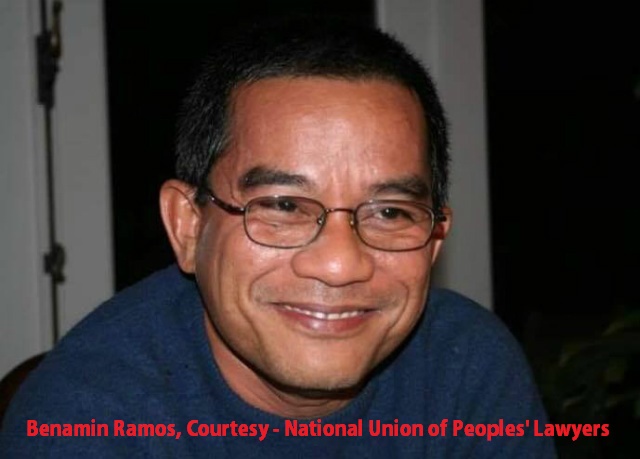
Lawyer Benjamin Ramos, one of the founding members of National Union of People’s Lawyers at the forefront of opposing President Rodrigo Duterte’s lethal war on drugs was gunned down on 7 November 2018, killed by three bullets as he was leaving his office for the night. He became the 34th lawyer to be executed since President Rodrigo Duterte took over two years ago. His only crime: pro-bono legal aid to poor clients whose families have been targeted by police, soldiers and death squads associated with the president’s drug war.
The killing reflected the pattern identified by the UN Special Rapporteurs in a joint statement on 23 November 2017: “Many of the killings appear to be perpetrated by law enforcement officials and by unknown assailants. This seems to indicate a climate of official, institutional impunity, which can only encourage further killings and other excessive use of lethal force by law enforcement personnel or those acting on their behalf or with their acquiescence.”
President Duterte: Elected with the promise to eliminate crime by killing all criminals
Answering a question from a Davao reporter during his election campaign and his human rights record as mayor, he said, “I do not want to commit a crime but if by chance, God will place me there, you all better watch out. That 1,000 will become 100,000. I’ll dump all of you into Manila Bay, and fatten all the fish there.” More than 1,000 people were killed since the Davao Death Squad, a shadowy group of vigilantes allegedly protected by government officials, started operating there in the late 1990s during his tenure as Mayor of Davao city. “Kill them all (criminals)”, was his answer as to how Davao city ranked 9th amongst world safest cities.
The basic foundation of Duterte’s presidential electoral platform was his promise to embark on a nationwide killing campaign against drug dealers and drug users. During his election debates in February and April 2016, he promised to “Kill big-time drug lords and suppress drug trade” within 3 to 6 months, if he is elected as president. His action plan to accomplish that objective included bringing back death penalty for all drug users and traders; tackling the drug lords through the military and police; recruiting militiamen who have completed basic Reserve Officers Training Corps and former soldiers who have experience in gun handling and law enforcement for the fight against drugs; and provide P5 million bounty for every drug boss caught and smaller bounties for other drug suppliers.
During a campaign rally on 15 March 2016, he had stated: “When I become president, I’ll order the police and the military to find these people and kill them. The funeral parlours will be packed… I’ll supply the dead bodies,” he said, to more cheers and laughter.”
Celebrating his presidential victory on 4 June 2016 in the southern city of Davao, Duterte had urged citizens with guns to shoot and kill drug dealers who resist arrest and fight back and that he will reward all those who help him in the bloody war against criminality.
President Duterte’s legacy: 22,983 cases of deaths under inquiry since 1 July 2016 and the killing goes on
Since assuming office as the President on 1 July 2016, Duterte has repeatedly vowed to kill drug dealers and users in the midst of skyrocketing reports of extrajudicial executions by the police and so-called vigilantes.
On 4 August 2016, he warned drug dealers: “My order is shoot to kill you. I don’t care about human rights, you better believe me.” He praised the soaring body count of victims of police killings as proof of the “success” of his “war on drugs.”
President Duterte began his anti-drug campaign titled “Project Double Barrel Alpha,” (“Project Tokhang” in Filippino) on his assuming office. According to the information released by the police, the government conducted 40,982 anti-drug operations from 1 July 2016 to 7 January 2017. In the first six months, the police had killed 2,206 drug personalities and arrested 44,070 others. During the same period, the police visited 6,097,672 houses as part of its Project Tokhang which involves police officers going around communities across the country in order to persuade suspected drug users to submit themselves to a drug rehabilitation program. The police also reported that 1,020,244 people surrendered to authorities in the past six months. More than 940,000 of those who surrendered are drug users while about 75,000 are pushers.
The precise number of persons extrajudicially executed in the war on drugs may never be found given the climate of impunity. Between 1 July 2016 when President Duterte took over and 31 January 2017, the death toll of those executed extra-judicially in Duterte’s war on drugs was about 7,080. The officials keep the death toll low and reported death of 3,967 “drug personalities” in anti-drug operations from July 2016 through 25 October 2017.
The Philippine National Police (PNP) however classified 22,983 cases as deaths under inquiry (DUI) between 1 July 2016 and 21 May 2018. The PNP Directorate for Investigation and Detective Management stated that at least 33 persons were killed daily from 1 July 2016 until 21 May 2018.
The Philippines also saw the extrajudicial executions of 11 mayors and six vice mayors since June 2016 and the killing of 34 lawyers by 7 November 2018.
As of 17 February 2017, as many as 31 minors under the age of 18 were killed by police and vigilantes since Duterte launched his campaign against illegal drugs on 1 July 2016. Many children have been orphaned or left behind without a breadwinner. Others, especially in urban poor communities, remain traumatised after witnessing at firsthand the killings of loved ones in their homes. Duterte himself admitted that several innocent civilians, including children, were killed by the police in some of the anti-drug operations. He apologized to the public but at the same time, he insisted that the campaign will continue until the end of his term.
No way out except waiting for the long arm of justice
At present, the Philippines and international community appear to have resigned to the fait accompli – unabated extrajudicial executions till President Duterte remains in power. The repeated calls of the United Nations to end the killing invited thuggish response. President Rodrigo Duterte repeatedly threatened of physical harm to Ms. Agnes Callamard, UN Special Rapporteur on extrajudicial, summary or arbitrary executions.
On 8th February 2018, the International Criminal Court (ICC) opened the “preliminary examination of the situation in the Philippines” to “analyse crimes allegedly committed in this State Party since at least 1 July 2016, in the context of the “war on drugs” campaign launched by the Government of the Philippines”. On 19 March 2018, the ICC was officially notified by the United Nations that the Republic of the Philippines had on 17 March 2018 deposited a written notification of withdrawal from the Rome Statute. As the ICC stated on 20 March 2018, “A withdrawal has no impact on on-going proceedings or any matter which was already under consideration by the Court prior to the date on which the withdrawal became effective; nor on the status of any judge already serving at the Court.”
The question remains will the long arm of the law will catch President Duterte one day.