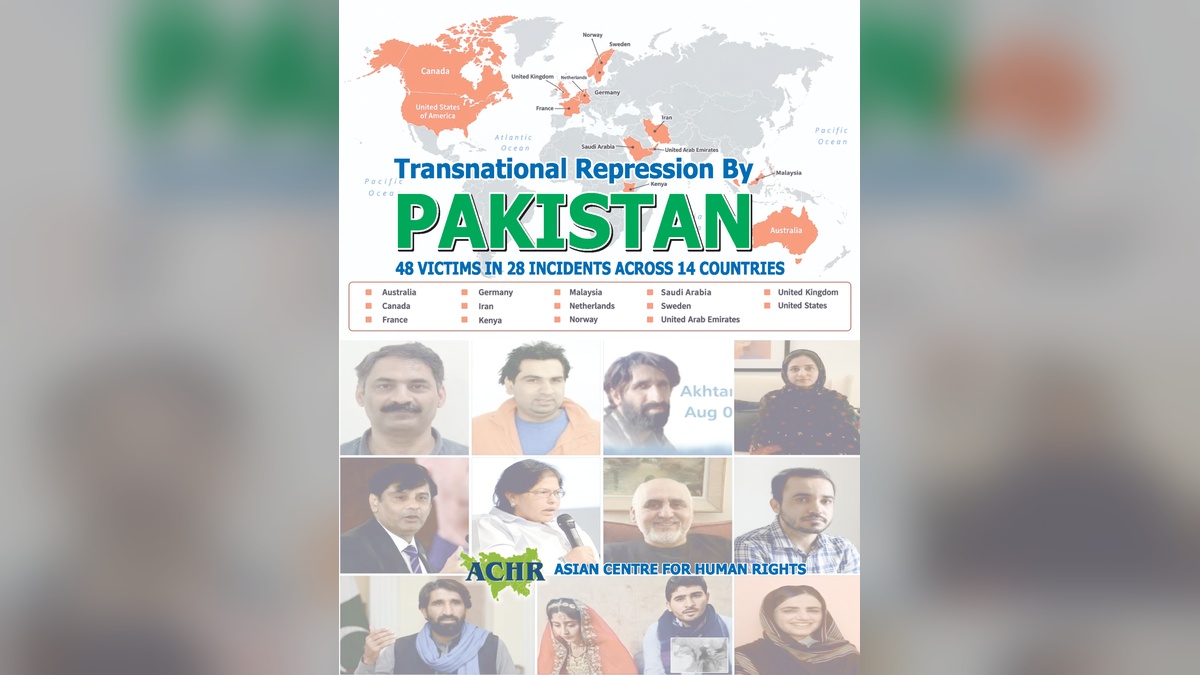
At least 28 cases of transnational repression by Pakistan, involving at least 48 distinct and identifiable individual victims in 14 countries across the globe, explains Pakistan’s involvement in one of the emerging human rights violations in the world.
The two contempt notices issued to Foreign Secretary Asim Iftikhar on 22 October 2026 over alleged non-compliance with an earlier court order concerning two Pakistan Tehreek-e-Insaf (PTI)-affiliated Pakistani citizens, Syed Salman Raza Zaidi and Muhammad Junaid Jahangir, who were allegedly detained in the United Arab Emirates (UAE) at the behest of the Pakistani government has brought into focus transnational repression in Pakistan. Zaidi went missing from his residence in Sharjah on 27 September 2024 and was subsequently taken into custody by the UAE authorities, while Jahangir was allegedly detained at Dubai airport on 24 September 2024 upon his return from Saudi Arabia. Both individuals continue to be denied consular, diplomatic and legal access. On 14 September 2026, the Lahore High Court had directed the Foreign Secretary to process and decide, within 15 days, representations concerning the detention of the two citizens, but the Foreign Secretary had failed to act.
Instances of transnational repression have intensified in recent years, following the ouster of former Prime Minister Imran Khan in April 2023 and the escalation of the insurgency, particularly in Balochistan.
The PDF version of Transanational Repression By Pakistan can be accessed here
The targets of transnational repression by Pakistan include journalists and commentators, human rights defenders, Baloch and other ethnic activists, academics, political opponents, former military personnel critical of the establishment, and other government critics living abroad. The countries in which the Pakistani government has allegedly targeted individuals include Australia, Canada, France, Iran, Germany, Kenya, Malaysia, the Netherlands, Norway, Saudi Arabia, Sweden, the United Arab Emirates, the United Kingdom, and the United States. Family members of individuals living in exile have also reportedly been targeted inside Pakistan as part of these transnational repression efforts.
At least 28 cases of transnational repression by Pakistan, involving at least 48 distinct and identifiable individual victims, have come into focus. These include intimidation of family members of Baloch activist Abdullah Abbas in Germany in 2011; deportation of Baloch activist Rashid Hussain Brohi from the United Arab Emirates (UAE) on 27 October 2018; threats against journalist Wajahat S. Khan and his family in the United States in 2018; threats and intimidation directed at journalist Taha Siddiqui in France in 2019; the mysterious death of journalist Sajid Hussain in Sweden on 2 March 2020; an attack on blogger Ahmed Waqass Goraya in the Netherlands on 27 October 2020; the mysterious death of Baloch activist Karima Baloch in Canada on 21 December 2020; surveillance of journalist Kiyya Baloch in Norway in 2020; threats against academic and political commentator Ayesha Siddiqa in the United Kingdom in February 2022; the incommunicado detention of Usman Ghani and Abdul Rehman in Saudi Arabia from January to August 2022; deportation of journalist Syed Fawad Ali Shah from Malaysia in August 2022; the killing of journalist Arshad Sharif in Kenya on 23 October 2022; threats against former Imran Khan adviser Dr. Salman Ahmad and his family in the United States in March 2023; the killing of Baloch activist Hani Baloch and her husband in Iran in August 2023; the killing of nine Balochis in Iran on 18 January 2024; the alleged abduction and torture of a family member of human rights defender Salman Shabbir in Australia in March 2024; surveillance of human rights defender Mahrang Baloch in Norway in May 2024; the disappearance of Ustad Wahid Kambar Baloch in Iran on 19 July 2024; the killing of Baloch activist Sabir Baloch in Iran on 4 August 2024; the killing of Akhtar Baloch in Iran on 28 August 2024; detention of Syed Salman Raza Zaidi and Muhammad Junaid Jahangir in the UAE in September 2024; death threats against human rights researcher Roshaan Khattak in the United Kingdom in December 2024; attacks on Shahzad Akbar, a former cabinet minister under Imran Khan, in the United Kingdom in December 2025; an attack on exiled journalist Adil Raja in the United Kingdom in December 2025; reprisals against journalist Ahmad Noorani and his family members in the United States in December 2025; the sentencing in absentia of seven Pakistani journalists and commentators living in exile on 2 January 2026; the disappearance of Osman in Iran on 18 June 2026; and the killing of two Balochis, Zubair and Jameel, in Iran on 21 June 2026.
Each of these cases, among others, have been raised or addressed by the US State Department in its Country Report on Human Rights Practices; the UK Parliament’s Joint Committee on Human Rights on 30 July 2025; the US Tom Lantos Human Rights Commission in 2025; Amnesty International; the US-based Freedom House; the Committee to Protect Journalists; and Reporters Without Borders.
Among the victims of these transnational attacks, 18 were killed or died under suspicious circumstances; two were deported or forcibly returned; four were abducted, forcibly disappeared, or detained; 10 faced physical attacks, threats, or reprisals against their families; at least 10 faced legal persecution and judicial harassment; and two were subjected to surveillance and monitoring. Furthermore, family members of these victims who reside in Pakistan have also reportedly been subjected to abduction, threats, harassment, surveillance, torture, intimidation, the freezing of bank accounts, the cancellation of passports and other official documents, and other restrictions intended to pressure critics living overseas into silence.
Ethnic Baloch people and PTI supporters or members have been the principal targets of transnational repression.
Undoubtedly, Pakistan has to appear in the global list of perpetrators of transnational repression which is emerging as a major human rights concern worldwide. On 23 September 2026, more than 130 UN Special Procedures mandate holders and members of UN treaty bodies condemned the increasing use of transnational repression to silence, intimidate, and punish individuals abroad for their political opinions, dissent, or human rights activities. The UN experts highlighted tactics used in transnational repression, including surveillance, online harassment, reprisals against family members, politically motivated prosecutions, passport restrictions, unlawful deportations, enforced disappearances, torture, and targeted killings. They warned that these practices threaten freedom of expression, independent journalism, civic space, refugee protection, and the rule of law, placing exiled journalists, activists, human rights defenders, and minority communities at particular risk.
It remains to be seen whether scrutiny by UN human rights experts will deter states such as Pakistan from engaging in transnational repression.