On 12 August 2026, Pakistan’s military allegedly carried out an airstrike in Surab’s Gidar Goandhan area in Baluchistan, reportedly killing 30 civilians, including women, children and infants, and injuring dozens of others. Pakistan’s military denied the allegation and stated that the casualties were instead caused by a premature explosion involving a vehicle-borne improvised explosive device allegedly being prepared by the militants, followed by a secondary explosion involving explosives stored at the site. The incident resulted in the deaths of three civilians, rather than 30 civilians.[1]
Be that as it may, Pakistan’s use of drones and airstrikes has been a matter of concern for the international community. For decades, Pakistan has been battling armed insurgencies and militant violence, particularly in the provinces of Baluchistan and Khyber Pakhtunkhwa. The Pakistani government and military maintain that such operations are necessary to eliminate militants and protect national security. Increasingly, the armed groups too are using drones which also target the civilians. These internal conflicts in Pakistan caused displacement of over 548,000 persons in Pakistan in 2025. [2]
Yet, reports from human rights organisations, local groups, media outlets and other sources have documented a disturbing number of incidents in which civilians were allegedly killed or injured in drone attacks and aerial strikes. Publicly available information indicates allegations of approximately 77 civilian deaths in drone attacks and airstrikes from 2025 to 15 August 2026, in addition to the death of at least 24 alleged insurgents from December 2025 to 15 August 2026.
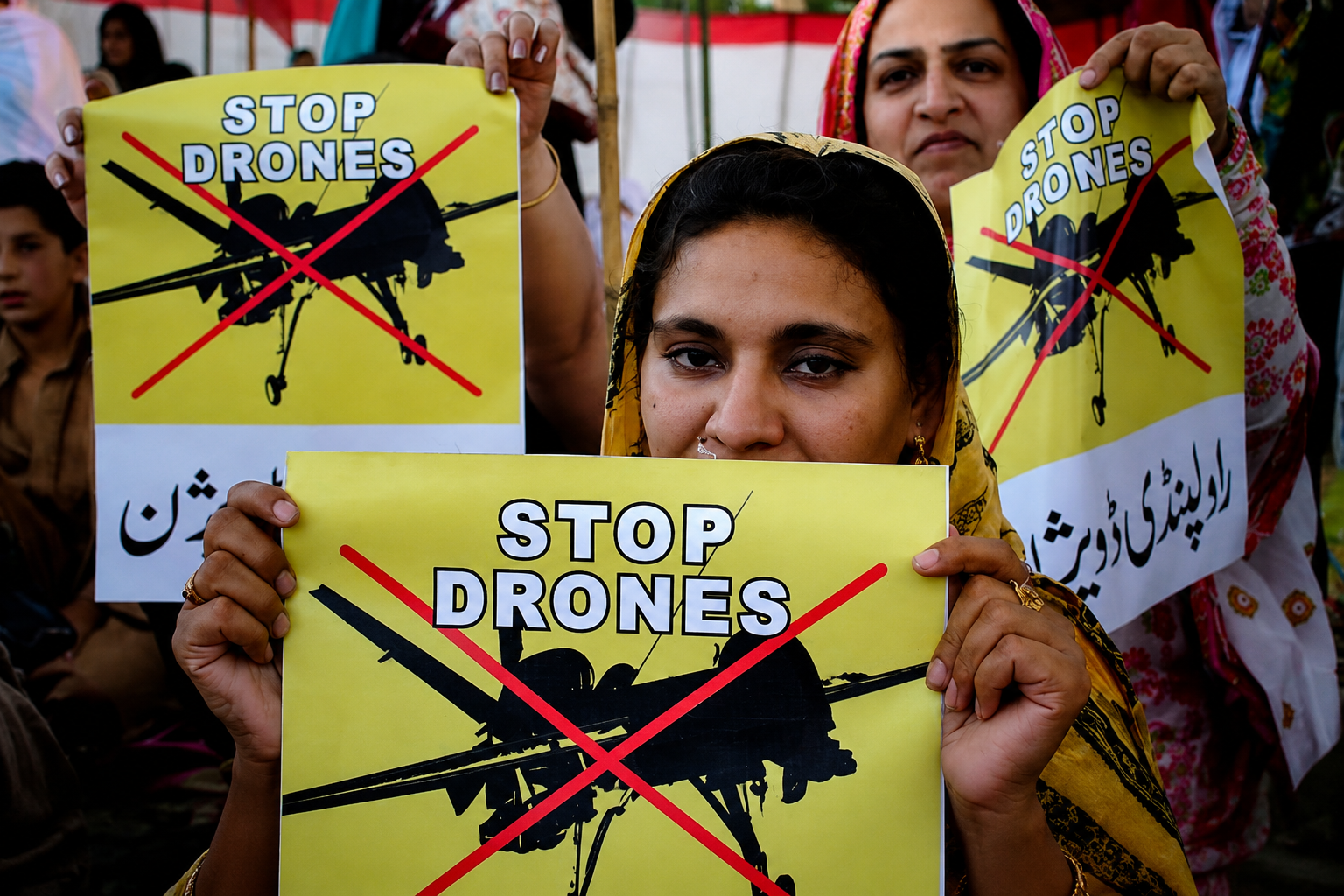
This increasing reliance on drones and other aerial strikes in counter-insurgency operations raises serious questions about possible violations of international humanitarian and human rights law, particularly concerning the principles of distinction, proportionality, necessity and precaution. The issue is not simply about Pakistan’s right to conduct counterterrorism operations. It is about how those operations are conducted, whether sufficient precautions are taken to protect civilians and whether allegations of unlawful killings are independently investigated.
A. The intensity of air strikes and drone attacks in Pakistan
Based on publicly available information, there are allegations concerning the deaths of approximately 76 civilians including women and children from 2025 to 15 August 2026, in addition to injuries to scores of others, and the deaths of at least 24 alleged insurgents from December 2025 to 15 August 2026 in drone attacks and airstrikes. The alleged 77 civilian death include death of 30 civilians on 12 August 2026, one civilian on 1 April 2026, two civilians on 29 March 2026, four civilians on 29 October 2025, nine civilians on 28 October 2025, six civilians on 5 October 2025, four civilians on 1 October 2025, three civilians on 17 September 2025, 17 civilians from January to 24 June 2025 as reported by Amnesty International and the death of one woman in a militant drone attack targeting a police station in Bannu in July 2025. The detailed reported incidents are given below:
– On 12 August 2026, about 30 civilians, including women, children and infants, were allegedly killed with injuring to dozens more while Pakistan military claimed that only three civilians had died because of premature explosion involving a vehicle-borne improvised explosive device by the militants.[3]
– On 21 July 2026, a woman was critically injured when the security forces targeted a residential house using a quad copter drone in the Dasht Kambila area of Mustang district, Baluchistan.[4]
– On 9 April 2026, a drone strike allegedly carried out by the security forces targeted a house in the Kurdgap area of Mastung, Baluchistan, killing one man identified as Abdul Samad, and injuring several women. Abdul Samad was taken to Quetta for medical treatment but died from his injuries while being transported.[5]
– On 29 March 2026, two civilians were reportedly killed in a drone strike by the security forces in the Sohanda area of Zehri tehsil (revenue unit) of Khuzdar district of Baluchistan.[6]
– On 29 October 2025, four young men went on a picnic to Jadeen Mountain in Buleda, Kech, Baluchistan after reportedly obtaining permission from a nearby military camp. A Pakistani military drone strike killed all four. The Inter-Services Public Relations (ISPR), media wing of the Pakistan Army, claimed they were “terrorists” killed in an intelligence-based operation. However, residents recovered their bodies on 2 November 2025 and identified them as local civilians, including two brothers. Three were from Zardan Kocha and one from Bitt Buleda. Three of the victims were identified as Zakir, Sadiq and Peer Jan.[7]
– On 28 October 2025, the Pakistani security forces allegedly carried out an aerial strike in the Chiltan Hills near Quetta, injuring nine Baloch civilians who had reportedly gathered for a picnic. The victims were identified as Jahanzaib Mohammad Shahi, Imrani Sumalani, Maqbool Ahmed, Zahid Baloch, Manzoor Ahmed, Daulat Khan, Arbab Baloch, Rafeeq Lehri and Wajid Ali.[8]
– On 5 October 2025, a drone strike in the Moola Pass area of Zehri, Kalat district, allegedly killed six civilians, including four children and two adults, and injured three others. The Pakistani authorities denied the responsibility.[9]
– On 1 October 2025, a drone attack in Noorgama allegedly killed four civilians who were sitting near cotton fields.[10]
– On 17 September 2025, three civilians, including two women, were allegedly killed and five others were allegedly injured after Pakistan forces carried out air and drone strikes on residential areas in Terasani (Qazib), Zehri, Khuzdar.[11] Those killed were identified as Bibi Amina (40), Lal Bibi (41) and Muhammad Hassan (30). The injured included Sanaullah (45), Ali Akbar, Abdul Nabi (38), Umair Ahmed (4) and Maula Baksh (65).[12]
– In a statement on 24 June 2025, Amnesty International stated that recurrent drone strikes in Khyber Pakhtunkhwa had killed at least 17 people, including five children, since January 2025, with several other civilians injured. Amnesty International cited drone strikes on 20 June 2025 which resulted in the death of one child and left five others injured in Dashka, Makeen Tehsil, South Waziristan district; on 29 March 2025 at Katlang, Mardan district which killed at least 11 people; on 19 May 2025 at Hurmuz, Mir Ali, North Waziristan district which killed four children and injured five others; on 28 May 2025 in Wana, South Waziristan district in which 22 people, including seven children participating in a volleyball match were injured.[13]
The Pakistan Army defended the use of drones and air strikes by describing those killed as “insurgents.”[14] A total of 24 alleged insurgents were killed in aerial strikes and drone attacks from December 2025 to 20 August 2026. These includes the death of five alleged insurgents in Khuzdar district of Baluchistan on 12 August 2026;[15] five Fitna al-Hindustan (FaH, a State term for Baloch insurgents) members in Nushki district of Baluchistan on 29 July 2026;[16] one insurgent at Bulbul Sharif Bagh area of Khuzdar district in Baluchistan on 20 July 2026;[17] four members of the Baluchistan Liberation Army (BLA) in the Shor Parod area of Kalat on 12 January 2026;[18] four Baluchistan Liberation Front (BLF) cadres in Zamuran area of Buleda tehsil (revenue unit) in Kech district of Baluchistan on 8 January 2026;[19] and five members of the Baluchistan Liberation Front in Kalat, Baluchistan on 25 December 2025.[20]
Militant groups in Pakistan, particularly in Khyber Pakhtunkhwa (KP), are increasingly using commercially available quadcopter drones to attack police stations, security checkpoints and military positions and civilians too became targets. The attacks became more prominent in North Waziristan in 2024 and expanded across KP in 2025, with drones reportedly used to drop mortar shells, grenades and improvised explosive devices.[21] According to Reuters, a militant drone attack targeting a police station in Bannu killed a woman and injured three children in a nearby house in July 2025.[22]
The publicly available data indicates that civilians may have been disproportionately affected or targeted. As a state actor, the government has a heightened responsibility to take all feasible precautions to protect civilians and minimise civilian casualties during security operations.
B. UN Special Rapporteur on extrajudicial executions and the denial of Pakistan
The United Nations Special Rapporteur on extrajudicial, summary or arbitrary executions has addressed the use of drones for targeted killings and violations of international human rights and humanitarian laws.
In May 2010, the UN Special Rapporteur presented his “Study on targeted killings” to the UN Human Rights Council highlighted that the use of drones have had the very problematic effect of blurring and expanding the boundaries of the applicable legal frameworks. In 2013, the Special Rapporteur warned that the expansive use of armed drones if not challenged, can do structural damage to the cornerstones of international security and set precedents that undermine the protection of life across the globe in the longer term.[23] The Special Rapporteur lamented the lack of clarity among States about their obligations, the absence of accountability and States’ broad and permissive interpretations of the rules.[24] The UN Special Rapporteur in a report in 2020 further addressed the issue of targeted killings using armed drones, particularly in light of the proliferation in the use of drones and their expanding capability and makes recommendations designed to regulate their use and enhance accountability.[25]
The UN Special Rapporteur on extrajudicial executions stated that the first use of armed drone outside the scope of a traditional armed conflict was reported in Yemen on 3 November 2002. By February 2014, the UN Rapporteur had reported, a minimum estimate of 2,835 individuals had been killed in drone attacks in Pakistan, Yemen and Somalia alone. [26]
However, it was only on 7 September 2015, Pakistan’s Inter Services Public Relations, Major General Asim Bajwa in a tweet announced the first “ever use of Pak made Burraq Drone”, hitting a terrorist compound in Shawal Valley killing 3 high profile terrorists”.[27]
On 30 November 2025, British Labour Member of Parliament John McDonnell raised concerns over worsening human rights violations in Baluchistan through three written parliamentary questions and an Early Day Motion. The motion highlighted the drone strike in Zehri, Khuzdar that killed six civilians, including four children, among other human rights violation in Baluchistan. The motion, among others, highlighted the Zehri drone strike, and called on the UK Government to take further action and raise these concerns with Pakistani authorities. The motion was signed by nine MPs.[28] McDonnell also questioned the UK Government over its diplomatic engagement with Pakistan and the potential use of UK-supplied equipment in such operations.[29]
C. The need for proper investigations
In 2014, the UN Special Rapporteur on extrajudicial executions held that “in some cases, such armed drone attacks may have been subject to and conformed with the rules of international humanitarian law (IHL), while in others there are serious concerns that they may not have met the IHL requirements. Some attacks also may not have occurred within the confines of an armed conflict, and as such should be measured by the more stringent requirements of international human rights law, which they almost certainly did not meet. There are also cases where there is genuine uncertainty. While there is agreement on most aspects of the international legal framework that is applicable to armed drones, there are some areas where its interpretation is still being debated.” [30]
In a further report in 2020, the UN Special Rapporteur stated that “the evidence continues to suggest that drone operations are also characterized by violations of the international obligation to investigate and to punish, where applicable, those responsible for violations of international humanitarian or human rights law. There is little public disclosure as targeted killings by drones are wrapped in secrecy extending to the investigation of civilian deaths”.[31]
The UN Special Rapporteur, among others, called on States, international decision-making bodies and other concerned actors to “(a) develop and commit to robust standards of transparency, oversight and accountability in the use of armed drones; (b) undertake effective measures to control the proliferation of drones through export and multilateral arms control regimes and/or under international treaties; (c) openly discuss the challenges that targeted killings using drones pose to international law; (d) call out any use of force not in compliance with the Charter of the United Nations and reject the purported legal underpinnings of such use of force; and (e) investigate all allegations of unlawful deaths related to the use of drones, including through international bodies where States fail to do so”.[32]
Considering the normalisation of the use of air strikes and drones in internal armed conflict situation, there is a need for Pakistan to conduct independent, transparent and effective investigations into all the allegations of unlawful deaths caused by these attacks; bring all those responsible to justice through fair trials; and further provide effective remedies, including compensation and other appropriate reparation to the victims.
[1].’30 civilans killed’: Baloch activist shares video of ‘Pakistani war crime’, seeks US intervention, The Times of India, 15 August 2026, https://timesofindia.indiatimes.com/world/pakistan/30-civilans-killed-baloch-activist-shares-video-of-pakistani-war-crime-seeks-us-intervention/articleshowprint/133259688.cms
[2]. 2026 Global Report on Internal Displacement (GRID), Internal Displacement Monitoring Centre,https://api.internal-displacement.org/sites/default/files/publications/documents/IDMC-GRID-2026-Global-Report-on-Internal-Displacement.pdf?_gl=1*1onz90s*_ga*ODEzNDU2MjkxLjE3ODc2NDI1ODM.*_ga_PKVS5L6N8V*czE3ODc2NDI1ODMkbzEkZzEkdDE3ODc2NDI1ODgkajU1JGwwJGgw
[3]. ’30 civilans killed’: Baloch activist shares video of ‘Pakistani war crime’, seeks US intervention, The Times of India, 15 August 2026, https://timesofindia.indiatimes.com/world/pakistan/30-civilans-killed-baloch-activist-shares-video-of-pakistani-war-crime-seeks-us-intervention/articleshowprint/133259688.cms
[4]. SATP, Pakistan, Drone related incidents:2026, https://www.satp.org/other-data/pakistan/Drone-Attacks_2026
[5]. One man killed, several women injured in drone strike by Pakistani forces in Mastung district of Balochistan, AIR, 9 April 2026, https://newsonair.gov.in/one-man-killed-several-women-injured-in-drone-strike-by-pakistani-forces-in-mastung-district-of-balochistan/
[6]. SATP, Pakistan, Drone related incidents:2026, https://www.satp.org/other-data/pakistan/Drone-Attacks_2026
[7]. Paank Monthly Report November 2025, 28 December 2025, https://paank.org/wp-content/uploads/2025/12/Paank-november-report-final.pdf
[8]. Pakistani airstrike in Balochistan injures nine civilians, says rights body, Telangana Today, 6 November 2025, https://telanganatoday.com/pakistani-airstrike-in-balochistan-injures-nine-civilians-says-rights-body
[9]. Pakistani airstrike in Balochistan injures nine civilians, says rights body, Telangana Today, 6 November 2025, https://telanganatoday.com/pakistani-airstrike-in-balochistan-injures-nine-civilians-says-rights-body
[10]. The Military Siege of Zehri: Indiscriminate Bombardment, Civilian Deaths, and Ongoing Humanitarian Crisis, Human Rights Council of Balochistan 17 October 2025, https://hrcbalochistan.com/the-military-siege-of-zehri-indiscriminate-bombardment-civilian-deaths-and-ongoing-humanitarian-crisis/
[11]. Pakistani Air Strikes Kill Three Civilians in Balochistan’s Zehri Region, AIR, 18 September 2025, https://newsonair.gov.in/pakistani-air-strikes-kill-three-civilians-in-balochistans-zehri-region/
[12]. Balochistan: 104 Enforced Disappearances, 65 Killings, and a Major Military Siege in Zehri – September 2025, Human Rights Council of Balochistan, 30 October 2025, https://hrcbalochistan.com/balochistan-104-enforced-disappearances-65-killings-and-a-major-military-siege-in-zehri-september-2025/
[13]. Pakistan: Recurrent drone strikes in Khyber Pakhtunkhwa signal alarming disregard for civilian life, Amnesty International, 24 June 2025, https://www.amnesty.org/en/latest/news/2025/06/pakistan-recurrent-drone-strikes-in-khyber-pakhtunkhwa-signal-alarming-disregard-for-civilian-life/
[14]. ‘War crime’: Pakistani forces accused of bombing homes in Balochistan, killing three civilians; four-year-old among injured, WION, 18 September 2025, https://www.wionews.com/pakistan/-war-crime-pakistani-forces-accused-of-bombing-homes-in-balochistan-killing-three-civilians-four-year-old-among-injured-1758184876516
[15]. SATP, Pakistan, Drone related incidents:2026, https://www.satp.org/other-data/pakistan/Drone-Attacks_2026
[16]. SATP, Pakistan, Drone related incidents:2026, https://www.satp.org/other-data/pakistan/Drone-Attacks_2026
[17]. SATP, Pakistan, Drone related incidents:2026, https://www.satp.org/other-data/pakistan/Drone-Attacks_2026
[18]. Human Rights Violations in Balochistan: 107 Enforced Disappearances, 78 Killings Documented in January 2026, Human Rights Council of Balochistan, 26 February 2026, https://hrcbalochistan.com/human-rights-violations-in-balochistan-107-enforced-disappearances-78-killings-documented-in-january-2026/
[19]. SATP, Pakistan, Drone related incidents:2026, https://www.satp.org/other-data/pakistan/Drone-Attacks_2026
[20]. Balochistan: 90 Individuals Including Women Forcibly Disappeared and 19 Killings Documented in December 2025, Human Rights Council of Balochistan, 24 January 2026, https://hrcbalochistan.com/balochistan-90-individuals-including-women-forcibly-disappeared-and-19-killings-documented-in-december-2025/
[21]. Growing Use of Drones by Militant Groups in Pakistan’s Khyber Pakhtunkhwa, The Diplomat, 7 August 2025, https://thediplomat.com/2025/08/growing-use-of-drones-by-militant-groups-in-pakistans-khyber-pakhtunkhwa/
[22]. Pakistani Islamist militants use drones to target security forces, officials say, Reuters, 21 July 2025, https://www.reuters.com/world/asia-pacific/pakistani-islamist-militants-use-drones-target-security-forces-officials-say-2025-07-21/
[23] . Armed drones and the right to life, Report of the UN Special Rapporteur on Extrajudicial Executions to the 68th Session of the General Assembly (A/68/382 and Corr.1), 13 September 2013, https://docs.un.org/en/A/68/382
[24]. Ibid
[25]. Use of armed drones for targeted killings, Report of the Special Rapporteur on extrajudicial, summary or arbitrary executions, UN Human Rights Council, A/HRC/44/38, 15 August 2020, https://docs.un.org/en/A/HRC/44/38
[26]. Report of the Special Rapporteur on extrajudicial, summary or arbitrary executions, Christof Heyns A/HRC/26/36, General Assembly, 1 April 2014, https://docs.un.org/en/A/HRC/26/36
[27]. Pakistan Surprises Many With First Use of Armed Drone, Defencenews.com, 9 September 2015, www.defensenews.com/air/2015/09/08/pakistan-surprises-many-with-first-use-of-armed-drone/.
[28]. Escalating human rights violations in Balochistan, UK Parliament, 1 December 2025, https://edm.parliament.uk/early-day-motion/64831/escalating-human-rights-violations-in-balochistan
[29]. UK MP Raises Alarming Human Rights Concerns in Balochistan, News on AIR, 30 November 2025, https://newsonair.gov.in/uk-mp-raises-alarming-human-rights-concerns-in-balochistan/
[30]. Report of the Special Rapporteur on extrajudicial, summary or arbitrary executions, Christof Heyns A/HRC/26/36, General Assembly, 1 April 2014, https://docs.un.org/en/A/HRC/26/36
[31]. Use of armed drones for targeted killings, Report of the Special Rapporteur on extrajudicial, summary or arbitrary executions, UN Human Rights Council, A/HRC/44/38, 15 August 2020, https://docs.un.org/en/A/HRC/44/38
[32]. Use of armed drones for targeted killings, Report of the Special Rapporteur on extrajudicial, summary or arbitrary executions, UN Human Rights Council, A/HRC/44/38, 15 August 2020, https://docs.un.org/en/A/HRC/44/38