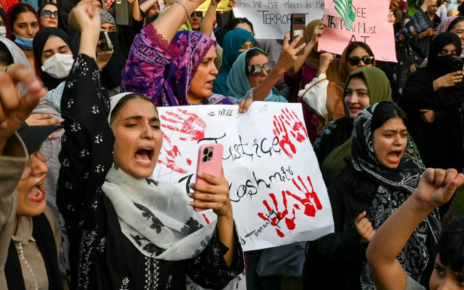
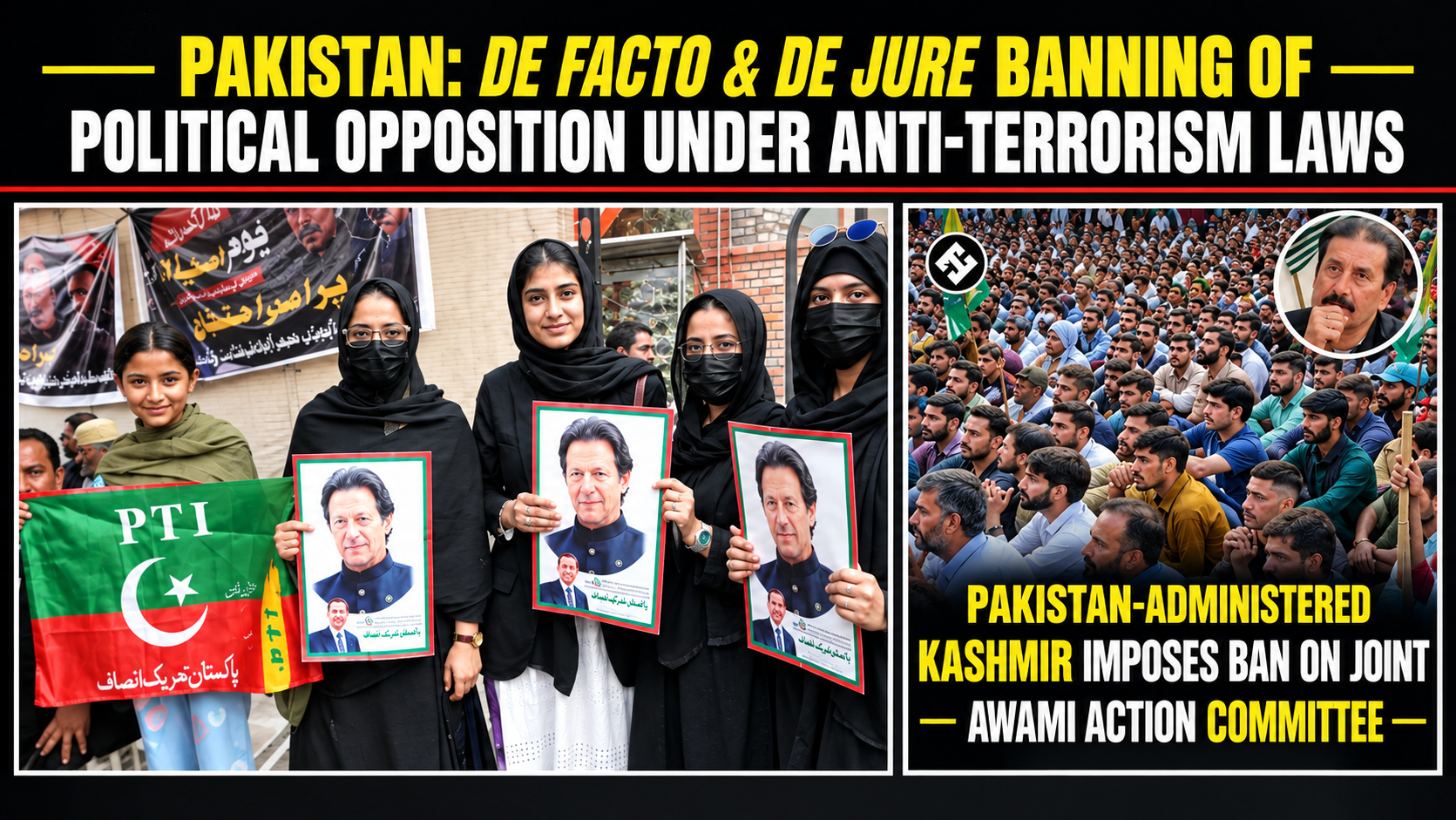
While the dismissal of the Khyber Pakhtunkhwa (KP) provincial government, led by the opposition Pakistan Tehreek-e-Insaf (PTI), on 11 July 2026 under Articles 232 and 234 of the Constitution of Pakistan raised questions about the status of democracy in the country, what has gone unnoticed is the de facto and de jure suppression of the political opposition through anti-terrorism laws in Pakistan. The three key national political parties are the Pakistan Tehreek-e-Insaf (PTI), founded by Imran Khan; the Pakistan Muslim League–Nawaz (PML-N); and the Pakistan Peoples Party (PPP). While the national government is formed by the PML-N and PPP, the provinces are divided between the two coalition partners. The PML-N governs Punjab and Pakistan-administered Kashmir, while the PPP governs the provinces of Sindh and Balochistan. Following the dismissal of the PTI-led government in Khyber Pakhtunkhwa, the province has been brought under the control of the central government.
I. PTI de facto banned as a terror organisation
The main opposition political party, the PTI remains effectively banned as a terror organisation. The key issue is not merely the incarceration of its founder, Imran Khan Niazi, the 71-year-old cricketer-turned-politician, whose detention was declared arbitrary by the UN Working Group on Arbitrary Detention (WGAD) in its Opinion No. 22/2024 on 25 March 2024[1] but the prosecution of the entire leadership of the PTI under anti-terrorism charges without designating the PTI as a terror organisation.
Almost the entire PTI leadership including Imran Khan has faced proceedings involving terrorism-related offences arising from the protests following the arrest of Imran Khan Niazi on 9 May 2023.
On 8 March 2026, an anti-terrorism court (ATC) in Rawalpindi sentenced 47 proclaimed offenders, including prominent PTI leaders Senator Shibli Faraz, Omar Ayub, Zartaj Gul and Hammad Azhar, to 10 years’ imprisonment in connection with the violent protests outside the General Headquarters (GHQ) of the Pakistan Army in Rawalpindi on 9 May 2023, following Imran Khan’s arrest. District and Sessions Judge Amjad Ali Shah convicted PTI leaders, including Murad Saeed, Shahbaz Gill and Zulfi Bukhari, as well as former MNAs Kanwal Shauzab, Rai Hassan Nawaz, Muhammad Ahmed Chattha and Sheikh Rashid Shafique. Several of those sentenced, including Mr Ayub, Mr Faraz, Ms Gul, Mr Nawaz and Mr Chattha, had already been convicted in other May 9 cases, resulting in their disqualification from public office. A total of 118 accused, including Imran Khan and Shah Mahmood Qureshi, were indicted in the case. The judge also issued perpetual non-bailable warrants.[2]
While the protests outside the GHQ turned violent and the accused were convicted of arson, vandalism, attacks on police officers and damage to government property, the critical issue is the prosecution of these offences under anti-terrorism legislation rather than solely under the Pakistan Penal Code, which already criminalises such acts.
As the UN Working Group on Arbitrary Detention stated in November 2025 that Pakistan amended the Anti-Terrorism Act, 1997 (ATA) through the Anti-Terrorism (Amendment) Act, 2025 “to authorise the preventive, arbitrary detention without charge or trial of individuals suspected of terrorism-related offences under the newly amended section 11EEEE of the ATA, in the absence of meaningful judicial review or effective remedies.”[3] Pakistan is a classic case of use of the “overly broad and vague anti-terrorism legislation” for “vilifying and delegitimizing peaceful protesters and activists as “terrorists” and “violent extremists”.[4]
The PTI launched its “final call” protest from 24 November 2024 onward and protests turned violent around D-Chowk, near Pakistan’s Parliament and the government’s heavily fortified Red Zone in Islamabad.[5]
On 10 September 2026, an ATC in Islamabad issued non-bailable arrest warrants for Khyber Pakhtunkhwa Chief Minister Sohail Afridi and other PTI-backed lawmakers, including Provincial Information Minister Shafi Jan, Member of National Assembly (MNA) Shahid Ahmed Khattak and Member of Provincial Assembly (MPA) Meena Khan Afridi. The warrants were issued in connection with terrorism-related and other charges registered at Ramna Police Station in Islamabad, arising from their alleged involvement in the violent protests of 26 November 2024, which demanded the release of PTI founder Imran Khan.[6]
In another case related to the 26 November 2024 protests, ATC Judge Tahir Abbas Sipra issued non-bailable arrest warrants for eight PTI-backed lawmakers in a case registered at Margalla Police Station. The accused included MNAs Shahid Khattak, Maulana Nasim Ali Shah, Aamir Dogar, Atif Khan and Iqbal Afridi, as well as MPAs Meena Khan Afridi, Dr Amjad and Shafi Jan.[7]
Earlier, on 1 August 2025, an anti-terrorism court issued arrest warrants for 50 PTI leaders under anti-terrorism laws in connection with the protests of 26 November 2024. Prominent PTI leaders named in the warrants issued by the ATC in Islamabad included former President Arif Alvi; then-Khyber Pakhtunkhwa Chief Minister Ali Amin Gandapur; Imran Khan’s sister, Aleema Khan; Senators Shibli Faraz, Azam Khan Swati and Faisal Javed; former National Assembly Speaker Asad Qaiser; senior lawyers Salman Akram Raja and Shoaib Shaheen; PTI Information Secretary Raoof Hassan; former federal ministers Murad Saeed and Hammad Azhar; and MNA Omar Ayub Khan.[8]
As Khyber Pakhtunkhwa Chief Minister Sohail Afridi launched the PTI’s long march towards Islamabad from Lakki Marwat on 3 October 2026[9], the Pakistan government dismissed the PTI-led provincial government on 11 October 2026.
Following the dismissal of the PTI provincial government, a large number of lawmakers in Khyber Pakhtunkhwa, including former Chief Minister Sohail Afridi and key leaders such as MNA Junaid Akbar and Provincial Assembly Speaker Babar Saleem Swati were taken into custody.[10]
On 13 October 2026, Dawn[11], a prominent Pakistani newspaper, reported the arrests of former KP Assembly Speaker and MPA Mushtaq Ahmad Ghani, along with Tahir Mughal, Niaz Mohammad Khan, Hayat Khan, Ghulamullah Torkhail, Sajjad, Fazal Karim, Asmatullah, Khalid Khan, Gul Badshah, Shahid Ahmad, Sultan Mohammad Sher, Shafiur Rehman, Aminur Rehman and Khwaja Shakeel. Three personal guards of MPA Arshad Khan Umarzai were also reportedly arrested. Approximately 140 party workers were arrested during protests on 12 October 2026, while approximately 15 party workers had been arrested in Charsadda by 13 October 2026.
Furthermore, The Express Tribune,[12] identified the following PTI lawmakers as having reportedly been abducted or gone missing since September 2026:
| Name | Position | Reported date or circumstances |
| Shakeel Khan | KP Minister for Construction and Communication | Alleged attempted abduction, 20 September |
| Fazal Shakoor Khan | KP Minister for Irrigation | Reportedly taken from a motorway toll plaza, 21 September |
| Fazal Khan | MNA, Charsadda | Reportedly taken from Rashakai, 22 September |
| Zubair Khan | MNA, South Waziristan | Allegedly abducted from his residence in Dera Ismail Khan, night of 22–23 September |
| Muhammad Riaz | MPA, Kolai-Palas | Reported missing, 25 September |
| Sultan Rom | MPA, Swat | Reportedly taken by unidentified persons, 26 September |
| Fateh-ul-Mulk Nasir | MPA, Chitral | Reported arrested in Islamabad |
| Dawar Kundi | MNA, Tank | Reported arrested in Islamabad |
| Abdul Salam Afridi | MPA, Mardan | Reported abducted; an FIR was lodged |
| Amir Ijaz | Regional general secretary, Insaf Lawyers Forum | Reportedly abducted, 17 September |
| Dr Nabi Jan | Insaf Doctors Forum | PTI alleged that he had been taken by unidentified persons |
| Abdul Nasir | Brother of MPA Abdul Karim Tordher | Reportedly abducted along with three security guards after an attack on the MPA’s hujra |
II. JAAC, de jure banned as a terror organisation
While there are a few regional, ethnically based political parties at the provincial level, the Jammu Kashmir Joint Awami Action Committee (JAAC), a civil society coalition comprising lawyers, students, traders and other civic groups, was also banned as a terrorist organisation on 5 June 2026.[13] The JAAC was founded in September 2023 in Rawalakot, Pakistan-administered Kashmir. It had no history of violence and had operated as a democratic organisation. The group organised small-scale protests primarily against soaring wheat prices and electricity costs.[14] Before the controversial elections conducted in three phases between 27 July and 10 August 2026 in Pakistan Administered Kashmir, the JAAC and the Pakistan government held negotiations until 30 May 2026 but once the talks collapsed, Pakistan banned JAAC on 5 June 2026, designating it a terrorist organisation.[15]
Following the ban, Pakistan’s police reported that approximately 425 people linked to JAAC had been arrested by 20 June 2026.[16] The JAAC, by contrast, claimed that approximately 800 people had been held in involuntary detention between 5 June and 9 October 2026.[17]
III. Pakistan’s descend to one alliance rule
The targeting of political opposition parties through anti-terrorism laws, and the designation of a civil society coalition as a terrorist organisation, constitute an unacceptable abuse of counter-terrorism powers that risks paving the way for authoritarian rule. Effectively, one party rule has been established by the PPP-PML-N alliance.
Unless the international community takes a clear stand against the use of counter-terrorism laws to label political opponents as terrorists, this practice could become a global trend. In Bangladesh, the Awami League was banned as a terrorist organisation on 12 May 2025. In response, the UN Special Rapporteur on the promotion and protection of human rights and fundamental freedoms while countering terrorism, the UN Working Group on Arbitrary Detention, and the UN Special Rapporteur on the independence of judges and lawyers expressed the following concerns:
“The suspension of the Awami League under the Anti-Terrorism (Amendment) Ordinance 2025 may further fail to meet the international law requirement that a restriction on association be properly authorised by law, since the new procedure circumvents the established legislative powers under the Anti-Terrorism Act 2009 and does not conform with international standards for prohibiting organisations under counter-terrorism law. To list an organization as terrorist under international law, it must have the substantial purpose of engaging in genuinely terrorist offences as properly defined, to a high standard of proof, in addition to providing due process and judicial safeguards. The restrictions flowing from suspension may also not strictly be necessary and proportionate in the case of the Awami League. We emphasize that the use of counter-terrorism powers to suppress a political party, rather than to address specific, individualized, and credible threats of violence, risks undermining the very democratic order that such laws are intended to protect”.[18]
The use of counter-terrorism laws to suppress political opposition risks pushing the countries towards prolonged and potentially irreversible political conflicts, with wider implications for regional and global stability and peace. Ending the use of terrorism-related charges against political opponents, including members of the PTI and the JAAC, therefore ought to be a priority for the international community.
[1]. Opinions adopted by the UN Working Group on Arbitrary Detention at its ninety-ninth session, 18–27 March 2024, Opinion No. 22/2024 concerning Imran Ahmad Khan Niazi (Pakistan), https://digitallibrary.un.org/record/4064719?v=pdf
[2]. PTI leaders among 47 convicted in GHQ attack case, Dawn, 8 March 2026, https://www.dawn.com/news/1979668
[3]. Letter of the Special Rapporteur on the promotion and protection of human rights and fundamental freedoms while countering terrorism; the Working Group on Arbitrary Detention; the Working Group on Enforced or Involuntary Disappearances; the Special Rapporteur on the promotion and protection of the right to freedom of opinion and expression; the Special Rapporteur on the rights to freedom of peaceful assembly and of association; the Special Rapporteur on the situation of human rights defenders and the Special Rapporteur on minority issues (Ref.: OL PAK 12/2025) dated 18 November 2025 on adoption of new counter-terrorism measures authorising preventive detention at the federal and provincial levels in Pakistan, https://spcommreports.ohchr.org/TMResultsBase/DownLoadPublicCommunicationFile?gId=30492
[4]. Protecting the rights to freedom of peaceful assembly and of association from stigmatization, Note by UN Secretary-General to the UN General Assembly (A/79/263), 31 July 2024, https://documents.un.org/doc/undoc/gen/n24/226/62/pdf/n2422662.pdf
[5]. PTI’s Nov 24 protest: PA speaker advises govt against ‘showing restraint’, The Dawn, 23 November 2024, https://www.dawn.com/news/1874187/ptis-nov-24-protest-pa-speaker-advises-govt-against-showing-restraint
[6] . Non-bailable arrest warrants issued for KP CM, other PTI lawmakers, GeoTV, 10 September 2026, https://www.geo.tv/latest/681508-non-bailable-arrest-warrants-issued-for-kp-cm-other-pti-lawmakers
[7]. Non-bailable arrest warrants issued for KP CM, other PTI lawmakers, GeoTV, 10 September 2026, https://www.geo.tv/latest/681508-non-bailable-arrest-warrants-issued-for-kp-cm-other-pti-lawmakers
[8]. Warrants for 50 PTI leaders over Nov 26 protests, The Dawn, 1 August 2025, https://www.dawn.com/news/1927944
[9]. ‘We are not yes-men’: CM Afridi launches PTI long march to Islamabad, convoy enters Karak district, Dawn, 4 October 2026, https://www.dawn.com/news/2034698
[10]. Sohail Afridi, KP assembly speaker in preventative custody: police, The Dawn, 12 October 2026, https://www.dawn.com/news/2036604/sohail-afridi-assembly-speaker-in-preventative-custody-police
[11]. Scores of PTI workers held in crackdown across KP, The Dawn, 13 October 2026, https://www.dawn.com/news/2036702
[12]. PTI’s K-P ranks hit by arrests, The Dawn, 9 October 2026, https://tribune.com.pk/story/2633826/ptis-k-p-ranks-hit-by-arrests
[13]. Pakistan Administered Kashmir: Reported Killing Underscores Need for UN Investigation Amid Internet Shutdown, Asian Centre for Human Rights, 23 September 2026, https://www.achrweb.org/whats-new/pakistan-administered-kashmir-reported-killing-underscores-need-for-un-investigation-amid-internet-shutdown/
[14]. Unrest in Pakistan-administered Kashmir: What’s behind the recent protests?, Aljazeera, 24 May 2024, https://www.aljazeera.com/news/2024/5/14/unrest-in-pakistani-kashmir-whats-behind-the-recent-wave-of-protests
[15]. Pakistan-administered Kashmir elections and protests – all you need to know, Aljazeera, 3 August 2026, https://www.aljazeera.com/news/2026/8/3/pakistan-administered-kashmir-elections-and-protests-all-you-need-to-know
[16]. Azad Kashmir faces shutdown as protests leave over 20 dead, Gulf Today, 20 June 2026, https://www.gulftoday.ae/news/2026/06/20/azad-kashmir-faces-shutdown-as-protests-leave-over-20-dead
[17]. Jammu Kashmir Joint Awami Action Committee, https://jkjaac.co/ accessed on 15 October 2026
[18]. Communication of the mandates of the Special Rapporteur on the promotion and protection of human rights and fundamental freedoms while countering terrorism; the Working Group on Arbitrary Detention and the Special Rapporteur on the independence of judges and lawyers (Ref.: AL BGD 6/2025), OHCHR, 29 December 2025, https://spcommreports.ohchr.org/TMResultsBase/DownLoadPublicCommunicationFile?gId=30514